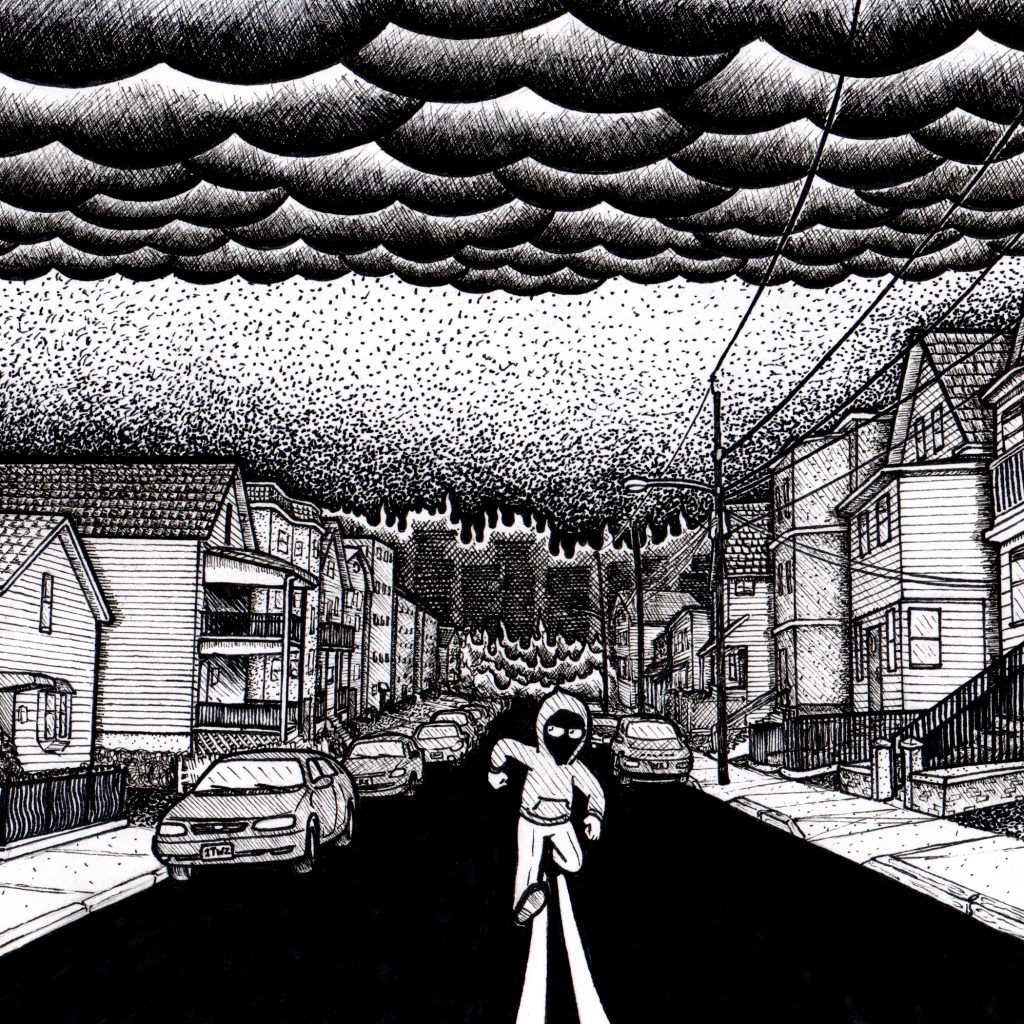
Some work needs very little introduction. Please enjoy this banger from Simoun Magsalin, whose writing on anarchy in the Philippines we’ve had the pleasure to publish previously.
On the Erasure of Anarchists in the so-called “Third World” by the Western Left Simoun Magsalin
Again and again, white and Western leftists have erased anarchists in Asia by saying anarchism in the so-called “Third World” does not exist. If they deign to acknowledge our existence, they deride us by saying we are small or marginal in the context of large hegemonic left blocs led by various communist parties. We anarchists in imperialized nations know we are a minority. We are not like Marxists who seek to proclaim gospels and anoint converts. We are not here to proclaim anarchism but anarchy, for people to freely act under their own power. Freedom is a constant struggle.
On and on, these white and Western leftists talk of the “correctness” of Marxist movements, implying marginalization denotes incorrectness. However, to argue that anarchists do not exist in imperialized countries because our milieus are small or marginal is to think that population size determines correctness. Comments spewed from frothing mouths suggest that, because the Communist Parties of China/Vietnam/N.Korea/Cuba boasts several millions of members combined, therefore they are doing something correct. This is obviously ludicrous; population size has never denoted correctness. If that was so, then capitalism is correct and so is liberal democracy, for the hegemonic forces of liberal democratic capitalism still indoctrinate its tenets to the proletarianized the world over.
Elsewhere, these white and Western leftists talk of correctness in the context of “successful” revolutions in Russia or China. But to argue Marxism is correct because of the USSR, PRC, etc. is to fallaciously appeal to past victories. Past victories do not determine the conditions of our struggle today. Nor do we wish to build states and cadre bureaucracies. We struggle for more than that.
Besides, to claim that Marxism is “correct” because of the 1917 Russian Revolution seems to suggest that an absence of “victories” implies incorrectness. If this is indeed so, then ironically Marxism was incorrect on the eve of the Russian Revolution, before which Marxism had only failed. That anarchism has not “succeeded” according to the criteria of authoritarians (whatever that is), therefore does not discount the possibility that anarchy can still win the day in the future.
We know our victories in the imperialized world are limited. We are anarchists not because of our victories, but because we know what currently exists does not have to exist in the way it does. If you “Marxists” want to be victorious, join the United States Military which dominates the entire world, for they are a victorious power. Anarchy is never easy.
In the context of the archipelago so-called as the Philippines, white and Western leftists would uphold the Communist Party of the Philippines (CPP) and their armed wing the New Peoples Army (NPA) as righteous “proletarian” actors against the “petty-bourgeois” anarchists. White and western leftists would claim that the “liberated barrios” and extensive guerrilla infrastructure are ultimate proof of the validity of Marxism. So what if the CPP-NPA “works”? If you are a Marxist because Marxism “works,” you must interrogate what exactly constitutes as “working.” What works is not necessarily what is desirable. Imperialism works and reigns victorious over the world; shall you be an imperialist because it “works”? We anarchists already know the answer: yes, Marxists shall become imperialists because it works. This is proven by the social imperialist policies of the former Soviet Union and the current People’s Republic of China and endlessly defended by many Marxists today.
Yet so what if cadres “work” to build guerrilla fronts? We are not in the business of building guerrilla fronts; we are in no business at all! Party work disgusts us; I ain’t nobody’s political officer!
When we organize, we must ask whom we intend to empower and who is centered in the struggles. Are we empowering an army or workers? A cadre or the proletariat? A party or a people? These are not equivalent. Yet the devotees of Saint Marx such as those in the CPP-NPA see themselves as “proletarian” by virtue of having taken up arms against the bourgeois State, forgetting that to be proletarianized is a negative consequence of this capitalist world that marks us as proles, not a virtue that can be emulated, because it is not a virtue at all.
A social revolution is not determined by past victories nor by a “correct” line but by the generalization of an insurrectionary break with the world that proletarinizes, a break from which there can be no return to the status quo ante. Such a generalized insurrectionary break cannot be directed by any cadre or party, nor even by a party of anarchists. Such a break can only be self-directed by proletarians-in-abolition, those that strike at the world that marks them as proles. By directing militancy towards consolidating guerrilla fronts instead of striking at proletarianization, Marxists such as the CPP-NPA actually suppress revolutionary agency. Yet it is exactly the self-direction of proles striking at their proletarianization that keeps alive the prospects of anarchy in the imperialized world!
More than merely an anarchy, multiple anarchies sprout across the world like mushrooms after a rain. The spontaneity of mushrooms is not accidental but rather the product of large spanning mycelia with long interconnected threads which then sprout mushrooms when the opportunity arises. Just so are the prospects of sprouting anarchies the products of long and patient organizing, of interlinked sites of struggle. Thus the organization of the anarchists is not the party-form, but in our struggles interlinked.
So let us now retire the talk of anarchist erasures in the imperialized world. Let us retire this talk of “correct” lines and party curricula of “victories.” It matters not if we are a minority for anarchies everywhere are forming, and we shall be here when they sprout!
You can send your report-backs, zine submissions, critiques, graffiti/action photos, demo tapes, hate mail, & memes to…
Filler_PGH@protonmail.com
We’ll try to get back to you in a reasonable amount of punk time.
Send reports in email form, as an attachment, or better yet, on an easy to use (and free) Riseup Pad or CryptPad.
Civilian control of the police has long been a demand of groups seeking an end to the predation of police in their communities. It is an also an end that abolitionists have viewed as unworthy of attention. This resource created by Mariam Kaba and others outlines why civilian control has failed in the past and remains a mistake to implement now. But in our present moment groups in Pittsburgh are renewing a push for this flawed, failed program.
Pittsburgh’s Community Control Over the Police (CCOP) initiative has as a stated goal to create “a democratically-elected Civilian Police Control Council with full powers over the Pittsburgh Bureau of Police”. CCOP grew out of the #StopTheStation, a campaign by Socialist Alternative to prevent Pittsburgh Police from moving into a new station in East Liberty. Currently, activists are gathering signatures to get their legislation as a ballot initiative.
A brief digression illustrates the best case series of events for CCOP.
The signature drive must gather enough signatures for the legislation to be put on the ballot.
The ballot initiative must be successfully voted into law.
The legislation must survive inevitable legal challenges from the FOP et al.
The PA state government must at no point pass language preventing Pittsburgh from adopting such a measure.
The movement behind CCOP must win and continue to win the elections that fill the CCOP board.
Following this, at the next contract renewal (possibly years in the future) between Pittsburgh Police and the city the CCOP board will notionally be able to negotiate with the FOP. If police sympathizers happen to win enough of the elections any notional benefit of the whole system will be undone. This idea that systems of hierarchy can be good as long as the right people hold the levers of power is the strategy of the Democratic Party in the USA. That CCOP seeks to create more systems vulnerable in this way is pure folly.
Initiatives like CCOP legitimize the institution of policing. They make us think that policing can be “good” as long as the right people are in charge of hiring, firing, and discipline. This will not fundamentally change the brutality baked into the system. The only way to reduce the harm of policing is to defund, dismantle, and finally abolish.
It is better if CCOP fails sooner rather than later. We do not need community control of the police, we need no more police. CCOP moves to entrench policing in our communities. I condemn the organizations and individuals who hold up CCOP as a goal. CCOP will not help liberate us and instead do the opposite.
A Pittsburgh anarchist, July 2021
[Photo: 2014, former Pittsburgh Police Chief Cameron McLay holds a sign and changes nothing.]
You can send your report-backs, zine submissions, critiques, graffiti/action photos, demo tapes, hate mail, & memes to…
Filler_PGH@protonmail.com
We’ll try to get back to you in a reasonable amount of punk time.
Send reports in email form, as an attachment, or better yet, on an easy to use (and free) Riseup Pad or CryptPad.
On a casual stroll among the rows of houses and storefronts during my all-too-short shift break, I noticed for a moment how the weatherbeaten jumble of townhouses jammed together from block to block would occasionally – and troublingly, increasingly – give way to the drab monoliths of modern condo apartments. Although so common now it has become unremarkable, upon meditation one cannot help but recognize that these bland structures serve as the symbolic and the material manifestation the violent force of capital attempting to fully dominate and shape our lives. They have become a much-hated symbol of our forced coexistence within and around these structures, perhaps to a nearly cliched degree. The sterility of their architecture marks yet another terminus-point in the march onward toward something greater in the rationalist machinery of urban planning; each distinct style of architecture marking away eras of alienation, forming a kind of rock-strata by which one could see the tandem progression and decomposition of time manifested upon a neighborhood; of ownership and the embedded speculative finance of real estate becoming more and more abstracted and alienated as time marched on. Reassuringly, even under this ever-looming spectacle and its near-total enclosure of daily life, there are still the gestures of refusal – hurriedly sprayed upon the rationalist megaliths or etched into the dark mirrors of storefront windows – articulating a desire to be free of the miasma of the political program of urbanity, and its march toward utopian ends.
In stark contrast to these actions, one sees the attempt to recuperate the grey march of modernity into expressions of art. A four-story mural on the side of a building, painted at the height of a pandemic which pushed the contradictions of the existing order into stark contrast for so many, declares that “Essential Workers Make The World Work”. Skinned with softened aesthetics of Soviet Socialist Realism, red and gold banners surround the manifold identities and uniforms that make up the abstraction of The People or The Worker. They are posed, heroic, arms akimbo as if in some vitalist physique pictoral, to be lauded for the essential nature of their work to the function of the spectacle, of commodity and capital. Nothing is mentioned of the impoverishment of their daily lives, or the nature of their exploitation that makes their work “essential” to the profit of the industries they toil within, those hours of unwaged time dominated by recovery from each valor-laden shift; many represent the wage slavery of massively-profitable local industries such as UPMC, Whole Foods, Amazon, even the contractors who bid upon the forward progress that displaces neighborhoods and terraforms our streets in the service of capital and speculative real estate.
In extolling their service to the functioning of the economy, we are meant to find hope in the struggle of the factory, the jobsite, the grocery, etc, – which we anarchists recognize as the struggle for self-management of our own immiseration. A change in factory management barely haunts the mildest contours of our imagination. We refuse to bask in commendation for being coerced to work in the name of the functioning of state and empire – either under the capitalist order we have now or some speculative order in the Worker’s utopia. To see the employment of The Proletariat in some heroic moralist form that greases the wheels of the endless progress of our enclosure by capital is hardly surprising – it is not the destitution of empire and the refusal of the existent – just the recuperation of our coercion and alienation, the veneration of grey dead time that segments our lives into hours of labor and hours spent recovering from it – all in the service of profit, accumulation, speculative finance – no matter who holds the economic reigns.
The same artist has struck again, blocks away, with a new mural proclaiming “Read More Books” in much the similar style – now with a different abstraction playing at the heartstrings of passers-by. The People – a body politic hungry for the salvation and evangelism that revolutionary education can bring about – are accompanied now by The Child – who in their abstraction represent the promise of futurity, the root of the great motivator for the accumulation of profit that brought us the proliferation of empire, of the mythology of human and societal progress, the enclosure of our lives under labor and the segmentation of time itself. Little future exists for the actual child besides the impoverishment of their eventual conversion into capital and slotting into the rational machine of economy – perhaps moreso now with civilization facing the inevitability of a slow, protracted and unequal collapse that no amount of technology, labor, or self-management – Red, “green” or otherwise – can avoid. Even the dream of The Child (or The People, being made to understand just how oppressed and dominated they really are by the salvation of the rational science of a prefigurative utopia) becoming literate in the dialectical materialism that transforms them into the Revolutionary Subject of the future obscures our immediate desire to unmake what impoverishes us right now, in the hope that some future generation will get it right someday.
Revolutionary programs such as Leninism attempt nothing more than the elevation of incremental reformism to the positionality of revolution. They are an attempt to modify the conditions of life as opposed to destroying them; of building utopias grounded in repression and historical determinism. We can see this in these murals, which attempt to replace actual gestures of revolt with better working conditions and more books that will bring about revolutionary change. No wonder groups like the PSL can simultaneously support the monopoly of violence and sovereign power in other authoritarian states in opposition to American hegemony, yet encourage participation in electoral politics for the reformation of the regime under which we exist – and can talk a big game about some mythological frontal confrontation with the state while adhering rigidly to the the form of protest and activism which is perhaps its most mediated choreography. I tip a hat to our Comrade artist who is perhaps learning that even the Gramscian war of position that creates a metaphysical space of communal proletarian aesthetic can be so swiftly recuperated into the underlying utopian futurism of Americana with just a few “censoring” brush-strokes. Perhaps there is hope that one might find this a demonstration of the dead ends of ideology – or at very least the dead ends of attempting to bring principled Socialist Realism to small business.
The anarchist – unpopular as we are in the era of clearcut dialecticism, formulaic revolutionary programs and the secular catechism of activism that affirms how morally “good” one is for throwing oneself into the struggle to bring about heaven on earth – must identify the architect of immiseration as the massification of society as manifested by civilization, economics, work and the political itself. We must find ways to resist and subvert the enclosure of our autonomy with daily acts of refusal and unmaking that embrace the immediate, with ourselves alone as the actor – not some abstraction what may carry us into a future utopia. We must be willing to name the attempts to recuperate the social relationships of the existent – the coercion we face in our work lives, the transactional economic relationships in which we feel pressured to partake, the social segmentation into atomized units with roles to play in the forward-motion of rational machinery – for what they are, and as such reject and refuse our place in the narratives envisioned for us by would-be revolutionaries. We must open ourselves for conversations that tease out and name the structures of our domination and the way these are reified in our own thought – to build space where we can construct a practice of anarchic daily living beyond the goals and mythologies of the political.
– H.C., July 2021
You can send your report-backs, zine submissions, critiques, graffiti/action photos, demo tapes, hate mail, & memes to…
Filler_PGH@protonmail.com
We’ll try to get back to you in a reasonable amount of punk time.
Send reports in email form, as an attachment, or better yet, on an easy to use (and free) Riseup Pad or CryptPad.
On Tuesday 04.13, Pittsburghers took to the street in solidarity with those protesting the killing of Daunte Wright by police in Brooklyn Center, MN. The details of his case follow an all-too familiar cadence. And regardless of the particulars, it is clear that the police continue to kill at will. Abolition remains the only viable solution.
The action started similarly to many, many actions from last year. After speeches and a move down Penn, the crowd ended up in Mellon Park. While most people gathered to sit around one of the pavilions, a smaller group of people held space at the intersection of 5th and Beechwood. Eventually, they were joined by a few others, mostly black bloc.
We did something uncommon in Pittsburgh when the march moved on towards Peduto’s house. We didn’t follow. We stayed behind in the intersection. We asked each other what we wanted to do. We were a crowd of 30. We wanted to go somewhere else. We wanted to make sure that people knew why we were marching. We made it known.
And moving through those darkened streets, encouraging residents to join us, raising the name of the latest victim of the state’s bullets, we also found each other more deeply. We navigated as a collective. We took a water break as a group. The voices leading chants changed as those who had the breath to give them voice spoke out in turn. It was exhilarating. Our little group was in the streets but also in community.
When it came time to scatter ourselves back to our homes, we concocted a plan. We made for a bridge but slid off the sides to the street below and from there into the night.
There was something special about our little breakaway. There was a joy, a purpose different from what many of us had felt for some time. It was simple. It was beautiful.
Find each other. Get out there.
In solidarity, anonymous
You can send your report-backs, zine submissions, critiques, graffiti/action photos, demo tapes, hate mail, & memes to…
Filler_PGH@protonmail.com
We’ll try to publish your report // promote your content // reply in a reasonable amount of punk time.
Send reports in email form, as an attachment, or better yet, on an easy to use (and free) Riseup Pad or CryptPad.
The following are three very initial reflections on events in PGH. They developed from discussions between individuals in a small, multiracial group of former area residents.
1. The abolitionist struggle is a struggle towards a free and egalitarian society. Its leadership must be collective, and power must flow from the bottom up. This is the organizational structure of successful anti-authoritarian social movements and anti-colonial struggles in the United States and worldwide for hundreds of years.
2. The singling out of fellow march organizers and affinity groups with verbal abuse and threats mirror the tactics used by evangelical preachers, cult leaders, and other grifters. It enforces an abuser’s power over a group of increasingly docile participants by marking other potential leaders as “out groups” based on lies regarding said group’s racial makeup. In the future this should be met with a harsh response, and that response should come from anti-authoritarians of color and backed up by their white comrades.
3. Bad leadership destroys social movements. Bad leadership puts us all at risk: newcomers, progressives, revolutionaries, bystanders. Leaders worthy of the title do not verbally abuse and threaten those they seek to lead. They don’t scream in their faces, attempt to publicly humiliate them, or force them to sit in the mud to listen to them talk about their own personal experiences. Good leaders do not berate disabled and queer people, nor do they accuse black people who disagree with them of somehow being “white”. That is the behavior of bullies: of abusive parents and cult leaders. And that is the behavior that you unfortunately now are dealing with.
This dangerous behavior, if left unchecked, will (and already has) lead to drastically smaller turnout in the streets. It has made abolitionists in Pittsburgh vulnerable to police and fascist violence.
Good leadership seeks to build coalition with others. It seeks to bring new comrades into the fold and to embrace their unique experiences and worldviews. It is based on solidarity — not a misguided sense of self-importance and shame.
Bad leaders should not be allowed to hold on to the power that they are abusing.
[photo from a pgh demo in solidarity with the 2018 national prison strike]
You can send your report-backs, zine submissions, critiques, graffiti/action photos, demo tapes, hate mail, & memes to…
Filler_PGH@protonmail.com
We’ll try to publish your report // promote your content // reply in a reasonable amount of punk time.
Send reports in email form, as an attachment, or better yet, on an easy to use (and free) Riseup Pad or CryptPad.
[submission from DJ Cunnilingus received on 01.04.21]
Greetings,
I’m writing today from occupied Cherokee territory to describe a failed action undertaken by myself, inspired by media seen on the Filler Distro social channels.
I received a misdemeanor citation for shoplifting a few hundred dollars worth of merchandise at a big box corporate store, one whose profits have soared since the onset of the COVID-19 pandemic, and whose workers have risked their lives for the same meager hourly wage. I was there for supplies for houseless survival kits: items such as backpacks, gloves, a sleeping bag, warm hats, several pairs of pants in various sizes, packages of socks and shirts, deodorant, tampons, toothbrushes and other toiletries in travel sized containers, first aid kits, covid masks, etc. I intended to assemble the supplies into kits and distribute them amongst the local houseless population, which has of course seen a boom recently.
I wore plain nondescript clothes, a common medical mask, and a plain black beanie pulled down to my eyebrows. I walked in confidently, armed with a plastic bag full of bags, and a long receipt from another store in my pocket. I grabbed a buggy, and proceeded to confidently shop around the store, with my plastic bag of bags resting in the seat of the cart. I gathered my items and moved to a part of the store with no camera coverage and packed my items up in the plastic bags I had brought with me. I made my way to the front of the store and walked out when the receipt checker walked away, and as I was leaving the store a plainclothes “Asset Protection Manager” and another person ran up behind me, surprised me and apprehended me and redirected me towards the store and into an office.
I waited there for a while before 3 police officers showed up, all wearing bulletproof vests and holding their hands on their pistols as they entered. None of them wore masks, including the “asset manager.” They took a copy of my ID, social security #, phone #, and my picture. They wrote me a citation, and I’ll appear in court and likely receive a fine and probation/community service. It’s a cruel reminder of the banality of evil.
As a younger comrade, this was my first attempt at revolutionary expropriation. I had grown accustomed to occasional five finger discounts, but never larger scale swipes such as this. After discussing an action like it for a while with a comrade, I grew impatient and decided one day to undertake the action solo, guided by the mantra, “If not now, then when; If not me, then who?” Regardless, there is nothing noble in failure. Receiving a criminal charge will suck time and resources away from me which could have instead been funneled back into my community. The state will then leverage that charge against me whenever it can going forward. This is not to dissuade comrades from undertaking expropriative action. On the contrary, expropriation must spread. I wish to share the lessons I learned from this failure and discuss possibilities going forward.
First, I didn’t even know to be alert for “asset protection managers.” I hadn’t thought of that problem whatsoever, and I paid a price for that ignorance. Had I been less surprised at my apprehension, or quicker on my feet in the moment, I could have sprinted away when the asset protection manager and his cohorts descended on me. My car was parked in a far corner of the lot to avoid cameras, backed in to make for a quicker drive away, and better hide the license plate. A patch of woods and a residential neighborhood adjacent to the store could’ve served as a location to recoup and remove clothing layers before making my way back to my car via a different route.
In retrospect, I think my solo and all at once approach was stupid. A team of four comrades could’ve hit the same store much more quickly. If a list of items to loot were to be divided, perhaps by category, with crew member knowing exactly which items they are looting, and the approximate location of those items in the store, teams could go in and out, splitting up and acting as total strangers. Comrades can stagger their entrances into the store, agreeing beforehand on time inside and approximate exit times.
Comrade A would enter the store approximately two minutes before Comrade B enters. They’d both spend the same amount of time gathering items, and leave in the same 2 minute stagger. Comrades C and D would continue the cycle, with C entering 2 minutes after B. A “cover” item of some sort, such as a chocolate bar, to scan and actually pay for at self checkout, makes for added protection. Baggy nondescript clothing, masks, and hats are a must: two layers of grey bloc are ideal. If one comrade is descended upon by an asset protection manager or someone else of his kind, they can sprint away, perhaps into woods as in my case. Identifying clothing can be shed. The comrade who left the store with their own looted goods exactly two minutes prior to the compromised comrade, and the comrade expected to leave the store with other looted goods some two minutes later, will be able to rendezvous with and pick up the compromised comrade in a vehicle, losing only 25% of the loot, and staying safe and anonymous the entire time.
Members forced to act alone should understand the value in gathering goods from multiple locations. Survival items can be found in almost any store these days.
Try to hit stores away from where you live. Don’t hit the same big box stores in which you’ve already shown your face a dozen times or more. Be aware of surveillance cameras in parking lots and on intersections which can gather footage of cars and license plate numbers. Be aware of surveillance cameras within stores. Distribute goods in your community to those who need it most. In this case, the houseless sleeping outside in winter, who didn’t even receive the paltry $600 the ruling class decided to throw at us.
This is my first attempt at communication with other folks fighting directly against capital and empire. Transmissions from outlets such as yours serve as a beacon of hope and a place for learning. I humbly wish to join the conversation on entry points into action for younger folks like myself, and continue seeing actions spread which have real and immediate material impact. Filler Distro has been an important source for me, and analysis from such folks as the Anarchy in the Burbs crew really hits home as we struggle against logistics capital. Thanks for the work y’all do.
With love, DJ Cunnilingus
You can send your report-backs, zine submissions, critiques, graffiti/action photos, demo tapes, hate mail, & memes to…
Filler_PGH@protonmail.com
We’ll try to publish your report // promote your content // reply in a reasonable amount of punk time.
Send reports in email form, as an attachment, or better yet, on an easy to use (and free) Riseup Pad or CryptPad.
Annotated Response to “Equity Action In Pittsburgh” [an official press release from Pittsburgh Mayor Bill Peduto’s government].
Under Mayor William Peduto the City of Pittsburgh has taken a number of actions to drive real change and reform. He established an Office of Equity — only the fifth such office in the country, run by Chief Equity Officer Majestic Lane — and implemented many other efforts that included:
First of all, this was a renaming of the Bureau of Neighborhood Empowerment. Secondly, Ricky Burgess had this idea in 2012. Third, the office’s annual “equity indicators” report (ironically the 2019 report is late) doesn’t suggest immediately implementable policy changes, it’s only a measure of our inequity.
* Joining the Government Alliance on Race and Equity (GARE), leading to citywide training in racial equity and establishing racial equity toolkits for every City department to use when budgeting
There’s no evidence showing such training programs work. If they are to succeed, they must be accompanied by comprehensive change throughout the organization, and this is something we haven’t seen in the City’s hiring. Additionally, this contract was for a whole $26,235.
* Reforming the City’s Disadvantaged Business Enterprise program, leading to a 37% increase in contracts to minority and women-owned businesses
Avoiding the real numbers here is certainly an interesting choice. Only a portion of City contracting is subject to review from the EORC, but even that has declined in recent years, after Peduto received significant criticism. In 2019, the amount reviewed was $37.5 million, whereas in 2010 it was $272 million, and $205 million in 2017. What’s changed? Are more sole-source (exempt) contracts being procured? The budget isn’t transparent if it can’t answer these basic questions.
MWBE only refers to ownership, it’s not a panacea for a lack of equity in hiring, not to mention that a greater share of last year’s percentage are WBE, who are most often White, which is not what we mean when we say we’re demanding equity and justice for historical wrongs.
* Established the Housing Opportunity Fund within the URA, using $10 million in city funds annually to establish the Rental Gap, Homeowner Assistance, Down Payment and Closing Cost Assistance, Housing Stabilization, and For-Sale Development programs; overseeing rental and mortgage assistance programs for those impacted by COVID-19; and the citywide Roof-a-Thon which will provide a total of 24 homes in Pittsburgh between $30,000-$35,000 worth of home repairs and a new roof
In 2016, when the enabling legislation for the HOF was passed, Peduto let Council deal with bickering of how to fund it. This can be seen as completely normal in a Mayor-Council government, but what it’s definitely not is a real, “driven,” change led by Peduto. The best he did was offer his typical empty promise of directing what would otherwise be PILOTs to his proposed privately-run ONEPGH.
More recently, his Chief of Staff pushed for an increase to the AMI eligible for down payment costs (from 80% to 115%), because they’re concerned not enough young white homeowners with college debt can take advantage of it. (Original bill here, and a look at the URA website will come up short for any references to the former PHOP, which is what the exception was made for.)
When you see a housing crisis and are more concerned about helping people with above average incomes participate in the private mortgage market (aka, the status quo) than you are about building publicly-owned social housing, you’re not “driving change.”
* Established the Office of Gender Equity, released the Gender Equity Commission’s groundbreaking “Pittsburgh’s Inequality Across Gender and Race” report in 2019, and became the 6th U.S. city to approve a CEDAW (Convention on the Elimination of All Forms of Discrimination Against Women) ordinance
“Groundbreaking,” is an interesting word choice to describe what Black women have been telling the City for decades. No action has been taken on the report, as evidenced by the lack of even a cursory reference to anything remotely related on this list; this is no win for equity.
* Established the online Housing Assistance Resource Portal (HARP) to connect residents to organizations and resources that will help them buy a home.
This is brand new, but even if it weren’t, it’d likely show no equity improvements. Surely we’re all aware now that the problem isn’t the lack of financial ownership in housing (aka: debt), it’s the lack of agency, control, and safety. An elected Housing Authority board, a free eviction defense program, and a code enforcement system not driven by complaints that can easily be traced back to tenants, would all go much further in terms of people feeling invested and secure in their homes.
* Proposed and signed the City’s first Inclusionary Zoning Overlay District ordinance, which requires that all new developments in rapidly growing Lawrenceville include at least 10% affordable units
* Established free Financial Empowerment Centers to assist low-income residents with their personal finances, which has helped 557 people save a combined $319,777 and reduce their debts by $223,417 total
Lower income people don’t have a greater problem with financial literacy than middle income people, what they have is a lack of livable wages that allows them to make the same mistakes that middle income people do. Refundable tax credits at the City-level would do more to alleviate poverty. Paying part-time City staff $15/hr would also be a good step.
* Implemented expansion of “ban the box” on criminal convictions when applying for City jobs.
I can’t find anything to support this claim.
* Implemented a ban on salary history on job applications
This is nearly meaningless as a government employer, where most jobs are unionized or otherwise subject to pay scales, which are available for the public to see. Claims of hiring discrimination at the City have never been an issue of previous salary for exactly these reasons.
* Created the Rec2Tech program, which transforms our recreation centers into after-school learning hubs
Okay. The Northside has a total of 1 rec center. Not only are there not nearly as many tech jobs as Peduto believes in, but perhaps this isn’t a path to equity when we’re not even providing children with basic rec centers, tech programs or not.
* Joined the My Brother’s Keeper initiative, which coordinates with partners throughout the city and region to build opportunities and a brighter future for young Black men
This concept has been criticized by many people as being based in respectability politics, but all I want to say is: the impact of any project for the benefit of young Black men would be multitudes greater if you hired them to work for the city, instead of the (mostly) young white men who are hired (Police, Fire, EMS) or contracted (DOMI, DPW, Planning, Law).
Just last year, the administration pushed two bills, which Council passed (hereand here), that simplify the contracting process with numerous entities, reducing transparency around contracting, and all but assuring that the City won’t hire diverse candidates, be able to hold onto institutional knowledge, or leave room for apprenticeships or training that leads to career advancement; many City staffers could be better at their jobs if they weren’t stuck managing contractors.
The City “encourages” contractors to hire 25% minority and 10% women, but to what extent the contractors actually hit those goals doesn’t appear to be publicly available, and contractor status as a MWBE doesn’t tell us anything about whether they engage in discriminatory hiring practices, nor what they do to bridge equity gaps in their respective fields. Again, the City could be the real changemaker here, offering apprenticeships to abate the systemic racism of Pittsburgh trade unions, reserve City internships for City residents, and find other ways to break down equity barriers caused by racism.
* Created the Summer Learn & Earn program, which connects nearly 2,000 underserved residents in the region between the ages of 14 and 21 with six-week summer jobs
The city has had numerous summer jobs programs in the past, this is just a straight-up weird claim. The program has also never been evaluated for having an effect on equity disparities.
* Supported the URA’s Catapult program, the business incubation program for minority and women entrepreneurs who want to start a business, or existing businesses looking to grow
This was a URA-funded program; so “support” means you thought it was a good idea? More importantly, there’s no evidence that entrepreneurship has any effect on wealth or economic mobility, nor has it ever proven to increase equity.
* Joined 12 select cities nationwide in the Mayors for Guaranteed Income pilot, to help those with low and moderate incomes
Again, another brand new thing. Without any details whatsoever, it’s hard to take this any more seriously than the failed ONEPGH privatization project. But we agree, now would be a great time to implement a local EITC and a rent rebate for the majority of residents who are subsidizing the minority who own their own homes and have homestead exemptions.
* Distributed thousands of free books to children through the Dolly Parton Imagination Library
* Improved infrastructure such as sidewalks and countdown pedestrian signals in minority communities like Homewood that were long underinvested
Homewood is being gentrified, this is nothing new. Take responsibility for sidewalks city-wide, and you’d have an equity win. The current process benefits only private contractors while being incredibly confusing for property owners to deal with, while also consuming valuable staff time from DPW and the Law Department. It would literally be cheaper to implement a 5- or 10-year program for making sidewalks accessible to all, as ADA requires, instead of waiting for every neighborhood to be gentrified.
* Won federal support of the community-driven Larimer Choice project, which includes hundreds of mixed-income housing units and a new neighborhood park space
* Approved important gun safety ordinances following the Tree of Life massacre
This is actually a wasteful lawsuit that, if won, would only serve to further criminalize the same communities harmed by our existing gun policies. It’s important to note that these bills were demanded by White people, and there’s little similar concern for the gun violence that affects Black residents, or what ordinances they want to see.
* Established the civil affairs unit within the Pittsburgh Bureau of Police, increased staffing in the PBP’s Neighborhood Resource Officer and Community Resource Officer beats, and invested further in the Group Violence Intervention (GVI) program
An increase of staffing does nothing to remove officers from patrols, to prevent them from harming people. Additionally, the PBP has a relatively low ratio of non-sworn staff to sworn officers, which increases the size of the FOP, whose members require higher pension payments than other City staff.
* Required implicit bias training for police and all City departments
* Supported use-of-force legislation introduced by state Representatives Summer Lee and Ed Gainey, and called on state leaders to take action to amend Act 111 and allow municipalities to release police body camera footage
This is not a win for equity, the bill went nowhere.
* Agreed with American Civil Liberties Union to change police interview process for applicants in effort to boost minority hiring.
Several things are happening in this sentence. The case was ultimately about subjectivity and nepotism in hiring, which, in a white supremacist system, harms Black applicants more than White applicants; it was in no way about “boosting” minority hiring, this is an obfuscation, and it’s easy to “agree” in hindsight with something you roundly lost on. Peduto has done worse at “diverse” hiring than any of his recent predecessors, even as he expanded the force to levels not seen since the 1980s and 1990s, when the wars on drugs, crime, and poverty hit their stride and ruined entire communities.
Further, the year that lawsuit was settled (2015), the ACLU filed another for First Amendment violations, for residents cited for attempting to record officers. The main officer in that case was promoted to sergeant, in 2019, by Peduto.
* Signed President Obama’s My Brother’s Keeper Alliance Pledge, which charges the City with reforming our Police Bureau with community input
A signature doesn’t improve equity. Listing MBK twice makes this list seem extra desperate.
* Oversaw five years of declining crime rates, including the lowest number of homicides in 20 years
This is a statement of fact, not an equity accomplishment. There’s no proof that any action taken by the City has contributed to this, it’s a national phenomenon.
* Launched the Office of Community Health and Safety, which will utilize social and public health services rather than policing to respond to certain situations in the community.
This is new, it’s not an equity improvement until proven so by its work. Shifting funding from the PBP budget would be a good first step. It’s not hard.
* Collaborated with Allegheny County and CONNECT to implement a pre-arrest diversion program for people who commit low-level crimes stemming from behavioral health issues, including those whose crimes are related mental health and poverty as well problematic substance use
This is new, too. Further, it is funded by a grant from the County, and therefore requires little in terms of substantive change and commitment from the City.
In conclusion, I yield my time, fuck you.
***
You can send your report-backs, zine submissions, critiques, graffiti/action photos, demo tapes, hate mail, & memes to…
Filler_PGH@protonmail.com
We’ll try to promote your content // reply in a reasonable amount of punk time.
Send reports in email form, as an attachment, or better yet, on an easy to use (and free) Riseup Pad or CryptPad.
Originally published on 07.24.20 by TORCHLIGHT – Anarchist News from Pittsburgh
A local anarchist who has recently been involved in legal support sent us [Torchlight] this compendium of repressive activities by law enforcement. It has been edited for spelling and grammar, and supporting links added, but is otherwise unchanged.
* The so-called Damage Assessment Accountability Task Force has been going through surveillance camera footage from protests in late May and early June, and arresting protesters for allegedly throwing things at the cops, looting stores, etc. Right now they are pretty narrowly focused on the protests that happened on May 30th and June 1st, but it’s not hard to imagine them expanding into a more general role in the future. So far they’ve arrested at least 20 people, most of whom were new to protesting and don’t have any connections in activist circles. We don’t know exactly which police forces are in DAAT, but news reports point to the FBI, ATF, and Pittsburgh police.
* Grand juries are hella sketch, especially federal grand juries. There isone at work in Pittsburgh that has already indicted three people. All of them were allegedly part of the same two protests being investigated by the DAAT, but federal grand juries last 18 months. If this one has just started up, it has plenty of time left to indulge in mission creep.
* The FBI has approached two activists that we know about. They also attempted to talk with several protesters arrested at the action on June 1st. We don’t know what the feds were able to learn from these interviews, but we have to assume they’re coordinating with the DAAT and the grand jury.
* An anarchist squat was recently evicted. As awful as this would have been on its own, there is reason to believe that the squat was targeted specifically for the politics of its residents. Several cops tried to get the squatters to talk about their beliefs, and an “intel unit” officer took pictures of the inside of the house and tried to get permission to take several zines with him. Even the building inspector called in to condemn the house was getting in on the act, by taking pictures of the license plates of cars coming to help people move.
* The Allegheny County district attorney has been trialing facial recognition technology from Clearview AI, a company founded by an alt-right grifter and spammer. While the DA doesn’t appear to have a current contract with Clearview, they’re obviously interested in the technology and might have just gone with a different supplier.
This report shows the backlash is well under way. DA Stephen Zappala pulled off a neat PR coup by charging 61 arrested protesters with misdemeanors – and then loudly announcing that he was dropping the chargesfor lack of evidence. This let him take credit for respecting protesters’ civil rights while dodging the flood of criticism that would have accompanied the prosecution of proverbial peaceful protesters for minor offenses. Now he gets to rack up felony prosecutions in relative peace, knowing Pittsburgh’s liberal activist groups won’t give him any shit as long as he’s only going after “violent looters”.
In the street, actions continue under the same old implicit bargainwith the cops. Incredibly aggressive marshals scream at anyone deviating from the organizers’ script, undercover cops shadow every march taking pictures, and any possibility of militant action is snuffed out at birth. Multiple peaceful marches are taking place every week, which stretches police resources and forces them to spend money on overtime, but this is a very small consolation. The absence of state police and other outside reinforcements at recent protests indicates the Pittsburgh cops think they’re on top of the situation. It’s hard to argue with their assessment.
This pacification is reflected in the absolute denial of any concessions by local politicians. Unlike cities such as New York or Portland, where police departments have seen slight budget cuts and minor restrictions on their authority to use force, in Pittsburgh the police are getting more money. The 2020 operating budget grants them a 10% increase in funding. At the county level, the Allegheny county council refused to ban tear gas or even domass coronavirus testingat the jail.
Alternative approaches to defunding the police abound. In Minneapolis, where resistance fighters burned down the third police precinct building, cops are resigning in droves. While they might just be taking advantage of their generous health benefits to retire early on disability pensions, the fact remains that they won’t be murdering unarmed Black people on the streets anymore. In Portland, police admit to $8 million and counting in overtime expenses from two months of riots, already over half thepaltry budget cut imposed by the Portland city council.
We could go on, but you get the idea. Shrinking the Pittsburgh police is going to have to be a DIY effort. The sooner we start the better.
***
You can send your report-backs, zine submissions, critiques, graffiti/action photos, demo tapes, hate mail, & memes to…
Filler_PGH@protonmail.com
We’ll try to promote your content // reply in a reasonable amount of punk time.
Send reports in email form, as an attachment, or better yet, on an easy to use (and free) Riseup Pad or CryptPad.
Thelatest guidelinesfor unpermitted street protests issued by the Pittsburgh cops have generated a lot of outrage, but not much in the way of tactical or strategic analysis. We gave the document a quick glance to see what it might reveal about the cops’ plans and thoughts. In no particular order:
It’s tempting to laugh at the list of intersections and colored coded zones for revealing exactly where protesters should set up blockades for maximum disruption, but let’s face it, that wasn’t exactly classified information anyway. More interesting are the locations that were left out. Butler Street in Lawrenceville? Allegheny Center in Northside? Both are perfectly acceptable protest spots under the new rules, and both are virtual parking lots during rush hour even under ideal conditions. Pittsburgh’s, um, idiosyncratic street layout offers many more such choke points. Maybe it’s time to branch out geographically, if only for the hilarity of watching a police liaison wave a copy of the guidelines under the nose of a frustrated cop, screaming “We’re nowhere NEAR the red zone, what are you even complaining about???”
They do give themselves some wiggle room toward the end with “Officers may use their discretion to make other roadways or intersections off limits to protests if judged necessary to ensure public safety”, but still…
This sentence is highly interesting: “Whenever possible, warnings should be given with a bullhorn, a squad car PA system or LRAD.” For those unfamiliar with the term, “LRAD” stands for Long Range Acoustic Device, a crowd dispersal weapon that emits a piercing noise loud enough to cause pain and hearing damage. It can also be used as a loudspeaker. The LRAD made its US debut right here in Pittsburgh during the 2009 G20 protests, where it permanently damaged the hearing of a woman who wasn’t even protesting. She sued the city, won a $72,000 settlement, and Pittsburgh’s LRAD has been in mothballs ever since. The guidelines only mention the LRAD’s loudspeaker function, but the fact that the cops are bringing it up at all is intriguing. However, given their past experience with the thing, and their general hands-off approach to the protests for Antwon Rose II, they’re probably bluffing. Even if they bring it out, chances are they won’t use the crowd dispersal function. Protesters are advised to pack earplugs just in case though.
The guidelines say absolutely nothing about requiring permits. This should be a standing rebuke to all the liberal nonprofit organizations in Pittsburgh that refuse to set foot in the street without getting permission from the people they’re protesting against.
Zooming out a little, the guidelines as a whole make it obvious that the cops are gaining confidence and worrying less about Pittsburgh going up like Ferguson. At the most recent march for Antwon they shadowed the march with the usual phalanx of city cops, but they didn’t feel it necessary to call in the state police, and no more than one undercover was spotted in the crowd. Even after marchers got right up in the face of Chief Schubert and Public Safety Director Wendell Hissrich, no further reinforcements were called in. If the cops feel like they’re getting away with the current set of restrictions, more will surely follow.
[Author’s Note: This piece is not an entirely finished/particularly refined and doesn’t reflect my conclusive thoughts regarding the theoretical framework I forward in it (although I read Wynter and Lacan together here, working out the tensions and transformative implications of the combination is not really the goal of this paper, and I mostly cite McGowan because he’s useful for this analysis). A friend involved with Filler requested that I submit it because of its relevance to the conversations in the Pitt community regarding student protest, and I have no intention of repeating the academic’s mistake of using activism for scholarly gain without attempting to give back. Although I’ve tried to make it a more readable for a non-academic audience, I am inexperienced when it comes to that kind of translation, (and it takes a bit more time than I have with finals season coming up). I would hope that you approach this admittedly imperfect piece as an opportunity to perhaps work through and frustrate the way that you might imagine the purpose of higher education, but that’s largely up to you. Side note for debate people: card this at your own risk (like c’mon, have at least some restraint).]
Student Protest as Improper Enjoyment
RC
Introduction On the night of November 17th 2016 at the University of Pittsburgh, a coalition of different student groups led by Pitt Against Debt staged a non-violent protest against student debt and then President-Elect Donald Trump. According to a letter to the editor published by the Pitt News and written by the Pittsburgh Student Solidarity Coalition (2016), the protestors began by marching through the University of Pittsburgh’s Oakland Campus until they had reached the lobby of a campus dormitory, Litchfield Towers, and had a “speak-out focusing on sharing and celebrating [their stories].” Throughout the march, the students were watched by university-affiliated police in full riot gear. After the police detained a student, a group of the protestors went back to the Litchfield Towers lobby and reportedly began chanting “let him go” (Pitt News, 2016).
The police then blocked the main entrance and began to use violent force to remove students from the area and onto the patio of the dormitory, arresting two protestors in the process. Accounts of the violent confrontation between the student protestors and the university-affiliated police sharply diverge; Bill Schackner and Andrew Goldstein (2016) of the Pittsburgh Post-Gazette write that “violence abruptly broke out after protesters entered the Litchfield Towers dormitory complex on Fifth Avenue when University of Pittsburgh police ordered them to leave,” in contrast to the account above that claims that the protestors had first left the building and then returned after the detainment of their fellow student (Pitt News, 2016).
My interest in the protest is not to hash out the veracity of a specific account of the protest, but rather stems from what the reaction to the protest can tell us. The chain of events should sound familiar—student protest has been met with police brutality for centuries, if accounts of the University of Paris student strike in 1229 are to be believed. But in stark contrast to an event like May ‘68, where images of the protest would have to wait at least a day until being circulated for mass consumption through newspapers, a video of the protest was posted to Facebook within an hour or two of the event. The post demanded immediate response, accumulating hundreds of comments not only from Pitt students and alumni, but also from many conservative commenters who had no tie to Pitt. The vast majority of comments are either questioning or disparaging the student protestors, building an image of the protestors as “crybabies”, “spoiled brats”, and the like. The tropes invoked by commenters to justify the violence were not made in isolation—in the weeks after the election, similar rhetoric regarding student protests against Trump could be found across different new media platforms, from comment sections on Breitbart to Twitter and Youtube.
It’s useful to think here of Wendy Chun’s (2016) argument that the temporality of new media is defined by crisis (p. 71). Crises, as events that demand real-time decision making, become the essential grease on the wheels of the neoliberal economy of information, providing a constant stream of data input that shapes how we experience the Internet (p. 71). Think about how you might experience catastrophe in print newspapers: sure, you’re active in how you put together the pieces, but you aren’t really in control of the narrative—you are but one of many in an imagined mass community of faceless strangers the newspaper is targeting. But with algorithmically driven social media platforms like Facebook, news isn’t just distributed in the same package to faceless masses—it’s supposedly tailor made for YOU, and demands that YOU are constantly participating in conversations about the crises that erupt onto your screen.
The interactivity of the newsfeed conditions users to constantly respond and make sense of crisis after crisis, caught in a never-ending loop of adjusting their habits and beliefs to orient themselves in the imagined network of connections that make up how they perceive the world (p. 73). Images, videos, and articles that portray student protest as crisis are then moments that force you to make a semi-public (social media is where the private/public dichotomy breaks apart in the most confusing ways possible) judgment about the place of the university in how you imagine the connections in the political field in the United States. As of now, student protest is a constant fixture in political news coverage, providing a stream of crises that often come to stand in for broader anxiety that stems from the (relatively bipartisan) narrative of a crisis in campus free speech, often connected to (at best) mis-guided political correctness and overzealous student activists or (at worst) “SJWs,” “cultural Marxists,” and the “regressive Left.”
As such, the broader questions that this project seeks to answer is this: how do people imagine the relationship between the university and the field of American political discourse? And what can this imagined position tell us about the structural constraints upon what students can demand and how they can demand it in academic environments? And finally, what are the ethical protocols, the unconscious symbolic commitments, that lead us to imagine the university as such? The police violence against student protestors featured in the FaceBook video functions as a crisis that is perceived to demand the commenters ethical judgment. Using the theoretical lens of Lacanian psychoanalysis, I argue that these FaceBook comments reveal an investment in a fantasy of the campus as an apolitical space of private enjoyment. The invocation of tropes of safety, legality, disruption, and civility depoliticize student’s radical democratic demands by framing them as an improper form of enjoyment that breaks the unconscious ethical injunction to private enjoyment that structures the role of public institutions in racialized neoliberalism.
The paper is split into two parts. First, I articulate a theoretical framework through which to understand neoliberalism and its function in relation to desire. If you are a reader who doesn’t have a whole lot of time and is tired of reading a definition of neoliberalism for the umpteenth time, you can afford to skim this section until you get to the bit about desire. The second part begins with a short literature review regarding neoliberalism in higher education and then moves to an analysis of the comments. I have chosen four long comments that I think are representative of the comments that negatively read the student protestors (if you believe that this is insufficient or that I was cherrypicking the comments to make my argument, then you can always check out the video and the comments yourself). I conclude with a brief discussion of the possibility that student debt could be useful in traversing the fantasy of the apolitical campus.
Neoliberalism and Enjoyment
Neoliberalism is defined by David Harvey (2006) as “the first instance a theory of political economic practices which proposes that human well-being can best be advanced by the maximization of entrepreneurial freedoms within an institutional framework characterized by private property rights, individual liberty, free markets and free trade” (p. 145). Generally used as a descriptive term by those who seek to critique it, the beginnings of neoliberal thought emerge from the work of Austrian and Chicago School neoclassical economists such as Friedrich Hayek, Ludvig von Mises, and Milton Friedman in the early to mid-20th century (p. 146). These economists begin their work with the presupposition of individual liberty and freedom as the defining aspects of the subject and thus the basis of Western civilization; they hold those two values as what must be protected at all costs from the forces of historical contingency set in motion through the tumult of the first half of the 20th century (p.151).
Not only are individual liberty and freedom the defining aspects of subject as market actor, but these economists also claimed that the only mechanism by which they could be properly protected from the likes of both the fascists and communists would be through the expansion of the market and the shrinking of the state. Within this paradigm the state becomes a force that perverts one’s subjectivity through domination, with the only solution being the subordination of the state by the market that allows the intrepid entrepreneur an equal shot at maximizing their potential through a range of choices freely made as per the direction of their life. The primary role of the state is then as the institution that facilitates, rather than intervenes in, the mechanism of the market as guide to human action (Dean, 2009, p.11). The market is defined in opposition to the state in terms of choice; within the neoliberal framework, the market maximizes one’s freedom because of the incredible range of choices that one is presented with and the flexibility to choose whichever one aligns with one’s self-interest rather than the state’s imposition of choice by force of law (p.34).
Following Sylvia Wynter’s (2014) archival and rhetorical scholarship on the origins of our present struggles, I think neoliberalism should be thought of as the currently hegemonic iteration of a much older structure of desire: coloniality, or the logic of racial difference that undergirds the world produced by capitalist, colonial modernity. For Wynter, coloniality is stitched together by the overrepresentation of an idealized figure of White Western Bourgeois Man as the primary metaphor for what it means to be human, defining the anti-Black and settler colonial contours of being, truth, power, and freedom that render the world coherent ( p. 21). And for non-academics, that line probably sounds like the kind of ridiculous sophistry that unnecessarily complicates and obscures what I mean. But think of it more like this: Wynter’s argument is that whenever people (especially those in the global middle class) invoke a universal idea of what it means to be human, they rely on the definitions and conceptions of the human that could be provincialized to Western modernity in its encounter with the Americas. Western political thought needed a way to work around the pesky ethical issue posed by slavery and native genocide, two necessary conditions for the existence of modern America, and its solution was to pretend as if black people and indigenous folks were less than human by nature, trapped by their own flesh. Wynter indicates that it is dangerous to act like saying “we” or “everybody” is something neutral and grounded in common-sense, when in fact the patterns of belief that they commit to are a product of the contingency of historical violence rather than transhistorical truth.
Wynter furthers that in global racialized neoliberalism, the subject (or the concept of the universal agent) that stands in for Man is homo oeconomicus, the rational market actor biologically determined by evolution to freely pursue their self-interest. And here is where I will resist the oft-touted charge of “post modern relativism” (whatever people mean by that): Wynter is not claiming that biology doesn’t matter, nor that it’s all just words—but rather, drawin on neuroscientific research on the co-evolution of language with the human brain, that the grounds for a new humanism, a non-modern universalism, lies in the recognition that the human is a resonance between bios and mythos, story and flesh. Neoliberal multiculturalism, with its respectable celebrations of all ethnic difference, represses the racialization of homo oeconomicus, although it becomes obvious when measured in terms of racial disparities in the market distribution of formerly public goods such as housing, healthcare, or education (Goldberg, 2009). The global middle-class is thus an ethnoclass, where class status helps determine one’s proximity to whiteness and distance from blackness. Racism shifts from a formal code of the state to the informal code of private preferences of the market, muting claims to structural racism by directing the focus of anti-racist efforts towards individual bad actors expressing misinformed private beliefs.
Homo oeconomicus is then based on the fantasy that the self-interested market actor can rationally derive its own desire, and the world of social relations created as a result are a pre-destined product of natural market equilibrium. I turn to Lacanian psychoanalysis here as a theoretical lens that might allows us to better understand the structure of desire that results from this fantasy in the symbolic structure of coloniality. Jacques Lacan is often seen to turns Freudian psychoanalysis on its head—rather than having biologically determined “true” desires that people repress to be allowed into the community, Lacan claims that our entrance into language produces desire. Language translates our needs, like hunger and thirst, into articulated demands that express what we want so that others can recognize our desire. But something is lost in that translation as the symbolic order of language constantly gets in the way of you articulating exactly what it is that you want. Think about how people stop in the middle of a conversation to “search” for the words that could enable them to express themselves; in that moment, there is an obvious disjunction between the words we must use and the things we want. Your desires, and the demands that erupt from them, are always partially pre-figured—you are thrown into a language that pre-existed you, and as it must be shared, it can never be your own. It is at the same time both alien and familiar, and the price for entrance into communal shared reality is a fundamental disconnect from the world.
Desire is structured around the lack, his term for the cut between subject and object that is inaugurated in our entrance into language. Lacan articulates three different registers of subject’s experience: the Imaginary, or the realm of fantasy in which the subject imagines their relation to the object; the Symbolic, or the linguistic economy of signifiers that determine the position of the subject and the object in discourse through the movement of meaning through tropes like metaphor and metonymy; and the Real, or the unsymbolizable contingency of mind-independent reality that intercedes to break apart the other two registers. These three registers are caught in messy entanglements, and each one is at play in the production of the subject’s desire. The subject is constituted around a drive to enjoy repetition of its failure, a painful enjoyment that Lacan terms jouissance, because without habitual misrecognition of the object of our desire in fantasies that breakdown because of the Real’s introduction of gaps in the symbolic, we could not sustain the fantasy that we have agency.
If the assumption that “self-interest” and “rationality” are co-terminous is wrongheaded, then what are the grounds for homo oeconomicus? If the subject is to maximize their self-interest through freely made choices, it must know its own desires—from whence does it find its bearings? Todd McGowan (2004) claims that the advent of capitalism, read through Sylvia Wynter as coloniality, begins to change the hegemonic structure of desire in Western civilization (p. 1). Feudal structures of desire were generally based on prohibitions and taboos derived from tradition. But the advent of capitalist, colonial modernity in the form of the Enlightenment changes that structure, shifting the ethical imperative of prohibition (“do not enjoy!”) to the ethical injunction to enjoy by pursuing your rational self-interest (p. 5).
Following Alenka Zupancic’s (2000) claim that the Enlightenment’s ethical imperatives are the manifestation of the Freudian superego that subjects identify with to enter into society, the ethical imperative of Man as homo oeconomicus is to pursue proper modes of private, individuated enjoyment. Not enjoying ones’ newfound freedom where nothing is prohibited (only regulated) entails not that something is wrong with the world, but rather with the subject themselves—being unhappy is your fault for not learning to properly enjoy (McGowan, p. 22). Enjoyment becomes a private enterprise, where the market’s influence on desire through the symbolic pre-figuration of consumer goods and lifestyle choices is repressed through the fantasy of endless enjoyment (p. 65). The imperative to enjoy then becomes the basis for social activity in a neoliberal society where the subject’s constant misrecognition of desire is buried under the command to demonstrate one’s humanity through enjoyment. This ethical injunction of is the condition for rendering punishment upon those whose enjoyment is rendered improper or criminalized in coloniality’s sorting of the selected and the dysselected in terms of proximity to Man. For further discussion of the differentiation of enjoyment, I would suggest engagement with scholars who interrogate how modernity constitutes the ethics of desire and freedom in terms of slavery, settler colonialism, and imperialism, such as Sadiya Hartman, Hortense Spillers, Lisa Lowe, and Shannon Winnubst.
Enjoyment in the Protest
My argument here is that the ethical imperative of neoliberal pedagogy is oriented around proper and improper modes of enjoyment. Already a central institution for the production and reproduction of coloniality as a regime of truth and founded with profits from slavery on stolen land, the antagonisms within the pedagogical practices of higher education further shift with the emergence of neoliberalism. Henry Giroux (2010) writes that the economic neo-Darwinism of neoliberal pedagogy “places an emphasis on winning at all costs, a ruthless competitiveness, hedonism, the cult of individualism, and a subject largely constructed within a market-driven rationality…[it] strips education of its public values, critical contents, and civic responsibilities.” (p. 185). Higher education faces both a crisis of legitimacy with ever more students taking on massive student debt in the desperate hope for a job in a market of shrinking opportunity; the curriculum now must meet the needs of the market (Bousquet, 2008). The ‘college experience’ is marketed as a consumer choice, with students produced as compliant individualized subjects who are taught to manage the brutal effects of neoliberal precarity and anxiety through depoliticized therapeutic education (Firth, 2014; Amsler, 2010). Critical pedagogical practices are chastised as causing discomfort and confirming the stereotype of the university as hotbed of liberal indoctrination (Wilson, 2015). Struggles against anti-Blackness/white supremacy are met with lipservice in the form of diversity discourse that substitutes the superficial reforms of liberal multiculturalism for structural changes in both the faculty and student bodies, downplaying the deep cut of social inequalities (Kymlicka, 2013).
I think that the common thread in this literature indicates the veracity of McGowan’s argument—if higher education is figured as a consumer choices to prohibit the politicization of the student body, then learning becomes a practice of private enjoyment. Students isolate themselves in the imaginary register, fantasizing about the potential their jobs might bring in new modes of enjoyment (McGowan, 2004, p. 148). Political questions are a disturbance to one’s inner private life of enjoyment; the only political issues that are worth taking up are those in which personal private enjoyment is at stake such as with the 3000-strong student protest against an alcohol prohibition Michigan State University (p. 150). Student protest then makes more sense in the 60s university campus that is characterized as one of prohibition, with students rights under threat (Altbach and Cohen, 1990). Prohibition as demand makes apparent the experience of dissatisfaction the sacrifice of enjoyment, leading the inadvertent side effect of politicization through a desire for a change in the structure of a repressive social order (McGowan, 2004, p. 138).
In the neoliberal university, the valorization of free speech norms and student choice allows students to feel political as long as they don’t step out of bounds. Note the ever multiplying number of politically oriented student groups, each centered on a specific set of goals that are not meant to overlap and instead provide a safe outlet for the desire to be political. These organizations can be housed in student government organizations, and you can be as radical as you as want as long as you don’t act in such a way that would significantly disturb the status quo, which is a strange shift when put in contrast with previous student agitation centered on questions of radical political change in the university structure. Student and faculty resistance that politicize the space of the university through anti-racist class struggle are met with vociferous backlash from the American public that university administrations are loath to participate in, as evidenced by the lack of administration defense of professors like Dr. Keeanga-Yahmatta Taylor, Dr. George Ciccariello-Maher, and Dr. Dana Cloud. And I will admit that any criticism of this piece that points out the lack of a productive and nuanced discussion of campus political groups I support is well-warranted; I am bracketing that discussion to put a focus on how administrations and the American public, especially right-wing new media users, approach enjoyment in the university. Desire for change is instead channeled through politics as private enjoyment, figured as an interesting side effect of campus culture, a quirky consumer choice to modify the ‘college experience’ to one’s own tastes.
This structure of desire is not one that is pre-given by biological necessity, but requires constant maintenance through the reinforcement of the socio-symbolic coordinates that shape subjects conscious perception of the world. Crises on new media force subjects to draw upon the unconscious to make ethical judgments moment to moment. In these moments, the symbolic order works as a reserve of argumentative fragments for when the subject must speak of what they think of what’s happening in the moment; and this is not to say that there is no agency in these moments of judgments, but rather that any choice is a kind of recombination of previous argumentative fragments. The video of the violence and brutality where the police push and shove students is made sense of through the structured invocation of a series of tropes regarding legality, civility, and the meaning of pedagogy. And so, what is the construction of enjoyment in academic space that is used as argumentative resource in the online conversations about the protest?
Let’s begin with how student protestors are figured as subjects who do not know how to properly enjoy academic space. The political demands of the student protestor are constructed as indicating excess enjoyments, where the motive for protesting is entitlement to space. One comment reads:
Keep crying and feeling entitled young America. The law is the law. During all of my encounters with a police officer they have never been rough with me. I wonder why. Oh yeah that’s right, I do what they say when they say it! Duh! How dumb of me to forget! Fucking kids now a days throw a big hissy fit if something doesn’t go their way or they don’t get what they want. The Rolling Stones said it best, you can’t always get what you want. About time these kids realize that or they will live an angry unhappy life. (Pittsburgh Student Solidarity Coalition, 2016).
Violence is justified against student protestors because they improperly enjoy; political demands here stem from the desires for private enjoyment and an excess of enjoyment in the form of entitlement. It is fine to have private desires for change, but to mobilize that in protest becomes grounds for punishment. Dissatisfaction with the status quo is not political but rather is the product subject’s own inability to properly access private enjoyment. One does not deserve violence as long as one does not feel ‘entitled’ or if one does not ‘throw a big hissy fit’ if they don’t get what they want. The law becomes the limit to enjoyment; rather than prohibition of enjoyment, it is facilitator that is meant to maximize proper private enjoyment. ‘Young America’ stands in for the student protestor, who protests because of a sense of ‘entitlement’ to excess enjoyment in academic space in the form of politics. This reappears in the tie between the private enjoyment of other students in relation to the enjoyment of the protestors.
Looks to me like they were occupying a residence hall. You mean to tell me every protester there was assigned to that hall? Also really inconsiderate; I get that y’all need to hate Trump, and the only way to justify it for y’all is to protest and cry, but some responsible students were probably studying and relaxing, and you were ruining that environment for them…or do you not care about safe spaces? (PSSC, 2016)
The protest is not read as a demand to end the injustice of student debt, a central focus of the protest, but rather as ‘crying’ because the protestors do not enjoy Trump. The student protestor as ‘crybaby’ is frequently invoked in the conversation, tying the expression of political demands to the expression of one’s preferences. Crying is then a infantilization of the protestors in an effort to figure them as accessing an excessive enjoyment that disrupts the enjoyment of other students—they metaphorized as children who demand too much. Responsible enjoyers use the space to ‘study’ and ‘relax’, not to use the implications of what is learned to ‘ruin’ the academic environment political demands. To be apolitical is to be civil; the rough ground of politics is outside of the bounds of proper enjoyment. Studying is not to serve political ends. This becomes a common thread in several of the comments; violence is justified because disruption of other student’s enjoyment.
This isn’t “your” campus. You were a fraction of 100 of thousands of students who also pay to be there for and education. Other students may have felt threatened by your actions. Stay in the streets and say what you want, sit where you want that is your right. Disruption of this kind, inside a building is putting the safety of others in harms way. Since the election, students have been barricaded in halls by other students against their will as well as physical disruption to other students by your aggressive behavior. You are threatening your own peers by fear mongering. There have been protests and marches done peacefully, yours wasn’t one of them. And went stating an opinion that you disagree with your answer is “fuck you”. Shaming other people that voted for the same candidate you did. And comparing your behavior to MLK and Vietnam protests…really? (PSSC, 2016)
Disruption of private enjoyment is here found in aggression and physical location of political demands; the political demand is again figured as an expression of one’s right to private enjoyment, but the threat posed by that private enjoyment to other students who ‘also pay’ to be there for ‘education’ ensures that this is excess enjoyment. The highest sin in the society of enjoyment is to disrupt the social bond crafted through the imperative to enjoy; protest is only valid if it is based in the individual’s personal expression, not in democratic contestation with other students that might be against their will. Disruption of the status quo is the limit of private enjoyment.
1. Yes, it is your right to protest.
2. But really, in Towers Lobby? That’s just a disturbance to the 99.9% of students that need to walk through that area that aren’t protesting with you.
3. The police are required to ensure safety of the majority. Y’all were not the majority.
4. Sure, the way some of them acted were brutal. BUT, if you would have OBEYED their requests, they wouldn’t of removed you from the lobby (mind you so the MAJORITY OF US could continue on with our lives as normal) with force. They were yelling so you could hear them. They pushed and pulled because you weren’t evacuating like they asked.
5. Peaceful protests happen all over the world every minute, and you don’t hear about them. Why? BECAUSE THEY WERE PEACEFUL.
6. They managed the protest that walked down fifth and Forbes very well, so you can’t tell me they do they aren’t fair and just and doing their job for your protection. (PSSC, 2016)
Here we find the completion of neoliberal logic in the understanding of what the role of the police in the university system. The police are here to facilitate learning in safety rather than to prohibit speech. Peaceful protests are good because they are not heard; the subject can find enjoyment in political demands as long as the work of democracy can be avoided. The actions of the police are instantly rationalized as justified in the face of threatened private enjoyment; pushing, pulling, and yelling are all benevolent when done through the work of a superego who does not demand anything of his subjects but that they enjoy themselves properly.
The hysterics of the small majority are never to be read as something to engage, but rather is understood as talk with no expectation of response. Disobeying the police is a sign that the student protestor has misunderstood the actual purpose of the academic space. The student protestor does not understand that the university is in fact meant for the comfortable and safe process of learning so that one can enter into the market a whole and emotionally stable worker who does not express dissatisfaction with the status quo but rather learns to relieve any anxiety through private enjoyment that does not encroach on the enjoyment of others. As McGowan writes, “the only political issue worth taking up is one in which my private enjoyment is at stake.” (148)
Conclusion
To draw my argument to a conclusion, the ethical justifications for the crisis of police brutality directed against student protestors is a product of neoliberal society’s imperative to enjoy, wherein private enjoyment is the ethical injunction by which the student body must live, or otherwise expect punishment. The university is crafted as an apolitical space, where political engagement is only an option as long as it is figured as a consumer choice that does not disrupt or antagonize other student’s private enjoyment. But I do not think that this means there are no grounds for student resistance. Racialized neoliberalism is fueled by contradictions, with one of the most apparent being student loan debt. As put simply by one of my fellow students who has since graduated, ‘you go to school to be able to afford to go to school.’ Student loan debt is an incredible achievement in the instantiation of market logic in higher education; as Chris Masaino (2012) writes “education, among other things, is conceived as a form of “human capital” rather than a social good, an investment security for one’s personal economic portfolio rather than the foundation of democratic citizenship. Student debt — the price one must pay in order to gain access to the possibility of upward mobility — is now one of the most risky investments in that portfolio.” Mobilizing these kinds of contradictions, these gaps and tensions in the symbolic structure of coloniality, is no panacea—I would not be surprised by the incorporation of such a struggle into the redemptive arc of progress upon which the University reproduces itself. But to use it as a topoi, as a commonplace that could begin a conversation that moves towards radicalization, could perhaps be a way forward. Such encounters could start with student debt as a metonym for the more general use of debt as part of a politics of disposability that finds its bearings in turning points in coloniality like the Zong massacre, where 133 slaves were sacrificed to cash out on the insurance on the “cargo.” But as I am quite inept at praxis, and would rather not pretend like I’m some kind of organizer that knows what they’re doing, I will strategically end this paper here before I write something that puts me in a bind.
Bibliography Altbach, P. G., & Cohen, R. (1990). American student activism: The post-sixties transformation. The Journal of Higher Education, 32-49.
Amsler, S. S. (2011). From ‘therapeutic’to political education: The centrality of affective sensibility in critical pedagogy. Critical Studies in Education, 52(1), 47-63.
Bousquet, M. (2008). How the university works: Higher education and the low-wage nation. NYU Press.
Firth, R. (2014). Somatic pedagogies: Critiquing and resisting the affective discourse of the neoliberal state from an embodied anarchist perspective. ephemera: theory & politics in organization, 16(4), 121-142.
Foucault, M. (2008). The birth of biopolitics: lectures at the Collège de France, 1978-1979. Springer.
Giroux, H. A. (2010, June). Bare pedagogy and the scourge of neoliberalism: Rethinking higher education as a democratic public sphere. In The Educational Forum (Vol. 74, No. 3, pp. 184-196). Taylor & Francis Group.Goldstein, A. & Schackner. B. (2016).
“Pitt Protest Ends With Arrests At Dorm”. Pittsburgh Post-Gazette. Retrieved December 3 2016. http://www.post-gazette.com/local/city/2016/11/17/Another-protest-under-way-in-Pittsburgh-as-faculty-at-Pitt-Point-Park- call/stories/201611170240.
Harvey, D. (2006). Neo‐Liberalism as creative destruction. Geografiska Annaler: Series B, Human Geography, 88(2), 145-158.
Kymlicka, W. (2013). Neoliberal multiculturalism. Social resilience in the neoliberal era, 99-125.
“Letter To The Editor – The Pitt News”. (2016). The Pitt News. Accessed December 3 2016. http://pittnews.com/article/114107/opinions/letters- to- editor/letter-to-the-editor-121/.
Maisano, C. (2012). “The Soul of Student Debt.” Jacobin. Jacobinmag.com. Retrieved 10 December 2016, from https://www.jacobinmag.com/2012/12/the-soul-of-student-debt/
Police brutalized and arrested several… – Pittsburgh Student Solidarity Coalition – PSSC | Facebook. (2016). Facebook.com. Retrieved 27 November 2016, from https://www.facebook.com/pittsburghsolidarity/videos/10862704014859 01/?pnref=story