Posts Tagged ‘queer anarchism’

ZINE: Why I’m “Queer” (a sort-of manifesto)

Sunday, March 15th, 2020

“Why I’m Queer: a sort-of manifesto” was submitted to Filler on 02.21.20 by Thomas, a student at the University of Pittsburgh.


coverqqq

Click here for the imposed, print-ready PDF


Some Background:

This manifesto originated as a final project for a Queer Theory course at the University of Pittsburgh. As a student in their Gender, Sexuality, and Women’s Studies Program I’ve been fortunate and privileged to work towards an education that aligns with my identity and politics. Rather than writing a more “traditional” analytic paper for the course, I decided to stay true to my roots as a punk and a leftist by writing a manifesto which I’ve replicated in zine form, and you are now holding in your hands, with the hopes that in distribution I might be able to say shit that I think needs said.
When I tell people that I’m a Gender Studies major, I’m typically met with shock, confusion, or a mixture of the two. One thing that I’ve been told by some of my fellow queers is that they don’t see the use in taking any courses like queer theory due either their own personal knowledge or the inaccessibility of the literature. Which is why I decided to go with this manifesto as an idea.
I pulled a lot of ideas in my formatting and methods in writing from the anonymously written “Queers Read This” which was initially distributed by queers at a New York pride march in 1990. In echoing that zine, I’m hoping to provoke some thoughts about what it means to be queer. To echo one of the most well known slogans of second-wave feminism, “The personal is political,” I think of my queerness of being both of these things. So if you decide to give this a read I hope I gave you something to think about, whether you agree or disagree with what I’ve written.
Stay Queer, Stay Punk,
– Thomas 

Introduction

What is queer? For most of my life I just thought it was another identity that people identified with. In a world where there seemed to be a word for everything in the ever-expansive LGBTQIA+ acronym, I just assumed it was another way to say you’re not straight or cisgender. I knew a lot of punks liked to call themselves queer, so I thought it was just something that became trendy and didn’t think of anything of it. For all I knew, queer was just the new name for the LGBT rights movement. A lot of other people seemed to think so at least. But then I started to notice a trend in the people I saw using queer. It wasn’t just an identity, but rather a way of thinking. There was a whole politics to the world of queerness that I’ve slowly been exposed to. As I’ve immersed myself in this kind of political queerness, I’ve been able to come to new conclusions on what it means to be queer.
The anonymous writers of Queers Read This state “Being queer is not about a right to privacy; it is about the freedom to be public, to just be who we are” (2). We live in a heteronormative society. No matter who you are, the default in the eyes of society is heterosexual. We “come out” to tell everyone that we weren’t born the default. To be queer is to fight this. To be queer is to lay a claim to the rights and privleges that we aren’t granted because we aren’t the “normal.”
What’s Queer’s goal?
The goal of queer isn’t to just conform to a society where your existence is allowed. With government policies like “Don’t ask, don’t tell” you can see how society hates queers. It’s ok to be gay as long as you don’t let people know! You can fuck in private! And even then, queers were only given the right to fuck fairly recently. In the United States, by the time the Supreme Court ruled on gay sex in 2003 there were fourteen states where it was illegal! To be queer is to acknowledge this struggle. “Every time we fuck, we win” (2). Fucking is a radical action becauste it shows we are not constrained by a heteronormative society. Every time we fuck, we win because we’re fighting for the rights that straight people have. We’re fighting for the rights that straight people take for granted.
Queerness is a fight not just for the ability to fuck in private. Straight people can flaunt their sexuality all they want. They’ll do whatever they want and they don’t even know they’re doing it. The only time that we can feel safe is when we make our own spaces for it. Free from the eyes of straight people. But queerness is our way to say “Fuck that!” When queers make out in public we’re carving our own place in society. Why is it that straight people are allowed to do so but if we so much as kiss our partners we can face violence? But that’s not to say that queerness only fights for the right to fuck.
Queer is more than just rights about where you can fuck and who you can tell about it. It’s a movement that is open and sympathetic to more than just the gays. Queerness benefits all marginalized people. Queers fight against all oppressive institutions. Queerness is for those shunned and stigmatized by society.
Why Queer?
The question on the minds of many people is “Why do we use queer?” Queer can unify everyone who is marginalized by society. We can unite in our sameness, our queerness. While it may not be a word that fits everyone’s taste, it allows us to subvert the expectations of a straight society. In this society, we are queer and we need to remind everyone of it. But that doesn’t mean we’re only queer for the sake of the straights. It allows us to look beyond the differences we have from our queer siblings. When you walk down the street or sit down on the bus and see someone who’s wearing a jacket that says “queer” you’ll know that they’re your ally.
Fuck Your Binaries
In Teresa de Lauretis’ introduction to Queer Theory: Lesbian & Gay Studies, she states “The term “queer,” juxtaposed to the “lesbian and gay” of the subtitle, is intended to mark a certain critical distance from the latter, by now established and convenient formula” (iv). The term “lesbian and gay” implies an intrinsic difference between the two categories. And while both identities are unique, it is hard to ignore the focus that’s been happening on the Gay. Gay as a term implies masculinity, and is not adequate to define all the experiences that women and non-binary individuals may face.
Queerness isn’t supposed to recreate binaries that we need to live in. I can understand the desire for terms like “Lesbian” or “Gay.” Queerness doesn’t need these words in order to unite us. If you’re gay, then you can unite with lesbians through your shared queerness. And if you’re a lesbian, you can unite with the gays through your shared queerness. And it will unite everyone who feels as though those terms don’t fit their experiences. Queerness also has room for the bisexuals, pansexuals, or anyone else who may feel like their sexuality needs to be defined in those terms.
Queer, but not Gay
The enemy of queerness is not just heteronormativity, but also homonormativity. To define what this means, I’d like to look towards Lisa Dugan who compares it to neoliberalism in her piece “The New Homonormativity: The Sexual Politics of Neoliberalism” stating that it’s “…a politics that does not contest dominant heteronormative assumptions and institutions but upholds and sustains them while promising the possibility of a demobilized gay constituency and a privatized, depoliticized gay culture anchored in domesticity and consumption” (179). Neoliberalism aims to not just accept individuals for their gender or sexuality, but to homogenize these experiences in a way that will not challenge the values and views of a heteronormative society. A gay politics does not necessarily means a queer politics.
Queerness needs to fight against homonormative institutions. We should not have to depoliticize our identities just to exist in a culture. We should not just exist in a state of being tolerated. As long as there is a dominant heterosexual culture we are engaged in a day to day battle for our own autonomy. We need to center our queerness on what we want for ourselves and not what others want for us.
If to be queer is to be political then we must fight against the nonpolitics of neoliberalism and homonormativity. Doing so is to give into a movement that still wishes to suppress identity in the name of tolerance. “Don’t ask, don’t tell” is the epitome of this kind of rhetoric. Ignoring the politics of even participating in the military service, policies like this serve to remove the queerness from the gays. Actions such as these are proof that straights have no interest in legitimate queer rights. They claim that it’s an act of tolerance to allow gay individuals to serve in the military, but if you let them know you’re gay then you’re out. “We get the marriage and the military then we go home to cook for dinner” (Duggan 189).
Should we Hate Straights?
In case the tone so far has been unclear, a queer politics is inherently critical of a heteronormative society. But that does mean we need to say “Fuck all the Straights?” Some of us have friends and family who are unfortunately straight, but that does not mean they are our inherent enemy. As stated earlier, one of the benefits of queerness and why queer is helpful is because of how it is able to unite groups based on their sameness.
Cathy J. Cohen in “Punks, Bulldaggers, and Welfare Queens” states “…a queer politics which demonizes all heterosexuals discounts the relationships-especially those based on shared experiences of marginalization-between gays and straights” (450). While queers are marginalized, that does not mean all straights are our oppressors. That isn’t to say that anybody who is for our causes can just call themselves “queer” because they’re with us. We should not force ourselves to hate all straights.
To form a monolithic understanding of heterosexuality is to fall into the same trappings that straights use to oppress us. So queers need to be there for those who heteronormativity has left behind. While the straights may hate queers, they also hate single mothers or teen mothers. They hate “lower-class individuals” many of which are people of color. Even if these groups have members who are “heterosexual” that does not mean that they are oppressing us in the way that the straights are.
What’s in our Future?
So far it may just seem like I’m documenting my own anger and frustrations. And it’s true to an extent. I am angry at the culture which leads to queers like myself getting murdered for existing. I am choosing to hold onto and acknowledge this anger in a way that I feel is rational. It’s an anger that comes from looking back on history and the sadness that comes from knowing that we live in a society that continually harms us. I hope that others feel the same emotions I do. I don’t wish to push a fatalistic view of a queer future that ends in our inevitable deaths. I want this sadness and anger, that both I and other queers hold, to let us look into a future where we can exist. Not just so we can be tolerated, but so we can exist as individuals who are allowed to express our queerness without fear of repercussions, whether that be from individuals or society at large.
What do Queers Want?
This is the question which Michael Warner asks in his introduction to Fear of a Queer Planet. He argues “The preference for “queer” represents, among other things, an aggressive impulse of generalization; it rejects a minoritizing logic of toleration or simple political interest-representation in favor of a more thorough resistance to regimes of the normal” (vi). In this sense, queerness is not just a just a challenge to heterosexuality. It is a challenge to the “normal.”
Queerness is radical not because it is a way for us to say how much we hate straight people. Queerness is radical because it allows us to look at the systems in place and critique those systems. To be queer is to state one’s dissatisfaction with the now. When asking the question “What do queers want?” the answer is not to prove how being gay is superior to being straight. It’s not an issue of who you fuck, it’s an issue of how you are treated because of it.
Cohen states “The radical potential of those of those on the outside of heteronormativity rests in our understanding that we need not base our politics in the dissolution of all categories and communities, but we need instead to work toward the destabilization of and the remaking of our identities” (481). The issue with the categories we create like straight, gay, lesbian, cisgender, transgender, is now the differences that exist between them. The issue is the power relations that form between them. Queers hate straights not because they’re heterosexual, but because of the power that they have over us queers. Queerness holds a radical potential that can allow us to eliminate these power relations.
In Conclusion… Queer is not a word that is easily definable. Depending on the context in which it is used, and who is using it, queer can be seen as a revolutionary ideology, or an insult that is thrown around in day to day life. Despite this vagueness, I still firmly hold onto my queerness and hope others will do the same. I hope that queers are able to not only unify under this identity, but also that we are able to use it for the radical potential that it holds.
The queerness that I choose to claim is one that aims to destroy power relationships by fighting against the normal. It is the ideology which I believe has the power to destabilize and destroy concepts of heteronormativity. I do not hate straights because of who they choose to fuck. I hate straights because they impose these thoughts onto every individual. I choose queerness not because straights don’t like who I fuck. I choose queerness because of straights who insist that my choice should lead to my marginalization and oppression.
I am queer because I choose to recognize the history of oppression against my queer siblings. As long as there are forces who are inflicting harm on me and my queer siblings, whether it be through physical violence, suppression of my identity, or restrictions on my rights, I will fight as a queer. I will fight alongside the other queers who refuse to be subjugated by these forces. My queerness is an opposition to the normal so that as we look towards the future, we can see a world where we won’t need to exist in opposition.

Works Cited
Anonymous. “Queers Read This.” June 1990.
Cohen, Cathy J. “Punks, Bulldaggers, and Welfare Queens: The Radical Potential of Queer Politics?” GLQ, v ol. 3, 1997 pp. 437-465
de Lauretis, Teresa. “Queer Theory: Lesbian and Gay Studies, An Introduction.” differences, vol 3.2, 1991 pp. iii-xviii
Duggan, Lisa. “The New Homonormativity: The Sexual Politics of Neoliberalism.” Materializing Democracy, edited by Russ Castronovo, Dana D. Nelson, Duke University Press, May 2002, pp. 175-194

Werner, Michael. “Introduction.” Fear of a Queer Planet: Queer Politics and Social Theory, Univ Of Minnesota Press, 2003, pp. vii-xxxi


 ***

You can send your report-backs, zine submissions, critiques, graffiti/action photos, demo tapes, hate mail, & memes to…

FillerCollective@RiseUp.net

We’ll try to get back to you in a reasonable amount of punk time.

Send reports in email form, as an attachment, or better yet, on an easy to use (and free) Riseup Pad or CryptPad.


fillah


Pittsburgh, PA: “We Will Outlive Them” Banner Drop Against Anti-Semitic Attacks

Friday, January 3rd, 2020

Anonymous report-back originally published by It’s Going Down on 12.30.19


On Sunday, December 27th, 2019 a group of queer anarchist Jews and loving co-conspirators dropped a banner in so-called Pittsburgh in solidarity with those facing anti-Semitic violence in Monsey, Brooklyn, Jersey City and across the country.

Below is a reportback:

“We Will Outlive Them,” the banner announced to the cars heading down Bigelow Blvd. We watched as the spray painted words billowed throughout the night and into the next day. Together we declared; we will claim our space, our anger, our voice even amidst the fear.

“Mir Velen Zay Iberlebn!”

“We will out live them!” ​The banner echoes the words sung in protest by Jews captured in their town square in Nazi-Occupied Eastern Europe. “Sing us a song,” the Nazis commanded the corralled Jews in an attempt to humiliate them  in their final moments. But they sang in triumph, in grief, in love for one another. “We will outlive them,” while death stared them down. Their words became blessed flames, strong enough to light fires of rebellion today.

But our hearts are breaking.

Across the US our Jewish community is bracing for a new wave of anti-Semitic violence that feels so familiar. Our hands are beginning to move like the hands of our great-grandparents. Those sweating palms that slammed shutters closed as Pogroms tore through their villages. The jumpy fingers that locked doors, wondering if it would soon be  time to leave again.

We look out to our non-Jewish comrades and ask: will you have our backs?

We ask you to listen to us and hear our fear. Will you stand against anti-Semitism that happens to any Jewish person? Will you learn about anti-Semitism and understand its unique ways of working? We ask you to honor our own ability to fight back while joining us in our song and protest, our joy and grief.

We ask you to not look away.

As we walked up Pittsburgh’s winding hills, the banner to our backs, a comrade reminded us, “We are so powerful and beautiful together.”

We returned home to light Chanukah candles and sing and pray. It is in practicing  persecuted rituals and small acts of resistance like this that we will continue to survive. ​We burned eight candles and watched as they turned to smoke on this final night of Chanukah.


bannerdrop11


You can send your report-backs, zine submissions, critiques, graffiti/action photos, demo tapes, hate mail, & memes to…

FillerCollective [at] RiseUp [dot] net

We’ll try to get back to you in a reasonable amount of punk time.
We recommend using Tor and guerrilla mail together if you want to submit something anonymously.


fillertorch

A R.O.T. Crew Manifesto | Zine

Friday, November 8th, 2019

A R.O.T. Crew Manifesto is a submission from Evelyn Kronfeld, an independent journalist and It’s Going Down columnist. Her IGD column, Tranarchy!, stands at the intersection of trans identity and revolutionary Leftist politics and consists of radical news and analysis.


A R.O.T. Crew Manifesto

RAVAGE ORDER THOROUGHLY // CREATE RADICALLY, EXIST WICKEDLY

This zine is an array of brief, notebook-style essays deconstructing some ideas and issues relating to mental health, social relations, love, destruction, and upheaval.


aROTCREWmanifesto_full_manuscript(1)


PDF for Online Reading

Imposed PDF for Printing


For more zines, check out the Filler distro archive.

fillah


Who is the Gender Abolitionist?

Wednesday, June 5th, 2019

WHO IS cover

click here for a print-ready pdf


Who is the Gender Abolitionist?

L. T.


Dear friend,

I was surprised to hear from you today given how busy we both have become, but I am grateful for your letter. I have no doubt you’ve heard me mention the person you are inquiring after from across the room or have seen their text on occasion across the various social media platforms. I openly acknowledge the enigma surrounding the person you’re looking for. It seems they are too-often explained in only the fuzziest usages of language, and so this begs your question: who is the gender abolitionist?

It is probably best to begin by pointing out who the gender abolitionist cannot be. They are not a feminist, for what they strive for is neither the equality of gendered bodies nor the liberation of women from men. This latter point is important, because while the gender abolitionist admits openly that the millennia-old subjugation of women’s bodies is the root of immense and ongoing global catastrophe, they do not see the continuing existence of these bodies as possible after that patriarchy has been truly dissolved. The culmination of a global, years-long campaign to eliminate all misogynistic practices only arrives for the gender abolitionist when women and men have been rendered so materially indifferent to one another that the distinction between the two is decided to be eliminated. I will return to this point later.

The gender abolitionist is, similarly, not one who tolerates the crux of performative accounts of gender such as those advanced by scholars such as Judith Butler. Certainly, transgressions against norms of gendered practices are punished, but this does not reduce the vast structural forces that enforce those norms to the role of policing one’s appearance alone. It is true that trans women faces misogyny in-so-far as they attempt integrating into what is conceived as a normative womanhood, and that trans men may, conversely, reap social and political benefits. Yet we should not forget that it is equally true violence against a trans woman stems from their body’s challenges to a coercive and mandatory practice of strictly gendered sexuality; a body may be altered or disguised, but so long as these two methods by which one pursues performance lies strictly within the structure of gendered discourses, the gender abolitionist must reject them.

If the preceding two approaches do not set out satisfactory practices for the gender abolitionist, what does? I am not sure I can answer this question on every gender abolitionist’s behalf, but I will try my best to at least elucidate what I consider the most important points.

First, to return to a previous point: the gender abolitionist sees patriarchy, and not gender binarism, as the root of the gendered conundrum humanity has found itself in. This is a not unimportant distinction. To decry gender binarism as too limited a model for the possibilities of gendered expression is entirely anti-ethical to the understanding that it is the oppression of one class (women) by another (men) that gives rise to gender in the first instance. By shifting rhetoric from patriarchy to gender binarism, the critics of gender abolitionism immediately give up the ghost of any potential for revolutionary change, and instead embrace a comfort-oriented politics aimed at a mere expansion of terms for those beings men will ultimately, and usually already do, work to subjugate. As I’m sure you are already aware, the historical struggles of black anti-racists have shown us there is no room for the inaction of moderates who prioritize their personal comforts over substantive change during revolutionary struggle.

This is not to say that those who feel as if they to need to step outside of gendered terms in order to describe their way-of-being are at any fault for recent rhetorical shifts. Obviously, the constraints of gender have been felt by much of humanity for many thousands of years, and those who protest these limitations to their desires have always existed. Yet the ways in which this problem has been addressed have been historically unsatisfactory, often leading (if they lead anywhere at all) to the creation of new social roles which are still uniformly constrained but can function as a release valve for the pressures of ongoing, patriarchal oppression. For the gender abolitionist, the various alternatives to what is merely gender binarism, and not gender itself, are not satisfactory in a post-colonial world.

More contemporarily, an increasing number of people now describe themselves as non-binary, genderqueer, or some other variation of an essentially anti-gender impulse. For the gender abolitionist, this is an encouraging development, but it is also a potentially dangerous one. These anti-gender identities are not themselves revolutionary in content; this is all the more apparent to the gender abolitionist who, as I have already pointed out, rejects performativity as an accurate accounting of gender. On one hand, this allows the gender abolitionist to correctly locate the root of anti-gender identities and acknowledge them in their friends as something not based within performativity-based practices such as “passing”; on the other hand, the gender abolitionist recognizes that anti-gender identified friends who fall short of practicing a politics that centers the destruction of patriarchy are not yet themselves gender abolitionists. The non-binary person who still reproduces patriarchy by refusing women dialogue, by not acting in direct opposition to legislation targeting women, and by not even disputing gender directly outside their own self-affirmation cannot be recognized by the gender abolitionist as a comrade in pursuit of gender’s systematic destruction.

All of this to say: representation is dreadfully incapable of telling the gender abolitionist who can be called a friend.

As you know, it is not enough, nor has it ever been enough, for white people (myself especially) to simply call ourselves “not racist.” We long ago agreed that every white person worth their salt in a fight carries out anti-racist practices in order to not just abolish race, but specifically their own whiteness. The gender abolitionist would, I think, hold that this logic extends to gender, ham-fisted of an analogy though it may be. It is not enough for those who refuse the constraints of gender to be not men or neither woman nor man. Those who go about their lives being systematically recognized as a part of manhood must seek to be anti-men; not just among their fellow radicals, but everywhere they go. This is not a process that can leave any stragglers: trans men and non-binary people cannot abdicate their practical complicities in the subjugation of women due to a misguided belief that it is only the binary or the binary’s lack of inner mobility which is the fundamental problem. Such a belief reeks of all the mistaken judgements that characterize the white person who is racially “moderate” and believes the simple construction of a black middle class will soothe all the ills of society.

Ultimately, the gender abolitionist is the one who asks everyone to take up the practices of leveling gender just as readily as they would ask them to be anti-capitalist and anti-racist, because it is only via this leveling that gender’s horrors will be forced to exit from our collective history. Forcing some to give up their real or desired power over others will never be a peaceful or comfortable process, but it is a necessary one.

My friend, I am sincerely sorry for the length of this reply; I do hope it goes some way in prompting even more questions about this topic that we can discuss next time we sit down over a meal.

Yrs.,
L. T.


felix2


***


Filler is a DIY media platform, recording studio & anarchist zine distro affiliated with Pittsburgh’s autonomous student network and the Steel City Autonomous Movement (SCAM).

You can send your report-backs, zine submissions, critiques, graffiti/action photos, demo tapes, hate mail, memes, etc to FILLERCOLLECTIVE [at] RISEUP [dot] NET … we’ll try to get back to you in a reasonable amount of punk time.

We recommend using Tor and guerrilla mail together if you want to submit something anonymously.

Twitter @PghAutonomy
IG @Filler_PGH

fillertorch


Breaking Binary: A Discussion on Gender Nihilism

Monday, September 18th, 2017

Our discussion with the IGDcast was originally posted to It’s Going Down


CLICK HERE to listen to the podcast.


Detractors on the Right claims that they are the only ones opposed to identity politics, but time and time again, we have seen that they are simply promoting another reactionary flavor. On the Left, many people instead push for a diversity of identities to be represented within capitalism. For those that want the destruction of all forms of domination, we must ask if there is an alternative. But what would that look like, and is it possible to push towards something that conceivably we cannot have a blueprint for? What does this mean for our day to day lives as well as how we struggle, organize, and build collective power?


In this episode, we caught up with several people involved in the Filler Collective, to talk about the concept of Gender Nihilism. In short, we ask if it is possible to understand gender and overcome it in a way that goes beyond liberal notions of inclusion within the dominant system. Is a genderless world possible, and what does fighting for one mean for those living in one where gender norms and roles define all aspects of our lives?


CLICK HERE to listen to the podcast.


Music: Harum Scarum

More Info: Filler Collective, Beyond Another Gender BinaryDestroy Gender.

Fuck Stiegemeyer, Fuck the Patriarchy, Fuck the Peace Police

Monday, April 11th, 2016

403817-004-tn

CW: discussion of anti-trans violence

This past Friday the 8th of April, Pitt lent its spacious dining room in the O’Hara Student Center to Reverend Scott Stiegemeyer. He is a Lutheran pastor who often uses the pulpit as a means of furthering a transphobic agenda that would see prayer and crocodile-tear “compassion” take the place of life-saving hormone treatments and surgeries that allow many trans individuals to feel at home in their own skin. Even before the event, Stiegemeyer’s crusade against the “sin” of deviation from his interpretation of the Judeo-Christian creation story by making our bodies match our minds could be gleaned from his numerous writings and interviews available online.

Thus, a large contingent of the Pitt community was deeply concerned and angered that Stiegemeyer would be welcomed by the administration to speak on campus. Around 100 transgender individuals and cisgender “allies” showed up at the event, outnumbering the rest of the attendees. Still the Reverend went on with his brazen diatribe against trans bodies based on the idea that an unseen entity has the sole right to decide who is male or female, with the ecclesiastical class as God’s gender police. Early on, Stiegemeyer told an anecdote, in rather poor taste, about a child disfigured by a botched circumcision who was raised as a girl but later decided he was a man. He seemed to imply that this story reflected the experience of most trans people; that transition is something brought about by external forces of confusion, malice, or sin. Thus he concluded that we, as trans people, were “disordered”. Quickly he amended this, saying that everyone was disordered because of original sin. And in a way he is right. All of us, cisgender and transgender alike, are caught up in the cultural disorder of enforced gender norms. But the source of that disorder is not original sin. It is something the church is far more familiar with: the patriarchy.

A small contingent of trans people and their cisgender accomplices stood up in defiance, refusing to sit in silence until the “Q&A” period. We saw that this hate speech contributed to the same internal angst and suicidal tendencies the Reverend says saddens him deeply. We raised our trans flags and banner with a battle cry of “Your God Can’t Control My Body.” Immediately self-appointed “peace police” within the body of “protesters” sprang into action, demanding that we sit down and continue to take Stiegemeyer’s bullshit while our trans siblings die every day through murder and suicide. With at least five cops present at the event other than the “volunteers,” we decided to leave the space with a chant of “No Justice, No Peace, No Gender Police.” Though we didn’t stay for the Q&A session, our friends who remained inside told us that most of the questioners saw Stiegemeyer as the wolf in sheep’s clothing he was and asked some very pointed questions to expose his thinly veiled hate speech.

Those who stood up to oppose us played directly into the hands of the Reverend’s ilk. By presenting themselves as the “respectable” LGBT community, they took the side of the Reverend and the cops against those who were not willing to be silent in the face of the war against our trans bodies. They forget the war cry of ACT UP’s fight against AIDS during the 80’s and 90’s: Silence Equals Death. Only those “allies” who are not directly threatened by hate speech against trans people and the violence against us it engenders have the option to remain silent without potential deadly consequences. When our fellow queer folk call for us to be quiet, many trans people are greatly upset. Instead of joining our mutual enemies in attempting to snuff out our rage, we’d prefer you to accept our methods as equally valid to other forms of struggle so we can all take on our adversary in our own ways. We see you as potential accomplices in our liberatory project, and would much rather fight beside you than against you.

Speech that can bring bodily harm is not “free speech.” Even if Stiegemeyer has no personal malice towards trans people, his de-legitimization of gender transition is an invitation for others to engage in even harsher attacks on our experiences and our bodies. Make no mistake: we trans people are in a war for survival whether we like it or not. We are dying by the hundreds and thousands. This society wants to kill us, either physically to erase us entirely, or rhetorically to be “born again” as good law-abiding cisgender men and women within patriarchy. The only way for us to survive and thrive is to transform the social landscape by dismantling patriarchal structures and ideas in our communities. To that end, we must regard the priests of patriarchy not as partners in a “dialogue” but as an enemy force to be smashed.

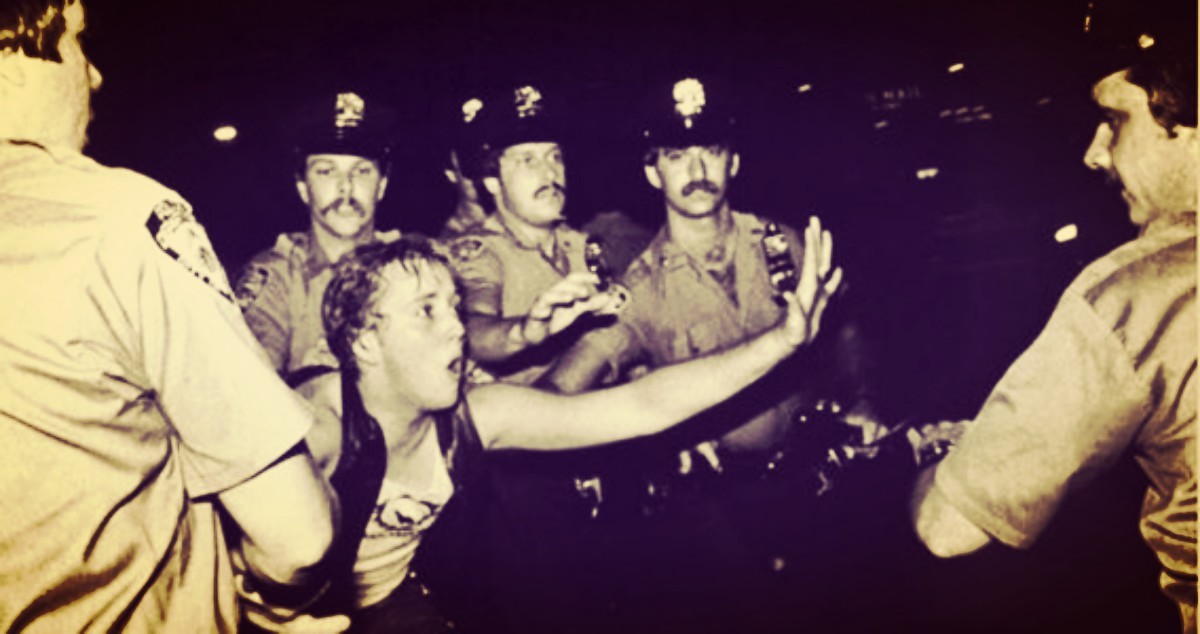
Nor should we allow the self-appointed peace police to colonize the trans experience that had its birth in the insurrectionary street battles of Stonewall with demands that all us angry trans folk quiet the fuck down and assimilate into the trendy bourgeois white gay male culture. The waning of the AIDS crisis from public view and the passage of marriage equality are not grounds to retire direct action as a means of queer liberation. Far from it. That time will not come until the murder and colonization of trans and queer bodies and the heteropatriarchal artifice that enables it comes crashing down in flames.

Fuck gender cops, peace cops, all cops.

Love and rage,
An angry-as-fuck trans girl

Destroy Gender

Wednesday, April 6th, 2016

CLICK HERE for a print-ready PDF of the Destroy Gender series by Lena Kafka.
CLICK HERE to read part 2 – Beyond Another Gender Binary


Gender as Governance

Gender is a hierarchy, one of the apparatuses of governance, that differentiates and categorizes bodies/people. Bodies are categorized into genders based on one’s appearance, behavior, economic/social/cultural position, and others. The categories are stacked in a hierarchy, where men and men’s labor are more valued than women and women’s labor (domestic work, youth/elderly care, psychological/social work, food service, retail, all jobs based on emotional labor, etc).

Gender uses its categories to play a part in governing the social sphere to maintain social reproduction. It creates a gendered division of labor, between masculine and feminine, “man’s work” and “women’s work”. Women’s work is valued and paid less, and for much domestic work not at all. The valuing women’s labor less than men’s attempts to make working class women reliant upon men economically. The forced reliance on heterosexual relationships is as old as civilization and class society. Women are coerced, structurally and interpersonally, into relationships with men for the sake of survival, and the reproduction of civilization. As “Against the Couple-Form”  puts it, “rather than an essentialist concept, the category of woman stems a gendered mode of exploitation and relegates certain types of labor to a private, unwaged sphere.”  The sphere of reproductive labor.

Economic exploitation is not the only way gender governs us. On a social level, gender sets standards and norms for our bodies and behaviors. Bodies get put into categories based on secondary sex characteristics, voice, behaviors, dress/aesthetic/ethnicity, etc. These expectations vary based upon social/cultural situation and position. Gender regulates bodies into certain norms to be interpreted into certain categories (man/woman, etc). These norms are regulated by stricter interpretation for women, and with harsher punishment for transgression. Gender is what tells women that we are not enough or too much anything and everything. Gender regulates our movements (“it’s not safe at night”) and our capabilities (“that’s not what women do”, “women shouldn’t do this or that”). Gender creates our anxieties/desires to be “manly” and “womanly”, to meet the capitalist ideal of easily identifiable, categorizable, and predictable bodies and actions.  Gender governs the social sphere.

Governance and gender define all aspects to the hierarchy of civilization. Governance is the regulation, normalization, and (re)production of bodies/people and territory. It does so through prisons, police, surveillance, borders, gender, work, evictions, school, racism, debt, xenophobia, etc, creating a class of those who benefit and a class of those who suffer.

Done be to is what?

Everyone in the milieu knows to make total destroy, abolish whatever, to smash this or that. Gender is but another apparatus to be smashed, burned, and scattered. To destroy an apparatus, we must destroy its roots. But first, the soil that covers and protects the roots.  The police, racists, misogynists—patriarchs of all varieties—this is the soil we must dig up.

Easier said than done.  Confronting police requires militancy (vigilance + awareness + tactical knowledge), but militancy demands the kind of commitment and preparation many aren’t ready for.  In most ‘progressive milieus’, going on the offensive is seen as hasty, ill-advised, or at worst, as reactionary. Revolutionaries know that those who wait for the state’s offensive to hit them, who wait for some tragedy to use as leverage and justification for reform, are the real reactionaries. Revolutionaries need to push beyond half-measures, beyond reform, concession and rollback, and push for breaking from the normalcy of daily life. We must push for insurrection against all governance.

The Coming Insurrection states, “The goal of any insurrection is to become irreversible.” To be irreversible means the roots are dug up and patriarchy, and all forms of hierarchy, are dismantled. In more real terms, it means that we have communities and spaces that aren’t just safe, but dangerous to those who oppose our desires and our spaces.  Not just a reading group safe space, but reclaimed territories capable of providing for the needs of the working class/women/the excluded (free from gender/gendered violence). These spaces can’t simply be given to us by a higher power.  Through occupations of the borderlands and sites of production, or less formal territories of resistance, such as friends who have each other’s backs, we will make or take the commons back.

No Tucking, No Masters

Our insurrection against gender cannot stop with just gender self-identification, or with a new list of terms for everyone to learn to respect. Insurrection must push beyond these limits to a free-play of actions, behaviors, sexuality, etc. Where doing or enjoying one action or another does not categorize you into a limiting role.

To be free from governance entails being free from gender. Being free from gender entails being free from categorization, normalization, and exploitation of governance.

Endnotes:

[1]  if one can separate the social from the political, private, etc

[2] these are not universal categories, exceptions may exist but we are looking at the structure of it all

[3] Lies: a journal of materialist feminism, Volume 1

[4] Distinct but not separable

[5] Viewing attacks on police as reactionary is a view normally held by those more liberal in our milieu, who still take their morality from the state despite the state being the one who facilitates our murders and misery. While I don’t think we should take their critiques to heart, we should still be aware of their presence in our circles and spaces.

[6]  Pg 130, Semiotext(e)

Lena Kafka

Further Reading/Inspiration
Gender Nihilism: An Anti-Manifesto
Whipping Girl
Against His-Story, Against Leviathan
Lies: a journal of materialist feminism
Caliban and the Witch
Feminist Theory: from margin to center