Over the next few days, we’ll be publishing pieces to highlight the work of some of the groups participating in the Cutting Class counterinfo network. We hope this will provide some clarity on where our crews are coming from and how that affects the way we have organized this project.
We also hope that these interview questions can provide a template for other autonomous groups to distill a collective understanding of their context and projects. If your crew finds these questions useful, write up a summary of your conversations and send them our way as a form of introduction! Cutting Class can be your platform, and we’d love to publish an interview with your crew and start collaborating—not just around CC but also with any other projects that these introductions might incite!
Today’s featured crew is the Filler collective from Pittsburgh, Pennsylvania.
Introduce your crew: what are some projects you working on, how long have you been around, where are you based, etc etc.
FillerPGH is a zine distro and counterinfo crew currently based in Pittsburgh.We’re basically just an informal collective of punks and writers who run a distro and claim the name Filler whenever it’s convenient.
Filler started in 2012 as a punk/hardcore fanzine, but has since grown into a platform for local anarchist scenes to share news, analysis, and other counterinfo. We write, design, and distro our own zines, and we usually table with cool zines from other projects too. You can visit our pdf archive and read or print our zines here. Our three most widely-distributed zines are The Relevance of Max Stirner to Anarcho-Communists, Destroy Gender, and For a University Against Itself.
Most of us currently go to / have graduated from the University of Pittsburgh, and so a lot of the content we get is affiliated with the autonomous student network and other youth crews. That being said, we’ve been actively trying to make the project relevant/useful for anarchists outside of the campus bubble.
The Big Idea is an anarchist collective that provides space for exploring radical ideas and putting them into action. The collective aims to foster a culture of resistance and mutual aid that celebrates individual and collective autonomy. Plus we have coffee and free wifi.
SCAM is a relatively new project that grew out of conversations between individuals from the Big Idea collective and the (now-defunct) Pittsburgh Student Solidarity Coalition. SCAM is not an organization, it’s just the name for a specific (1) autonomous forum, (2) social media platform, and (3) anarchist network – meaning that anyone who participates can use the SCAM “brand” to suit their own project’s purposes. The forum uses a spokescouncil model that’s meant to be a space of encounter to encourage mutual aid and coordination, and is in no way a decision-making body.
Nightshade is a two–year–old anarcha-feminist collective dedicated to providing physical, digital, and written safer spaces for women and queer people, as well as engaging in direct action against the heteropatriarchy. Nightshade collective members hold monthly meetings and at least one community event per month. This month, Nightshade is hosting a benefit partyto raise money for Survived and Punished—a collective that supports people wrongfully incarcerated for protecting themselves against domestic abuse. Not all community events are parties. Last month, Nightshade hosted two events—a reading of “The Secret Joy of Accountability” by Shannon Perez-Darby from the zine-turned-book, “The Revolution Starts at Home” and a facilitated discussion called ’Let’s Talk About Sex…Work’ to initiate conversations about sex work from a feminist perspective.
What are some challenges you’ve faced (internal or external)?
Pittsburgh anarchyland is currently recovering from some serious repression and burnout. Over a year of consistent militant actions resulted in ~30 felony arrests. Two comrades served several months in prison (hit us up if you want to throw some $$$olidarity their way) and a few more are still tied up in legal battles. By the summer of 2017, state repression dovetailed with existing internal tensions, and the subsequent burnout was real.
In the coming weeks, Filler will be publishing a longer piece(s) about this through several projects, including Cutting Class. Here’s an *ahem* exclusive sneak peak:
“2018 marks five years since the resurgence of an autonomous radical youth movement at Pitt, three years since the Pittsburgh Student Solidarity Coalition officially began flying black flags, two years since the organizations and crews affiliated with the autonomous student scene posed a real collective challenge to the populist-left’s monopoly on dissent, and over one year since the first coordinated Disorientation Week.
That first Disorientation Week sparked the brief and brilliant dumpster fire we refer to as “the” autonomous youth scene: a transient (yet genuine) expression of a collective “we.” At times, it felt like it was our first real glimpse of community, militancy, trust, repression, betrayal, and (attempted) accountability. It’s a declaration of “we” that weighs a bit heavy on the tongue these days.
Ten black blocs, 30-something arrests, and over a hundred felony charges later, it’s difficult to remove ourselves from the collective identity that “we” have developed over the past years’ struggles. The “we” used here is shorthand for the web of chance encounters that deepened as the autonomous youth scene grew. Filler most definitely cannot speak to the experiences of everyone in Pittsburgh’s autonomous youth scene. Consider this our contribution to a growing mythology of closure, a burial ritual for our own lingering nostalgia, a call for multiplicity.”
This resurgence in the local anarchist scene has broken down both social bubbles and social scenes.We’ve learned that we need more than the usual cycle of escalation and repression if we wanna rep the yinzurrection. We’d like to think that projects like SCAM and Nightshade (especially the second issue of their zine) reflect a broader learning curve in the Pittsburgh youth scene. To quote “PSSC is a SCAM,”
“[PSSC] originally began collaborating because we were sick of wasting our time seeking legitimacy through the dead-end channels provided by the Pitt administration and their police. But as much as we liked to position ourselves as inhabiting a space somewhere outside of Campus Life and its toxic social institutions and useless reformist activism, we now realize that we were merely carving out niche spaces within it […] Despite our best intentions, PSSC became an umbrella organization that assimilated (and sapped energy away from) the independent formations that comprised it. And so rather than continue to work together as a student coalition, we decided to re-prioritize our individual projects, crews, and organizations. ”
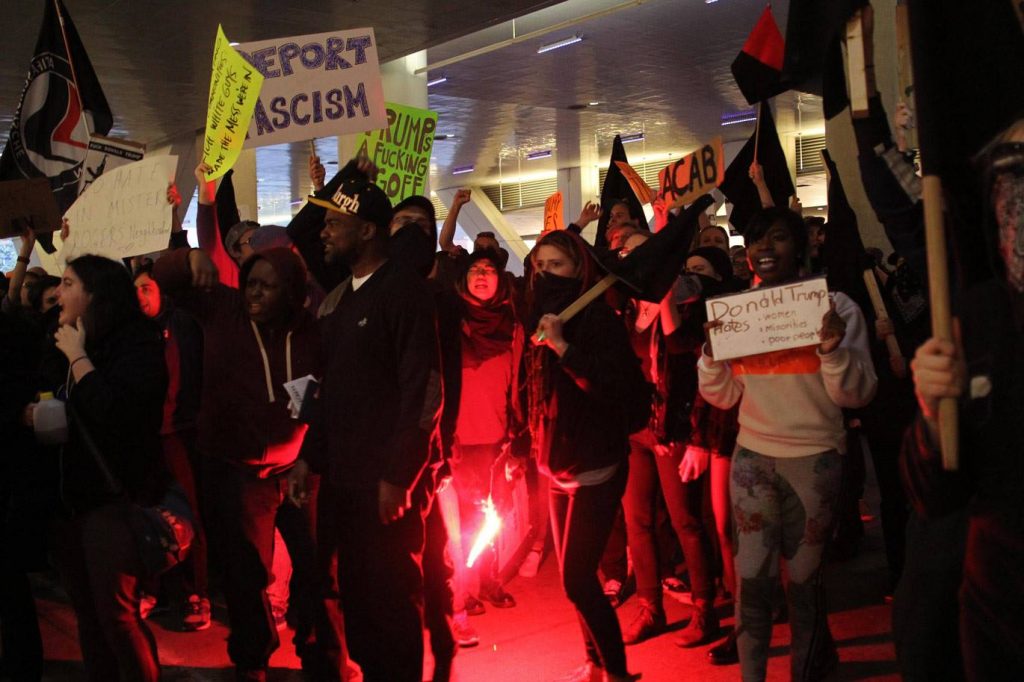
Photo: autonomous youth bloc turning up on election night on Pitt’s campus.
Read the report-back HERE.
What are some short and long-term objectives your crew has been working towards?
Counterinformation is communication, and communication is an end in itself. We’re not going to save the world (not that there’s anything about this civilization worth “saving”), but we might be able teach each other how to survive through the love and rage that grows in resisting it.
What do you think some of the major limits / major untapped possibilities for radical campus organizing are today?
Over the years, Filler has provided a platform for a variety of student voices. The only way to honestly discuss that question is to include them in the convo. We’ve compiled a selection of quotes from some of our personal favorite pieces below, which are divided into three broader themes:
Seizing and Repurposing University Space
The “Marketplace of Ideas” and Social War
Solidarity is a Weapon
TL;DR = There’s no unified “lesson” to take away, but one recurring thread is that students who work through the University framework end up compromising their politics. We have seen one too many radical organizations get recuperated after becoming / affiliating with University-sanctioned organizations. While organizing through the University can provide material benefits (beyond just funding and space), we think student crews should dedicate most of their organizing efforts to autonomous projects that operate outside the established University channels.
Not surprised at the administration’s routine disregard for student voices, we decided to continue our occupation of University space. Excited, scared and pissed, we brought flags, posters, zines, coloring supplies, books and snacks to a student study area on the second floor of the Cathedral of Learning. We sat down with confidence and declared that we were occupying the space. With comrades new and old, we plastered the walls with fliers, flags and art. We used the space for everything our teachers scolded us for doing in school: we shared food, played games, held political discussions and worked through interpersonal conflicts. After writing space agreements for our self-governance, we felt more at peace than we ever have walking the halls of our University.
An occupation is the realization of the threats we make through disruption. To occupy is to strike, to remove a material place from capitalist time and space, to derail alienated activity and ride its inertia off the tracks, to rip open latent contradictions in the fabric of consensus reality. When we occupy, we create a base from which to launch new negations, but more importantly a subjectivity that is actively experimenting with new forms of life.
Disruption, negation, experimentation, occupation — the suspension of routine and rhythm, the conversion of a thousand plagiarized, angst-ridden zines into something terrifying and new: the insurrectional desire to experience unmediated forms of life here and now, to live communism and spread anarchy. […] Elaborating insurrectionary potential requires more than blockading the flow of relations conducive to capital; it is a process of reorienting relationships and shared spaces towards the creation of new and transient collective realities. In other words, we must constantly recreate a “we” that isn’t a lie. […] Seriously, though. I sure as hell wasn’t radicalized after hitting up some student group’s meeting. I’m here because I’m still chasing the high from that first punk show in a squat house basement, that first queer potluck, that first renegade warehouse party, that first unpermitted protest, that first smashed Starbucks window.
Incite, Conspire, Diversify
Photo: Our generation’s first autonomous student bloc at Pitt Click HERE for the first report-back.
In the past two weeks at Pitt, we’ve shared ghost stories around campfires that we sparked with stolen electoral campaign signs from all political parties. We’ve cried in front of strangers and cheered each other on as we took turns shouting down the Pitt College Republicans outside of the library. We’ve kicked racists, sexists, and queer-phobes out of Halloween parties with both intelligent arguments and the occasional fist. We’ve graffiti-bombed racist propaganda and flipped over the tables of pro-Trump canvassers. We’ve seen glimpses of the future that’s offered to us, and then stumbled into an alleyway to piss all over it.
“We” don’t necessarily remember all of these stories, share a political disposition, or even know each others’ names. “We” is just a name for this sudden, transient inclination towards defiance, or some shit like that. Filler has heard a lot of inspiring anecdotes over the past few weeks, but we’ve also noticed that the far-right students at Pitt have monopolized the narrative over what is happening. On Halloween, we heard about yet another entirely spontaneous action and decided we’d try our hand at unpacking the situation. “We” don’t speak on behalf of anyone except those that resonate with our interpretation of their actions. To our friends we don’t yet know: keep turning shit up!
It hasn’t been until now that we can put names and faces to some of the sources of hate at the University of Pittsburgh. In the past few weeks our collective of anti-racist, anti-fascist friends and organizers have been compiling various screen shots and other evidence that ties members of the Pitt College Republicans and alt-right publication Polis Media to disturbing memes, jokes, and genocide apologia as well as r*pe joke including ones targeting some of the most vulnerable members of society – children and incarcerated persons.
We are queer and trans. Our existence clashes against the gender binary, and its crushing grip which polices our bodies and threatens our safety. The ways that we live—relate to one another, dress, gesture, and dream—are all in inherent subversion to that binary, which seeks to classify, erase, separate, and homogenize us. In turn, we fight for spaces free from gendered expectations, places where we can function and thrive in peace. […]
We will not be fooled – Pitt is a blatant and knowing enemy in our fight for trans-liberation. […]
Nightshade beckons the University to respond: Why are you, University officials, holding this basic need of your trans*queer students hostage?
What a shit show it would become if you were denied safe access to bathrooms…
Nightshade supports the autonomous actors taking matters of trans-liberation into their own hands. We should not need to assimilate to normative gender presentations in order to use the bathroom, and we stand against anyone who forces that upon us.
In the neoliberal university, the valorization of free speech norms and student choice allows students to feel political as long as they don’t step out of bounds. Note the ever multiplying number of politically oriented student groups, each centered on a specific set of goals that are not meant to overlap and instead provide a safe outlet for the desire to be political. These organizations can be housed in student government organizations, and you can be as radical as you as want as long as you don’t act in such a way that would significantly disturb the status quo, which is a strange shift when put in contrast with previous student agitation centered on questions of radical political change in the university structure.
[As soon as the disruption of the transphobe Reverend Scott Stiegemeyer began], self-appointed “peace police” within the body of “protesters” sprang into action, demanding that we sit down and continue to take Stiegemeyer’s bullshit while our trans siblings die every day through murder and suicide.
Those who stood up to oppose us played directly into the hands of the Reverend’s ilk. By presenting themselves as the “respectable” LGBT community, they took the side of the Reverend and the cops against those who were not willing to be silent in the face of the war against our trans bodies. They forget the war cry of ACT UP’s fight against AIDS during the 80’s and 90’s: Silence Equals Death. Only those “allies” who are not directly threatened by hate speech against trans people and the violence against us it engenders have the option to remain silent without potential deadly consequences. […]
Instead of joining our mutual enemies in attempting to snuff out our rage, we’d prefer you to accept our methods as equally valid to other forms of struggle so we can all take on our adversary in our own ways. We see you as potential accomplices in our liberatory project, and would much rather fight beside you than against you.
And I’d do it again. […] I would be astonished if either [cop] believed “disrupting a meeting” was an actual crime. The intention with which they bandied the phrase about was likely an attempt to make us fearful enough for our individual futures that we would comply with the questions they asked us about each other. Upon arriving at the station, my friend and I were led into an interrogation room. In an hour-plus conversation, the officers offered up such gems as “the Constitution is dead” and a lecture about my disrespect for the men and women who died defending my right to speech, the latter of which rang as hollow as the former did true while I sat handcuffed to a wooden bench for talking at the wrong time.
Photo: Trump visits Pittsburgh Click HERE or HERE to check out two report-backs from this action.
The line goes through the door as the rush peaks. I walk over to the cooler, put my back to it, and slide down. The AM sees me and immediately gets red in the face screaming at me.
“What is this? A fucking strike?!”
“I guess so!”
Five minutes of back and forth screaming and the area manager agrees to rehire the mother she fired an two hours ago. Unfortunately, none of my coworkers joined in. Some thought I was absolutely out there to risk my job, some later thanked me and started talks of something bigger…
We are deeply saddened and angered by the murder of comrade Scout Schultz by Georgia Tech campus police. As a small crew of radical queer youth and accomplices, we recognize that Scout could have been any one of us. We too struggle daily with and against our mental health; we take these actions as part of that struggle. We will continue to answer the calls to fight in Scout’s memory, one of which reads:
To anyone who is enraged, grieving, or who stands against the police and the murderous system they protect, we call for actions in solidarity with our fight here in Atlanta. To anyone who is fighting for liberation: in the coming days, fight with Scout’s name on your lips, on your banners, and in your hearts.
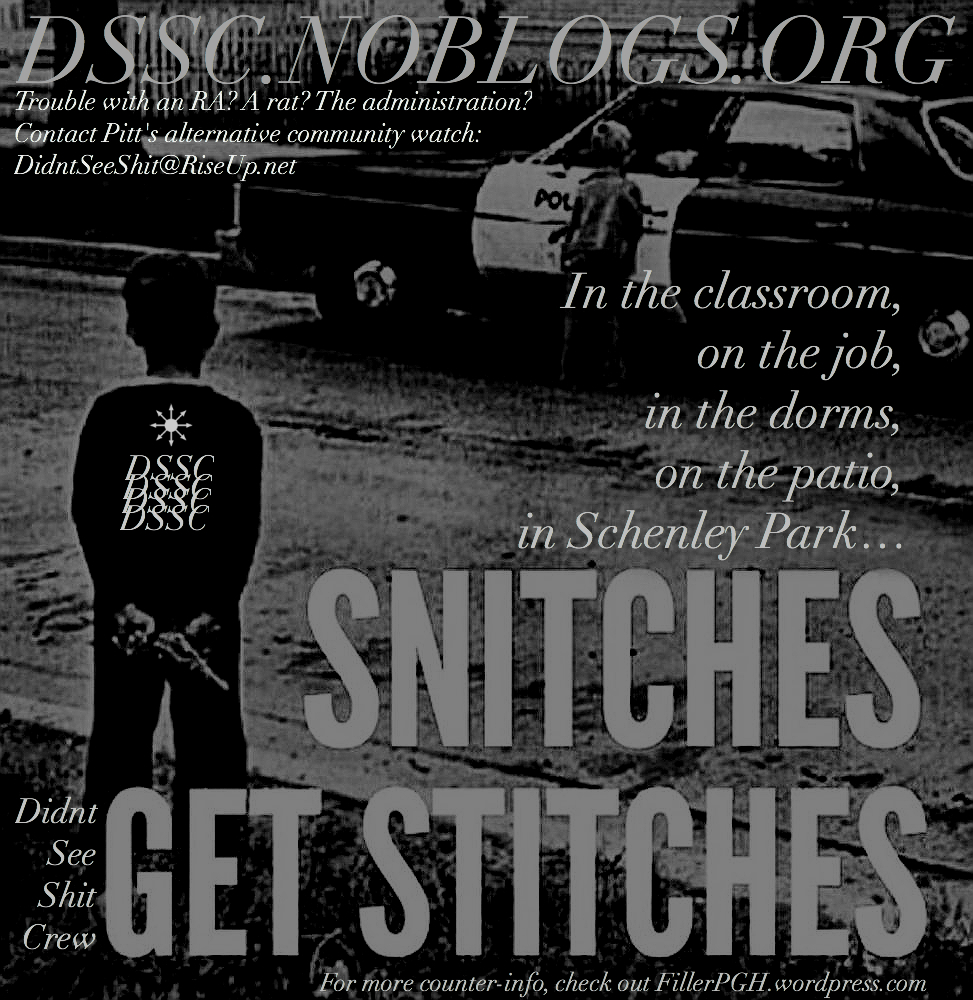
The University of Pittsburgh is full of snitches, from the tough-guy RA who takes his job too seriously, to the bigots who knowingly out queer folks and put them at risk. We’re sick of seeing good kids get expelled, arrested, or otherwise screwed over because some holier-than-thou bootlicker decided to fuck up someone’s life; because some snitch reported a graffiti artist, or tipped off a Pitt employee about a darknet mail order, or called the cops on students for flyering and promoting events without a permit, or chose to be an asshole of an RA and actually conduct a random dorm search, or ratted out a student who stole the textbooks they couldn’t afford…
Want help dealing with a rat? Send the Didn’t See Shit Crew an email detailing the nature of the incident (no incriminating details, please!), the informant’s motive, and your desired course of action. We will work with you to figure out how to best discourage this sort of toxic behavior, support any folks who are facing legal or school repercussions, and, if necessary or requested, facilitate retaliatory dialogue.
How can folks support your work?
Submit content, distro our zines, critique our zines, talk shit on/with us, email us your juicy intel, give us money – fillercollective [at] riseup [dot] net
Submit to the spectacle and follow us on social media:
Any closing thoughts / reflections from your crew’s conversation?
When we first came to Pitt, we had to reinvent the wheel when it came to spreading anarchy, and we made a fuckton of mistakes along the way. We’re stoked to be connecting with other youth projects, and honestly should have tried to sooner. We’re also stoked to hash out some ideas around intergenerational infrastructure and communication, because there’s always the possibility that Oryx and Crake accurately depicts the whole “no global future” collapse: the University is both a gatekeeper to the means of survival and an enemy as formidable as the state, and will be for the rest of the forseeable futures / protracted collapse.
And never forget that cringing is an affective bond, because maybe the real insurrection was the friends we made along the way 😉
Originally posted to It’s Going Down by an anonymous participant in the autonomous student network on November 18th, 2017
This time last year, comrades took to the streets of Oakland, Pittsburgh to express anger over Trump’s election and demand an end to tuition hikes and student debt. Campus and City police responded to our action by kettling us in Tower’s lobby, beating us with batons, threatening us with police dogs, pointing rubber bullets at our faces and ultimately arresting two march participants. The school condoned the police violence, congratulating the cops for maintaining University order. For simply wanting a more just school and society, the University enacted an assault on our bodies, minds, and spirits.
But we already knew the University to be fundamentally positioned against our free existence. We’ve seen the campus police stop and ID comrades for nothing more than dyeing their hair, piercing their bodies or kissing their queer partners. We’ve seen them harass students at Black Lives Matter protests and die-ins. The brutality that took place in Tower’s was just further affirmation that the University is a colonial machine that exists to uphold the capitalist State.
As anarchists we challenge any institution that perpetuates classism, racism and gendered violence. So we turn to our University and question the rising tuition which inhibits so many lower income students from attending school, the overwhelming whiteness of our student population, the failure of the school to hold anyone accountable for enacting violence against women and those of marginalized genders. Our questioning leads us right back to what we’ve always known: our school exploits its students and workers in order to maintain its institutional authority and wealth, and the Pitt Police force is the University’s private army that protects it from being penetrable.
So we demand change. We demand a world without police so we can create a world for each other, so we might be able to gather and grow with one another in a less alienating way.
Tuesday, November 14th, 2017, a small group of us entered the Chancellor’s office and stated that we would not leave until the Chancellor met our list of demands. We sat together on the floor of the office and read zines to one another while comrades stood outside the office doors telling fellow students what was happening. After less than ten minutes, security guards and police arrived and removed us from the office. After checking our student IDs, they told us that we were banned from all campus offices.
Not surprised at the administration’s routine disregard for student voices, we decided to continue our occupation of University space. Excited, scared and pissed, we brought flags, posters, zines, coloring supplies, books and snacks to a student study area on the second floor of the Cathedral of Learning. We sat down with confidence and declared that we were occupying the space. With comrades new and old, we plastered the walls with fliers, flags and art. We used the space for everything our teachers scolded us for doing in school: we shared food, played games, held political discussions and worked through interpersonal conflicts. After writing space agreements for our self-governance, we felt more at peace than we ever have walking the halls of our University.
Initially, campus police harassed us and repeatedly asked us to leave. They claimed we were singing too loud, disrupting the University’s normal flow of business. Essentially, they admitted that we were accomplishing our task. We ensured that there would be no business-as-usual that day.
When we told the police we wouldn’t leave the space, our desires grew into direct subversions of the system that has controlled us our entire lives. The police stared at us, not expecting anyone to refuse their command. We were able to say “no” with ease because the majority of the group was white, privileged variously under the social order. Our ability to refuse the police must be problematized by race, since our whiteness allows us to chip away at the hegemony of police power from a position of relative safety.
We know that our white comrades are not the primary target for policing. The violence of policing stems from the white supremacy and colonialism that built this country, and is continuously more devastating and prevalent in communities of color than in the lives of white people. We are enraged that police routinely terrorize students of color on our campus. We see the need for more dialogue on race and the role it plays in our theory and practice. Our actions are intended as acts of solidarity and resistance in the broader movement against police led by anarchist comrades and communities of color.
We occupy in hopes that all students can feel empowered to organize and resist autonomously; in hopes that one day we will occupy the entire University, and finally set it free.
By continuing to occupy, we undermined the police’s normal ability to rule spaces unchallenged. The space quickly became centered around sharing—students donated cookies, sleeping bags and pillows on their way to class. We played games, created art and invited people into conversations about the violence of policing and the capitalist hegemony inherent in the University. We experienced a free flow of resources and ideas, and remembered that we can create joy through vulnerability and trusting that we are capable of caring for one another.
We had intentions of sleeping in the space, but at 11 PM the Dean of Students led police in to the remove us. This was another reminder that the police and school administration serve each other, and that the force maintaining order within the University is the fear of violence and retribution. When the Dean of Students gave us the choice to leave, many cops stood behind him, reinforcing his words with the threat of their arms.
We decided not to occupy the inside of the Cathedral yesterday after receiving critiques about our strategy claiming that there is nothing radical about white people occupying space—white people have been taking and occupying space from the inception of this country. We take these critiques seriously and know that there are many more ways to center racism and the role of white supremacy in our politics and organizing. It is important that we continue to take time to slow down and listen to our friends as maintaining relationships and staying accountable to our broader community feels more important than sticking to a strict strategy that aligns with our political ideals.
Instead of occupying the space yesterday, Wednesday, we handed out 70 burritos and many zines with comrades from Food Not Bombs in efforts to strike up conversations with other students about anarchism, police violence and the politics of free food. This was an act of defiance in its own right. We have been harassed in the past for trying to set up Food Not Bombs and share fairs on campus grounds. The distribution of food is not permitted on campus, and our share fairs were seen as ‘demonstrations’ instead of movements towards mutual aid. But we will continue to provide for each other in the ways that the University will not.
Other crews did banner drops to keep up the spirit of dissent.
Even if our occupation lasted for only 15 hours, the power of that brief departure from daily life will fuel our fight against all that suffocates our autonomy. For a moment, we created a space where the authority of the University fell away and we could answer to the needs of the students by our own collective means.
This is one perspective of the many people who participated in the occupation. Different analyses may come.
-Steel City Autonomous Movement (SCAM) // Autonomous Student Network PGH
While the rivalry on the football field between WVU and Pitt is well known, on the streets we declare our comradely support. On Tuesday, November 14th a coalition of autonomous students occupied Pitt’s Cathedral of Learning. At the time that we release this document the occupation has been ongoing for 18 hours. Faced with federal, state, city, and university police intimidation, the occupiers face an uphill battle to have a list of 15 demands met.
We call on the university to immediately fulfill the 15 demands as written. We also call on WVU autonomous students and other Morgantown radicals to show solidarity with the occupation and equal commitment to similar goals in our city and campus. Occupations and the fulfillment of the demands are only the first steps in the development of an anti-capitalist struggle. Even after the demands are met, we and our comrades will continue to demand the impossible.
After a four-year run, our coalition of radical student crews and organizations was formally dissolved on Wednesday, November 1st. We originally began collaborating because we were sick of wasting our time seeking legitimacy through the dead-end channels provided by the Pitt administration and their police. But as much as we liked to position ourselves as inhabiting a space somewhere outside of Campus Life and its toxic social institutions and useless reformist activism, we now realize that we were merely carving out niche spaces within it.
The Pittsburgh Student Solidarity Coalition is dissolving in order to further decentralize and diversify organizing efforts, and to grant greater socio-political agency to the participating crews and organizations. Despite our best intentions, PSSC became an umbrella organization that assimilated (and sapped energy away from) the independent formations that comprised it. And so rather than continue to work together as a student coalition, we decided to re-prioritize our individual projects, crews, and organizations. But we’re not exactly breaking up! We still want to coordinate projects and share access to media platforms, but the PSSC general assemblies were definitely not the right forum for that.
In centering the student identity and its socio-geographic limitations, we effectively sidelined our non-student friends and comrades and self-isolated our struggles; in imagining ourselves and our scene as somehow being exterior (and superior) to Campus Life, we self-sabotaged our efforts to organize around student issues. As a result, we spent most of our energy organizing according to the artificial relationships and interests imposed by the University, or trying to construct “alternative” scenes with the same building blocks that Campus Life provided. But we cannot hope to build a movement by hopping back and forth between cookie-cutter countercultures, half-ironically adopting the aesthetics and politics of a given scene until we’re left with the choice between complicity in the guise of left unity, socio-political posturing, and dropping off to watch as another scene falls out of fashion. As aspiring truants, we must experiment with all available means of disrupting the routes by which Campus Life follows us into our spaces and relationships. Therefore, we can no longer passively identify with the infantalizing range of behavior and thought permissible to “students.”
Our truancy is oriented against the University as a site of separation – the separation of students from other youth, of students from faculty, of students from community, of education from public life, of the individual from self-identification/determination, of thought from deed. We recognize that we cannot take down the university-colony without fighting alongside the rest of the city: alongside our friends who never fucked with colonial education, our peers who are getting paid poverty wages by the university-factory, our neighbors who are being pushed from their homes by the rising cost of living, the land that is continuing its generations-old resistance to the economic crosshairs of corporate education.
In collaboration with autonomous radicals from across the city, we decided (in what will hopefully have been our last large-scale consensus decision) to participate in a new coordinating formation, the Steel City Autonomous Movement.
SCAM will utilize a spokescouncil model in order to encourage decentralization. The spokescouncil is a forum for mutual aid and coordination, not a decision-making body. Any individuals, crews, or organizations that have a relationship to the movement will be able to attend spokescouncils, share platforms for communicating and disseminating information, and volunteer to join the infrastructure crew. The infrastructure crew is responsible for bottom-lining at least two spokescouncils every month (one off campus, one on campus), inviting / screening / vouching attendees, throwing social events (public and private), and compiling the weekly event rundowns. Anyone participating in the infrastructure crew is empowered to use the SCAM brand/platform to promote their own events/workshops and endorse events as SCAM, without the need for consensus – SCAM is not an organization, it’s just the name for a specific autonomous forum/platform and therefore can be claimed by anyone that participates in it. The infrastructure crew will meet once a month for a tekmil to ensure shit doesn’t centralize into an organization and that no one’s acting fucked up or some shit.
Our friendships, houses, projects, crews, and organizations could be so much more than an edgier version of Greek Life. So fuck politics. Fuck professionalism. Fuck only building relationships with other students. Fuck living as if we aren’t witnessing the collapse of an empire.
We call on students and youth everywhere to join us in bursting the campus bubble. Let’s use our position as students to scam the University, just as it’s scammed us. Let’s take some time to venture off campus, chill in unfamiliar places, make dangerous friends. Let’s invite Pittsburgh back into Oakland. Let’s become ungovernable.
Submission from the Queer Coffee Run crew, received on September 21st, 2017.
On Wednesday morning, we dropped two banners at the University of Pittsburgh. They read, “From Pitt to Georgia Tech: Disarm the Police, Arm Your Desire” and “Solidarity with St. Louis and Atlanta: Fuck the Police.” The first was hung from student dorms, the second from condemned housing near campus – we hope the symbolism is clear. Later that night, after campus police arrested a student protestor during coordinated disruptions of a right wing “debate” on immigration, we linked up with two other crews to beautify campus with chalk and flyers [just a heads up, the link is from a right-wing student news site, and it’s kinda hilarious]. Another crew from the autonomous student network tells us they also tagged and wheatpasted the Oakland area on Tuesday night.
We are deeply saddened and angered by the murder of comrade Scout Schultz by Georgia Tech campus police. As a small crew of radical queer youth and accomplices, we recognize that Scout could have been any one of us. We too struggle daily with and against our mental health; we take these actions as part of that struggle. We will continue to answer the calls to fight in Scout’s memory [1,2, 3, 4], one of which reads:
To anyone who is enraged, grieving, or who stands against the police and the murderous system they protect, we call for actions in solidarity with our fight here in Atlanta. To anyone who is fighting for liberation: in the coming days, fight with Scout’s name on your lips, on your banners, and in your hearts.
We are also enraged, but unsurprised, by the continued impunity of racist police in St. Louis. Rest in Power, Anthony Lamar Smith.
We’re profoundly inspired by the uncompromising militancy of the resistance in both these cities. There is no dialogue to be had with those who continue to write our murderers’ paychecks, nor are there negotiations to be made with the forces of hetero-patriarchal white supremacy, capitalism, the state – Power.
Maybe you missed this, but you’re not in a dialogue. Your views are beside the point. Argue all you want—your adversaries are glad to see you waste your breath. Better yet if you protest: they’d rather you carry a sign than do anything. They’ll keep you talking as long as they can, just to tire you out—to buy time.
They intend to force their agenda on you. That’s what all the guns are for, what the police and drones and surveillance cameras are for, what the FBI and CIA and NSA are for, what all those laws and courts and executive orders are for. It’s what their church is for, what those racist memes are for, what online harassment and bullying are for. It’s what gay bashings and church burnings are for.
This is not a dialogue. How could you be so naïve? A dialogue—from which some of the participants can be deported at any time? A dialogue—in which one side keeps shooting and incarcerating the other side? A dialogue—in which a few people own all the networks and radio stations and printing presses, while the rest have to make do with markers and cardboard signs? A dialogue, really?
You’re not in a dialogue. You’re in a power struggle. All that matters is how much force you can bring to bear on your adversaries to defend yourself from them. You can bet that if you succeed, they will accuse you of breaking off the dialogue, of violating their free speech. They will try to lure you back into conversation, playing for time until they need no more stratagems to keep you passive while they put the pieces in place for tyranny.
This isn’t a dialogue—it’s a war. They’re gambling that you won’t realize this until it’s too late. If freedom is important to you, if you care about all the people marked for death and deportation, start taking action.
The early bird avoids the cops, Queer Coffee Run – Autonomous Student Network [QCR-ASN]
REST IN POWER, SCOUT
IT’S A SIN TO KILL A MOCKINGBIRD
“Love and Rage to student rebels at Georgia Tech – RIP Scout – Fuck Cops (A)”
ClickHERE to learn how to support Georgia Tech student rebels.
Our material environment arranges life into a procession of neat little rituals. All that is possible or desirable is administered according to the routines built into Campus Life.
No one is quite sure why the lobby of Litchfield Towers is first and foremost a place to glide through in passing, to dodge the solicitations of student clubs, or to purchase coffee. Nor is there much reason to question such fixtures of everyday life; these structures are simply taken for granted as part of our unspoken consensus on reality.
And who really even gives a shit in the first place?
Well, try using a university space for even slightly different purposes and you’ll find out pretty quickly. After all, there are people whose paychecks are predicated on having to give so many shits that they will physically retaliate against any breach in routine. But uniforms are easy targets, rhetorically speaking. The relations encoded in the blueprints of the places they are paid to defend, on the other hand, are what reproduce normalcy.
For an education that liberates. For a classroom that no longer spectates. For house parties where Pitt students, workers, and faculty can throw down together. For a campus culture that terrifies Pitt’s board of trustees. For a campus that celebrates life.
For a University Against Itself
Back in the spring of 2015, a couple friends brought hot food, some boxes of clothing, toiletries, books and zines into the lobby of Litchfield Towers to give away for free. This was the same school year that the University of Pittsburgh’s administration decided to raise tuition, organize a food bank for its students as a sort of half-assed apology, and then jack up tuition a second time just a few short months later. Needless to say, shit was getting rough for a lot of kids at Pitt.
I thought using a student space to share stuff was a cool idea, so I grabbed a few sweaters I could spare on my way out the door that morning. But before I even made it to campus, our group chat started blowing up.
My friends had been kicked out within half an hour of setting up. By the time I got there, a Pitt cop was already chasing them out the door, frantically squawking into his radio, flailing his free arm and demanding they come back to face the consequences.
“Must fulfill duty to defend Law and Order,” said the robot in his head.
“Finally, some action!” thought the man behind the uniform.
Art by Tild Eath
The Task at Hand
Rather than deferring to age and experience, we can sharpen our analytical skills through discussion groups, general assemblies oriented towards communication as an end in itself, and more writing, theorizing, and critique. These are the processes that enable a crew, a community, or a distributed network of subversives to gain mutual understanding and refine their analyses in order to speak precisely about what is happening, what must be done, and—most importantly—how to do it. It is essential to find the time and space to do this with people you trust, whose analysis you also trust, and ideally who come from a range of backgrounds and experience.
– “After the Crest: Part IV,” Rolling Thunder #11
This is not a populist appeal. Nor is this a program to be enacted by some specialized minority of student organizers, “social justice” activists, or would-be insurgents. This issue of Filler is about starting a conversation.
In Pittsburgh, we’ve seen a small but exciting resurgence in everything from reformist mass mobilizations to insurrectionary shenanigans. I have no clue what might go down next semester, but some shit seems to happen over and over again. There are patterns, if you’re looking for them; Campus Life has a way of dissolving back into routine.
An effective analysis of our situation, and a healthy bit of introspection and reflection on our personal objectives, might offer a vision for momentum. But no analysis is fundamentally correct, and certainly no analysis is correct outside the context in which it is conceived. A correct analysis is simply whatever interpretation of social reality best informs our efforts to achieve a given objective. Ideas and conflicts persist, but radical youth scenes, and therefore coherent strategies, are as transient and short-lived as our attention spans.
The conceptual frameworks proposed in this zine are meant to work in tandem with the organizing that folks are already engaged in. The task at hand is to figure out, for ourselves, how to conceptualize and organize the University struggle: what entrances are we neglecting, and where might we find points of departure from which to rekindle the excitement we once felt? After all, the shit we pull off today will determine both starting points and horizons for the next generation of Pitt students.
This zine is also an attempt to contextualize Pittsburgh’s nascent student movement, to frame the coming unrest in a way that just might make some careerist liberal think twice before mentioning their time as club president on a future résumé.
~ I ~ Stories We Tell Ourselves
Organizing has never meant affiliation with the same organization. Organizing is acting in accordance with a common perception, at whatever level that may be. Now, what is missing from the situation is not “people’s anger” or economic shortage, it’s not the good will of militants or the spread of critical consciousness, or even the proliferation of anarchist gestures. What we lack is a shared perception of the situation. Without this binding agent, gestures dissolve without a trace into nothingness, lives have the texture of dreams, and uprisings end up in schoolbooks.
– The Invisible Committee, To Our Friends
History under capital is a history of erasure, or else it would tell a story far more personable than the presidents and cash crops so familiar to students.[1]☭
Today in Pittsburgh, we learn how to reproduce the logic of the men who stamped their names on lecture halls, museums, and libraries. Over a century ago, but only a few miles up the road in Homestead, 19-year-old Andrew Henry Striegel died as a partisan for the living wage: a gunshot to the neck, delivered courtesy of two men also named Andrew and Henry. What is lost in high school textbooks is no mere anecdote, but an entire way of relating, being, and inhabiting that sidesteps the mediation of capital: the urge to live and to act directly in accordance with one’s understanding of the world.
But this is nothing new. History is written by the victors or whatever, right? The histories told in the classroom are just the stories popular culture prefers, an interlocking web of myths to explain the modern world.
All of America’s fundamental myths—property, borders, nations, liberty, debt, democracy—were born in acts of violence, are affirmed by violence, and reality is now mediated through their logic. The mythology of the University is no different.
The reemergence of an american student movement carries two discourses. One is familiar; the other is older and emerges far less often. The first is positioned within the march of progress, the student struggle for peace and opportunity, heated debates in the “marketplace of ideas.” It’s always returning to notions of civic duty and a generation’s political awakening, to celebrations of American democracy with a push from below. And it’s not just liberals or reformists that prefer this discourse. Plenty of so-called radicals fester in nostalgia for the old movement: the workerism of labor leaders, the naïve conservationism of the Greens, the rebranded demands for all-too-familiar concessions (whose benefits hardly last a decade before the economy is again restructured to render them meaningless), or the fatalistic certainty of an impending “final” crisis of capitalism. For these populist radicals, the day will come when all of the single-issue campaigns finally merge towards a swift and (relatively) peaceful transition into social democracy. Progress and Democracy, the Bernie-Bro’s wet dream.
The other discourse revolves around interpreting the social violence that sustains Everything, seeking out opportunities for material opposition and counterviolence. These kids orient themselves according to the latest communiqués and spectacles of the global civil war—the call-and-response discourse of Social War. Youth struggling against the american University inherit war stories from those few generations that figured out what the word “peace” really means, although their historical moments have likely been interpreted beyond recognition. While we can scrounge through the fractured bits of text, theory, and counterculture that these kids left behind, these artifacts do little more than hint at their movements’ key points of departure. Still, the fragments of their stories that somehow survived history are at least enough to inspire. For each retelling, it’s a question of improvising the plot gaps needed to link the acts. Good improv is hard, but not impossible. Sometimes all it takes to work out a strategy for momentum is a contagious tactic, as the 2009 student movement proved by occupying campus buildings all across California. But more often than not, would-be insurgents are left recycling tactics without a broader vision for sustaining disruption or infrastructure.
Of course, no single narrative is capable of telling the whole story, and fixating on a single discourse risks suppressing improvisation. Behind every discursive wave of Social War, from Santiago to Athens, are the privatized ruins of failed social democracies. But the key point here is that, ever since the movement of the 1960s, it’s the youth who are improvising theories of change: rejecting routine, escalating populist campaigns, pushing movements to their limits, writing their own mythologies, and even forfeiting their lives to fend off both State and fascist reaction.
The spectacle is not a collection of images, but a social relation among people, mediated by images.
– Guy Debord, Society of the Spectacle
Power, Routine, Legitimacy
The administration, the University, the student government, the State—none of these institutions wield power.
Power is a relation, a social structure, a logic. It is both the physical and the psychological force of routine, both the pigs’ monopoly on the legitimate use of violence and the racialized colonial alliances that so often complement it. Power is fused within the organization of space; it is the way in which the flow of things and people (in that order) is enforced and reproduced through infrastructural patterns, ritualizing social hierarchies to the point that they become material conditions. “Those in power” are simply the ones enforcing and rationalizing the arrangement, or perhaps slightly adjusting it to better suit the flow of capital.
Routine is a mechanism whose parts can be infused, even conflated, with one’s identity; both the material organization of a space and its accompanying roles and relations are dependent on popular, undisputed participation and faith. We see this in the games of respectability and professionalism played every day on campus. The dormitory resident assistant is your age, but you will never be their peer. How could you be? At any minute, they could receive an order to search your dorm, summon armed men to detain you, get you thrown out of school.
Behind all power relations are a series of affirming images, reproduced ad nauseum on billboards and social media, personalized in the commodified identities sold on shelves and television shows, and circulated by the institutions that assign and define roles and tasks. From your dorm’s overzealous RA, to the cops that he called on the stoners down the hall, “those in power” are really just fronting the aesthetics of power. They would have us believe that they own exclusive rights over arranging and organizing the places we inhabit, or over the deployment of violence to enforce those modes of relations. Look, they have even the shiny badges to prove it!
The continued reproduction of the images, roles, and identities within a given space is only stable so long as nothing interferes with the rhythms of routine. Whether it’s a student refusing to put her cellphone away in a San Antonio middle school, a young man suspected of shoplifting cigarillos walking down a street in Ferguson, or a few dozen Black youth hanging out at a public pool in a white suburb—any potential disruption of the routine functioning of power relations within a space threatens to destabilize the arrangement and function of that space. Which is to say, disruption carries the potential to temporarily rearrange and repurpose a space toward the production of subversive, non-hierarchical power relations.
Since disruption cuts off the dominant relations at the point of production, the social roles that have been granted “legitimate” uses of force are employed as the first line of defense. The student questioning her teacher’s authority is also questioning the relations encoded in her school; the prospect of a suspected shoplifter making off with a few dollars worth of merchandise warrants extra-judicial execution because it challenges the sanctity of property; the presence of Black bodies in a white space threatens a regime of segregation. Behind every identity that categorizes and enforces ways of being, behind every arrangement of space that directs and determines the relationships that comprise things and people, is a latent violence. Disruption exposes this reality, but it cannot experiment with new forms of life without the capacity for self-defense, for counter-violence.
Exercising force is a tactical maneuver in the discourse of legitimacy. The function and arrangement of a space (public school, convenience store, white neighborhood) must encode a distribution of power that considers the agents tasked with imposing it (cops, pigs, murderers) to be legitimate. In the heart of the Empire, spectatorship translates as passive compliance with the rules of the game, as deference to the legitimacy of white supremacist and capitalist logic; in each of the above examples, white police officers savagely attacked young Black people with legal impunity. The aesthetic of power, then, is also the aesthetic of legitimacy: legitimacy is white, he flashes a badge, he wears a suit, he is a professional, he works within the parameters of the law, he carries a megaphone, he is comfortable in his neon-yellow marshalling vest, he is a man.
Genuine acts of resistance make no appeals to conventional legitimacy, to the symbolic terrain of representation, to negotiation with those fronting the aesthetics of power. Rather, genuine resistance leverages force against the material structures that reproduce reality, in hopes of opening new possibilities.
The academic life contains reinforcing counterparts to the way in which extracurricular life is organized… academia includes a radical separation of the student from the material of study. That which is studies, the social reality, is ‘objectified’ to sterility, dividing the student from life…
– Tom Hayden, The Port Huron Statement
Factory, Colony, University
The University is a knowledge factory, a think-tank expanding capital, a colony in the service of Empire: a site of social control.
The University of Pittsburgh, and the surrounding Oakland neighborhood, is a fucking police state. City cops, Pitt police, Carnegie-Mellon police, Point Park police, Pennsylvania State police, and park rangers all have jurisdiction here (and this doesn’t include rent-a-cops like university security). The administration doesn’t even bother trying to cover up the University’s colonial project; Pitt raises tuition every single year, ensuring that each semester brings richer and whiter students to Oakland. Meanwhile, its legion of pigs occupies the remnants of the original Oakland community to stabilize the process. The colony must grow in order to survive; everywhere, the public University is in its death throes, self-cannibalizing in desperate hopes that the commodification of knowledge, paired with the expansion of its consumer base and labor force, might offset the crisis facing the traditional reproduction of the working class.
The social organization of the University-Colony is a voluntary caste system. The material reality of University infrastructure is sustained by the constant reproduction of social roles: student, faculty, employee, administration, campus police, etc. But those mythical identities only exist in relation to the routines of the University. So in order to ensure that social activity on campus is performed in accordance with the proper University-prescribed identities, Pitt must detach Campus Life from Pittsburgh life—the University “community” must exist outside of the society that constitutes it. And even that “community” is itself further divided into separate social groups, from the academics to the service workers, each premised on a series of affirming images. Pitt hoodies and student ID cards insist the spectacle of Campus Life is not simply a ritualized social performance, but a natural order.
So long as social interaction is directed by the logistics of the neoliberal University—so long as the worker’s labor is converted into the administration’s capital, or the student’s research and debt is transformed into the school’s endowments and marketable reputation, or the untenured professor’s job insecurity is realized as another boring-ass slideshow and multiple-choice exam—all relationships will be mediated by the caste system of Campus Life. So long as capitalists are in control of the University, so long as the University is comprised of capital, the University will oppress and exploit.
Campus Life is a frontline in the social war. Its pretensions of colorblindness, gender equality, and academic liberalism are little more than a smokescreen to cover up the fact that the University itself can never be a neutral institution. A cursory glance at Pitt’s track record is all we need to draw lines in the sand. The normalization and legitimization of misogynistand transphobicplatforms, the Pitt Police’s protection of sexist bro’s and subsequent harassment of queer students, the administration’s utter inaction in response to campus rape culture—this is not naive ignorance to the reality of conflict. This ispartisan activity.
To expand one example, Pitt will neverseriously address campus rape culture: not simply because acknowledging the routine violence of Campus Life might detract from the school’s reputation and therefore its income, but also because patriarchal violence is an integral part of the functioning of the University-Colony. Without that constant violence, and without the resistance to that violence being mediated by the relations of Campus Life, the governance of gender cannot be enforced, and patriarchy is left vulnerable to attack. Without that constant violence, the capitalist University might lose out on a highly profitable form of economic exploitation and social control. Some might go so far as to interpret this violence as an unspoken counter-insurgency strategy, where the brutal repression of half the population is so normalized that any resistance, let alone offensive militancy, is unthinkable.
The University is also a factory, and its owners control the means of knowledge production. Neoliberalism insists on reifying education as a product to be purchased, as a private commodity that can be divorced from daily experience and public life. But, of course, Pitt is somehow both public and private. And so some leftists desperately want to believe that education is still a public good to be defended, consequently ignoring the fact that all of the campus buildings (and everything inside of them) are University property…
If Pitt owns of the means of education, then our performance of “student” produces knowledge only as a marketable commodity. We don’t perform research to better understand our world. We don’t go to class for the sake of advancing, unpacking, and challenging our collective knowledge. Pitt isn’t searching for answers to the crises of this civilization. Finals week doesn’t mean shit. College is just work, except that we fund our bosses and get paid in promises. Academic labor is a glorified means of pushing the frontiers of specialization for the sake of economic growth; everywhere, the University promises its city an economic miracle that never materializes, swearing that the tech students are ushering in their very own Silicon Valley. A financial bubble to rationalize the campus bubble.
The true purpose of academic labor is obvious enough when we’re talking about the students with “practical” majors. Geology, engineering, environmental sciences? Training for the fracking industry. Economics, biology, business? UPMC is the new Carnegie Steel. Some cling to the liberal arts college as if it were the last outpost for receiving an authentic education purely in the pursuit of knowledge. Forbes Magazine calls the liberal arts degree the “hottest ticket” to the tech industry.
Each graduating class is the University-Factory’s latest upgrade to its most popular product: the designer labor force. Nearly a decade of state funding cuts can’t be balanced entirely through tuition hikes. Private and corporate donors funded around 62% of Pitt’s budget in the 2015-2016 fiscal year (30% came from tuition and other fees, a meager 7-8% from the Commonwealth of Pennsylvania). These donors, which include corporations like Google and Chevron Oil, don’t shell out cash from the good of their hearts. They want returns on their investments, and Pitt prioritizes its funding accordingly. The University of Pittsburgh’s state-of-the-art Chevron Science Center teaches us commercial sciences that serve the interests of capital, not people.
Pitt’s annual harvest of designer workers is primarily recruited by thesame companies that funded their specialized education. The more innovative graduates join the writers of the algorithms—becoming programmers, city planners, UPMC specialists, engineers. The entrepreneurs among them eagerly await the opportunity to commodify what little remains outside of the economy, perhaps producing trendy apps for couch-surfing, socializing, or sex.
But those jobs are reserved for the cream of the crop; the infrastructure that once provided the conditions needed to support middle class life now lies rotting across the Rust Belt. Capital doesn’t know what to do with our generation, and so we’re sent to school for 30 years, locked away in prisons, or left to fight over menial jobs to keep up with loan payments. The majority of us will graduate as indentured servants. Our generation looks forward to settling the frontiers of economic life, where we will labor in the newly colonized fields of the service industry and the sharing economy. Bill Peduto eagerly prepares East Liberty for the new residents Pitt promised him. Like their liberal mayor, white hipster graduates mourn the postponement of the latest Whole Foods and nod excitedly while watching Last Week Tonight with John Oliver.
The ongoing evictions tearing across predominantly Black and working class communities will never end so long as the University exists.
Radicals hardly obstruct this process. After all, Campus Life ensures that malcontents only mimic the appearance of resistance. We end up policing ourselves to build the legitimacy needed for the administration to take us seriously, organizing as “student allies” to abstract identity groups rather than fostering connections with individual workers and faculty, substituting the aesthetics of our countercultures for a concrete break from the images that reproduce Campus Life, working long hours to make Pitt a progressive and democratic university…
Pitt not only accommodates the appearance of resistance, but depends on it in order to stabilize the social groupings that make up the mythical University “community.” The University needs its student labor force to produce the kind of critical feedback that can reenergize and relegitimize its project of technical specialization, capital accumulation, academic centralization, and colonization.
To fight for a progressive and democratic University is to fight for a more brutal and pervasive exploitation, and better ways to disguise it.
Fuck Reality
Until our actions break free from the logic of legitimacy and consensus, until our struggles are oriented outside of all University-prescribed myths – until we openly organize against the University – our anger will be deflected and rerouted into more palatable channels for Campus Life to accommodate.
The interlocking series of myths, the University power structure and its relations, the spectacle of Campus Life that obscures the power structure—these all constitute consensus reality. Consensus reality is more than just the ways of relating that reproduce heteronormative patriarchy, capitalism, white supremacy, state control, specieism, and the myriad other hierarchies that constrain and destroy life. It is also “the range of possible thought and action within a system of power relations… enforced not only through traditional institutions of control—such as mass media, religion, and socialization—but also through the innumerable subtle norms manifested in common sense, civil discourse and day-to-day life” (Terror Incognita11).
It doesn’t matter what you think so long as you behave, so long as your sense of the possible and your experience of desire does not break with the popular consensus. “Consent discourse presumes that what we want is knowable and can be articulated within the framework of our shared reality” (Terror Incognita16).
Face it, our reality offers nothing to those seeking liberatory social change. Pitt’s consensus reality offers desires (potential courses of action, wants, needs, ways of defining and creating value) that serve only the interests of the University, of neoliberal capitalism. Nothing new can be built, let alone conceptualized, so long as those in power administer the frameworks in which we experience, express, and define our desires. If we have any hope of connecting our own stories to the growing web of insurgent realities waging social war against this reality, consensus must fracture into open conflict.
It follows that Campus Life can only be subverted in a situation of seductive and genuine participation, where the desire to act shatters the passivity and mediation of consensus reality. Should a number of folks at Pitt find a reason join conflictual spaces that negate Campus Life, which is to ask should they conceive of reality as a collaborative project, as participation in an ongoing war between autonomy and social control, how many might never fully return to their normal routines? Near-life experiences are addictive in that way. Suddenly, momentarily, Campus Life’s professional titles like “undergraduate,” “professor,” or “janitor” might be seen for what they truly are: barriers to forming relationships with others on your own terms, prescriptive categories constricting your capacity to define yourself, for yourself. Permits and property laws might no longer meet the collective consensus requirements needed for their reality to continue getting in the way of potential good times. Grades, bills, and three-day study sessions at the library might stop fucking with what were supposed to be the “best years of your life.”
Seriously, though. I sure as hell wasn’t radicalized after hitting up some student group’s meeting. I’m here because I’m still chasing the high from that first punk show in a squat house basement, that first queer potluck, that first renegade warehouse party, that first unpermitted protest, that first smashed Starbucks window.
For conflictual spaces to be truly dangerous, they must constitute a point of participatory, horizontal connection between as many social margins as possible. This requires mobilizing people beyond your social caste within the University-Colony, subverting the spectacular relations of Campus Life, and actively reorienting struggle in a way that violates consensus reality. Put another way, an effective conflictuality essentially breaks the spell, as a young militant told the cameras in Seattle ‘99. The broader social war is already raging beneath the fragile peace of consensus reality.
Last November, a student-led march ended with a brief occupation of the Litchfield Towers dormitory lobby. We seized a space that exists explicitly for our use, that is maintained through our tuition, and we briefly repurposed that space to suit our needs. We left the lobby peacefully, singing,
Don’t walk in front of me I may not follow, Don’t walk behind me I may not lead…
As people left, cops detained one kid from a crew that was trying to prolong the occupation by setting up a sound system from behind makeshift barricades of couches and tables. The march returned to the lobby to ensure the student’s safe release, and within seconds the University police brutally attacked the few protestors that made it back inside. The pigs even charged a student with felony trespassing on her own fucking campus.
https://www.youtube.com/watch?v=dZEZciB98Tc
That night ended with radical questions circulating beyond our countercultural bubble for the first time in recent memory: Do the Pitt Police really have the right to beat the students they’re supposed to protect? Wait, don’t we pay to use that building? Well shit, do the police even have the right to dictate how students use our campus in the first place?
The following Monday, the crisis of legitimacy reached new heights. A broad coalition of campus organizations called for a last-minute rally at the site of the previous week’s police violence. That morning, the administration sent out a text message and an email to every student enrolled at the University of Pittsburgh, warning them about the demonstration. On Towers patio that afternoon, nearly the entire Pitt police force, many donning masks, manned a militarized zone that separated students from the dormitories we pay to maintain. Inside the lobby, the Pitt administration cowered behind their armed guards. Outside, a small crowd of about 50 students, along with a few faculty members and Pitt workers, refused the admin’s sheepish request for us to send a single representative inside for a dialogue with the administrators. Instead, we proposed they come out and join us in the cold, where they would have no opportunity to control us by appointing and manipulating a leader.
The crisis of legitimacy, no longer abstract, was reified in the guns and batons that prevented students from entering the very building many of us call home.
Disruptions, undertaken individually or collectively, can become a force of negation. Disruptions are a threat on the assembly line, in the streets, in the lecture hall; anywhere the logic of capital administers the structure of space. But disruptions are not enough. As Franz Kafka reminds us, “From a certain point onward, there is no longer any turning back. That is the point that must be reached.”
An occupation is the realization of the threats we make through disruption. To occupy is to strike, to remove a material place from capitalist time and space, to derail alienated activity and ride its inertia off the tracks, to rip open latent contradictions in the fabric of consensus reality. When we occupy, we create a base from which to launch new negations, but more importantly a subjectivity that is actively experimenting with new forms of life.
Disruption, negation, experimentation, occupation — the suspension of routine and rhythm, the conversion of a thousand plagiarized, angst-ridden zines into something terrifying and new: the insurrectional desire to experience unmediated forms of life here and now, to live communism and spread anarchy.
In a university that also operates within (and maintains) consensus reality, orienting action as a search for conditions that might solidify and circulate anti-capitalist relationships is more than mere prefiguration. It ensures the reproduction of alternative social ties, spaces, ideas or desires as an offensive tactic. It is an attack on isolation: an opportunity to share our experiences with one another, to celebrate our differences, and to expose the real lines being drawn in the social war. Elaborating insurrectionary potential requires more than blockading the flow of relations conducive to capital; it is a process of reorienting relationships and shared spaces towards the creation of new and transient collective realities. In other words, we must constantly recreate a “we” that isn’t a lie.
The crisis sparked by the brief occupation of the Litchfield Towers lobby drew lines in the sand, and suddenly kids from both populist and autonomous scenes found themselves sharing a declaration of “we.” The front page of the Pitt News read, “Students, administration clash over Thursday night protest.”
The front page of the Pitt News read, pick a side.
It’s been two years since the fabric of Pitt’s consensus reality really started fraying. In April of 2015, 78 Pitt faculty signed a letter protesting neoliberal-Playboy Chancellor Gallagher’s call for “Making an Impact Through Commercialization.”
Keeping knowledge free is in our own professional self-interest. The open and free exchange of research and data is essential to advancing scientific knowledge, and commodification threatens this fundamental principle of scientific inquiry…
In addition, universities are increasingly subject to pressure from their corporate “partners” to manipulate, suppress or simply avoid research that counters the interests of those who fund it…. We must be prudent in devising strategies for the production and dissemination of knowledge that maintain intellectual integrity, are inclusive rather than exclusive, and that create opportunity for and empower all members of our communities.
The university is one of the few places where our society might find leadership in developing the ideas and models we need to re-orient society in ways that can help to ensure that everyone today and in future generations can share in the benefits that so many of us at Pitt enjoy.
In 2017, our teachers are no longer on the defensive. The faculty and graduate students are both organizing with the United Steelworkers, with many comrades among them. But in order for these efforts to force a rupture that reveals the social war raging behind every new Starbucks and tuition hike, radical agitation should also shift to the offensive. The discourse of Progress and Democracy is especially dangerous after the election of Donald Trump. Radicals working within reformist groups need to exploit the heightened polarization and emphasize an anti-fascist framework if they want to prevent liberals and Trump-collaborators from pacifying these campaigns. The radicals on the outside need to familiarize themselves with the new social terrain, identify opportunities for militant disruption, constantly reevaluate their ideas of autonomy, and develop a broader strategy for circulating alternative social ties and desires. If we can’t generalize such a conceptual shift soon, popular consensus will normalize not only the Trump regime, but also the impending escalation of reactionary violence and State repression.
On our end, student-faculty and student-worker solidarity efforts are almost exclusively defensive, not to mention predicated on the relationships between self-appointed representatives of abstract identity groups. Fighting for specific reforms that could help our friends survive in the short-term is no substitute for finding ways to meet those needs ourselves: a gradual accumulation of concessions will never outpace the march of neoliberalism and the resurgence of fascism, let alone offset the rising cost of living. Conventional approaches like “raising awareness” about issues like union neutrality, the far-right, shitty wages and tuition hikes are crucial in base-building, and they could potentially present a counter-narrative to the administration’s justifications and propaganda. But waiting around for the University to fuck up on its own isn’t going to start the insurrection.
“If you want to force a change,” Milton Friedman advised his Chicago Boys, “set off a crisis.”
~ II ~ Dead Ends
The same people who practice “critique” are also the most susceptible to cynicism. But if cynicism is simply the inverted form of enthusiasm, then beneath every frustrated leftist academic is a latent radical.
– Communiqué from an Absent Future
There is a peculiar grasp of method in the student organizing scene: the student group, the coalition, the teach-in, the petition, the letter-drop, the buttons and felt squares, the op-eds, the one-on-ones, the classic A-to-B march around Oakland, the discourse of accessibility or of buzzwords (intersectionality, systemic, anti-oppression, safe(r) space, self-love, revolutionary, collective liberation, community, consensus). Yet despite all of the base-building and the “meeting-people-where-they’re-at,” student groups at Pitt rarely break out of the initial education/negotiation stage of a campaign.
Each year’s new organizational leadership is drawn from that small base of students who spent their time as underclassmen slowly building their organizer cred: attending panel discussions and meetings, doing grunt work like flyering or gathering signatures, and then (maybe) hitting the streets during the occasional national mobilization. And each year the new board members, steering committees, core collectives, presidents, and “philanthropy chairs” mount their pylons of networking in-crowds and NGO internships only to gape helplessly at the massive turnover of the next semester.
For the student radicals working within reformist organizations, campaign strategies are inherited from the upperclassmen that bought them beer back when they first got involved. It’s chic to vaguely identify with anti-fascist and feminist politics, but some organizers cringe at –isms and are always sure to lecture newcomers on why it’s alienating to reference political theory. The only acceptable discourse is that of Progress and Democracy, which offers few tools for critiquing reform campaigns, but plenty of buzzwords for drafting petitions.
For the students who don’t try to disguise their analysis in the language of bourgeois populism, an unrelenting emphasis on intersectionality, autonomy, and horizontalism is the only authentic way forward—although nobody’s quite sure what these things look like in practice. This crowd is oftenlazily defined as the millennial activists; youth who conflate “organizing” with a directionless activism that is marred by ideological purity, adventurism, and (an admirably merciless) militancy. It’s a tired critique, but it definitely rings true whenever our organizing efforts and direct actions are oriented towards public visibility, rather than their emotional and material impact on both the community we long to build and the reality we despise. Besides, if the goal of an action is purely symbolic or designed to attract media attention, it ends up being little more than an impatient and unsuccessful populism (see: Democracy Spring).
Whatever way you spin it, student radicals in Pittsburgh are experiencing a degree of strategic polarization comparable to the tensions within highly mobilized campuses. One camp is acting out the politics of a populist routine, the other performs a pseudo-radical spectacle: one is base-building around modest demands without ever actually escalating, the other rides shotgun to trending hashtags from the latest revolt; one is checking off boxes on the never-ending list of “somethings” to accomplish before the final crisis of capitalism, the other desperately reblogs every adventurous breach in the anxiety of the everyday.
That being said, this section is not intended to define these tensions within some false dichotomy of “activists” versus “organizers,” or “autonomists” versus “populists.” Rather, I hope to challenge radicals working within one or both of the two most prevalent discourses (Progress and Democracy and Social War), to critically evaluate their relationships to the organizational frameworks, identities and desires produced by consensus reality. We won’t build momentum through the reconciliation of abstract tendencies, but there’s a chance things might start rolling if frustration can be articulated as the need for experimentation, or if the struggle to get out of bed nurtures a spirit of negation. [1, 2]
Critique illuminates all the errors of a society that its managers have overlooked. It is the perfect interlocking mechanism of stagnation, stunting the growth of burgeoning, subjective revolt by offering one a whole buffet of irresistible, irrelevant options for “change.” A release valve for intellectual dissonance, critique today resembles the state-sponsored “strikes” of communist countries, where the desire for resistance is satiated by a regimented diet of acceptable means of conflict, supervised by its very enemies.
– Preoccupied: The Logic of Occupation
The Populist
It’s true that the populist camp’s suspicion of ideology is a positive development. The tragedy of the 1960s is often told with fingers drawn at Maoist vanguards or lifestylist dropouts and escapist communes. But at least in the ‘60s you could generally figure out what the fuck it was that the people working with you really believed in. The problem today is that just about every populist, reform-oriented student group is a “Big Tent” organization, except that instead of involving the coordinated effort of multiple theoretical tendencies, there’s just a vague political spectrum that goes from “sorta liberal” to “hella radical.” With this in mind, it makes sense that the default discourse for most student groups is that of Progress and Democracy.
Regardless of one’s place in the spectrum, the ambiguous and moralistic populism surfacing alongside the Progress and Democracy discourse is now developing as an ideology.
The populist, much like their cultural mirror in the hipster, is quick to shed or appropriate new political aesthetics, shrugging off any attempt at classification with the flick of a hand-rolled cigarette. The absence of any theoretical framework or clear ideological affinity within student groups leads many organizers to act out populism as a sort of cautious defeatism, often under the guise of being “realistic” or “patient.” Populism is encouraged by the Unions and NGOs that assign demands to student front-groups, administer the organizing frameworks, and then recruit and fund young radicals. This practice is typically rationalized with talk of building power through a gradual procession of concrete “wins” and creating accessible, entry-level political spaces. Such arguments ignore the reality of the situation: most student organizations are reproducing the logic of capital.
Not merely capitalist logic, like equating brand recognition with public support, or choosing tactics based on the input of popular opinion (read: market research), but the logic of capital. The organizational leadership determines and enforces the character of the individual organizers’ productivity, extracting surplus value from their activism in the form of social capital, brand recognition, and financial donations or grants. The organizers’ productivity itself is valued according to event turnout, or by the sympathy that the student group wins from the administration (which is to say, the organizers’ efficiency in siphoning the inclinations of individuals into an agenda the student group controls). But most of all, the logic of capital emphasizes its own never-ending reproduction, of the definition of “activism” as it exists within the confines of Pitt’s consensus reality. Reformist organizations are ultimately conflating quantifiable “wins” and concessions with building movement momentum, conflating the range of possible reforms granted by the discourse of Progress and Democracy with the process of improving material conditions. Consequently, radicals working within the populist camp face a much higher risk of being co-opted; many end up adopting populism as an ideology, rather than using it as an accessible discourse for organizing conflictual spaces and materially supporting the people that inhabit them.
At Pitt, each and every student group is competing for our participation. Students really don’t have much free time, so of course it’s easier to focus on the things that are immediately accessible. Genuine concern for the working conditions of the people who create the products we consume translates into pressuring the administration to divest from this or that unethical company, or perhaps into individual choices like shopping fair-trade. But are these viable solutions? Now that the campus bookstore has a friendly face, the University can resume profiting from its brand name and new progressive image, and the “ethical” companies can continue selling their particular brand of green capitalism. Having a clean conscious is far too often a luxury that comes with the kind of price tag few can afford, although taking out loans is always an option. Good intentions are sabotaged by reality.
Time constraints force student radicals to narrow our rage into a single issue, or else risk overextending ourselves and sacrificing our mental health. After we’ve chosen a focus, reformist groups shape and mold that rage into a passionate-but-reasonable simmer in order to appeal to a broader audience. Each single-issue organization must specialize its labor force, lest its workers distract from the campaign narrative, or (god forbid) start assuming tasks that are generally reserved for the top-dog organizers, such as making PR decisions, organizing meetings and actions, networking with other groups, and writing propaganda pieces.
Sound familiar? That’s because it’s the same logic of our neoliberal education. Students’ skills are specialized during a point in our lives when we should be exploring our interests in ways that aren’t predicated on utility or dictated by specialists. I’m not trying to suggest there’s something inherently wrong with becoming skilled in a field, or committed to winning a demand, and it’s not like students have spare time to dedicate to every hobby we entertain. But just as students cannot keep ignoring the ways in which our education is centralizing knowledge production and training us for participation in the capitalist economy, the radicals working for populist organizations cannot keep ignoring the ways in which reformist campaigns are centralizing agency and training organizers for careers in the non-profit industrial complex. The liberal tendencies within student groups are dangerously close to monopolizing dissent on campus, and the populist discourse of Progress and Democracy is turning well-meaning radicals into another specialized class of students telling other students what to say and how to act.
Seriously, are there any radicals working in the populist camp that haven’t been lectured by some condescending liberal about cuss words and respectability? Hasn’t everyone heard an older, more “experienced” organizer exaggerate a sigh before vapidly explaining the difference between essentialist abstractions?
Between the “ill-timed” actions that are too disruptive/confrontational/alienating, and the merits of more “strategic” tactics, such as symbolic protest or asking super tough questions;
Between the events and meetings that are too broad or open-ended, and those that are building the movement (or rather, their organization);
Between the “good allies” passively following the instructions of a certain identity group’s self-proclaimed “leaders” (as if everyone within that identity has the same interests and beliefs as those that speak on their behalf), and the “bad allies” actively prioritizing social and political affinity?
Let’s not even bring up the violence vs nonviolence dichotomy…
The problems with the populist camp only amplify with scale. At the individual level, populist frameworks for activism and organizing do little to challenge the desires and social roles allowed by the University’s consensus reality. At the organizational level, the student group is structured by the relations of capital and thus depends on the perpetual specialization, reproduction, and exploitation of labor-power. The discourse of Progress and Democracy produces a populism that is both ideological and anti-theoretical, confining student groups to reformist narratives whilst depriving the radicals within them of the ability to collectively evaluate their efforts in relation to a broader vision for revolutionary change. When viewed as a whole, it’s clear that there is a widespread deference to the sorts of actions, decision-making processes, people, and ideas that are perceived to be “legitimate” within the campus Left; meaning that the majority of student-led campaigns—successful or not—do little to disrupt the Spectacle of Campus Life, cultivate actively (as opposed to passively) desiring individuals and collectivities, or subvert the myths that uphold Pitt’s consensus reality. The heteropatriarchal / white-supremacist / neoliberal University’s ongoing colonization of social and economic life remains unchallenged at best, reenergized and relegitimized at worst.
We seek to push the university struggle to its limits. Though we denounce the privatization of the university and its authoritarian system of governance, we do not seek structural reforms. We demand not a free university but a free society. A free university in the midst of a capitalist society is like a reading room in a prison; it serves only as a distraction from the misery of daily life. Instead we seek to channel the anger of the dispossessed students and workers into a declaration of war.
– Communiqué from an Absent Future
Reactive Autonomy
The emergence of an autonomous scene at Pitt is not the result of the spontaneous self-organization of radicals. In this early stage, it is a reaction-formation to the alienation of both Campus Life and the Populist Left.
Under Campus Life, each layer of alienation is turned into a private war with boredom, anxiety, and misery. The Pitt employee’s creative power is wasted on a 40-hour week of swiping IDs for students who will never learn his name. The adjunct professor must compete with her colleagues for a position, and even if she lands the job she’s not sure if she’ll be able to put food in her kid’s lunchbox. The student, perpetually intoxicated (if not through substance use, then through the countless other opiates sold to us), ironically satirizes and downplays the desperation underpinning their every attempt to balance life priorities—to finish class assignments, to keep in touch with distant relatives and loved ones, to calculate just how many hours of their life they must sell just to pay off their loans, to grapple with the scale of just how fucked we all are, to feel intimacy beyond the games of social capital and political manipulation. Everywhere, a quiet resignation to routine.
To be politically engaged, to root for one brand of elite interests against another, is no less a resignation to routine than going to work in the morning. To organize for University reform, to beg for the privilege to play faithful advisor to the administration’s strategic plan, is more of an endorsement of neoliberalism than an indictment.
Last year’s “strategic forums” once again channeled student anger into mediation, representation, and routine. The potential for a multi-front confrontation with the administration was outright squandered by a few prominent organizers, who leaped at the opportunity to represent the student body as student-advisors to Pitt’s strategic plan. In response to the populist left’s blatant complicity with these self-appointed student leaders and the administration’s recuperative efforts and propaganda, a few small crews of students broke away from their student organizations. Some of us opted to call for an alternative, autonomous “student action forum.” We thought the forum would create a space for students to discuss and self-organize around the issues closest to them. The forum was a flop (someone please remind me to at least hit up like a facilitation training or something before I ever try to call another general assembly), but it was also a turning point.
Autonomy attracts us because we’ve seen its potential to transform one’s sense of individual and collective power, to seduce spectators into active participation: its potential to inspire others to search for liberatory experiences and projects on their own terms. But autonomy is also a process. It requires intentionally theorizing and experimenting with our conceptions of autonomy in order to determine what practices will result in the active provocation, solicitation, and circulation of contradictory and complementary insurgent desires. Without continual experimentation and negation, without an intention that goes beyond “fuck that liberal bullshit,” we become passive consumers of the aesthetics and practices associated with autonomy, all the while reproducing the same relationships and arrangements of space that centralize power, agency, and legitimacy. In other words, we can cling to “spontaneity,” “horizontalism,” or “self-organization” (abstractions likely passed down from Occupy) all we want, but these words are practically meaningless until we start to facilitate spaces that provide the skills, platforms, tools, dialogue, material and emotional support required to inspire and nurture spontaneity, horizontalism, self-organization, autonomy.
The radicalism in our autonomous scene is reactionary primarily because it fails to break from the frameworks we are reacting to. Just because Pitt doesn’t recognize our crews as legitimate student organizations and none of us have “club presidents” doesn’t mean anything’s changed. The reactionary autonomist stagnates with their radicalism as an aesthetic; they parade their consensus processes, rowdy actions, militant rhetoric, nominally non-hierarchical meetings, and discourse pissing-contests in order to disguise the fact that they are reproducing the same organizing styles found in the populist camp, albeit with a sexier attitude.
If you think I’m projecting, that’s because I am.
How I became an organizer and started hurting people I care about.
Four years ago, my first real week spent “organizing” on a campaign ended with a series of banner drops that were timed to coincide with an SEIU strike. Shortly after, the more “experienced” student organizers suddenly stopped working with me. I found myself on a sort of unspoken blacklist after word got out that I allegedly dragged barricades into the street and vandalized University property with labor slogans. It was my first real mobilization; I honestly had no fucking clue what the word “escalation” implied, or how my actions might have made the campaign look bad. All I knew was that I wanted Something to happen, and that my decision to act on that desire managed to piss a good number of people off.
I still tried to be involved; I kept turning up at meetings long after I had stopped participating in any meaningful way. The older organizers gave me the cold shoulder, and I would leave early to cry alone in my dorm, or to smoke weed with you under the bridge in Schenley.
I don’t know where I’d be now if we hadn’t found each other. Like me, you were alone, stoned, and binge-watching that super dope first season of Vice on HBO. We rolled into every Free the Planet meeting high off our asses, even though we felt pretty unwelcome showing up there anymore. We spent most nights together, smoking by the Shrine under the bridge, throwing illegal bonfire parties on the lake by the train tracks, hitting every basement show at Bates Hardcore Gym, tripping face – sometimes twice a week – on Flagstaff Hill, passing around that grimey notebook I eventually scanned and printed as the second issue of Filler. I still remember holding your frostbitten hands as we climbed down from the roof of Towers Lobby; fifteen minutes spent fumbling with frozen wire, trying to drop our first banner together in the middle of a blizzard.
Months after the coalition splintered back into its original organizations, we realized we were still admins of the Facebook page. We hijacked that shit and told ourselves that we’d use it to organize differently, that we’d encourage militant action instead of shaming it, that we’d push the student movement toward the attack. We called for the first explicitly anti-capitalist march on Pitt’s campus since Occupy imploded, and all 40 of us marched for two blocks down the sidewalk…
Some older Pittsburgh radicals took notice, but despite their help we still had no idea what the fuck we were doing. We stagnated as those angry kids yelling on street corners, we fractured after our “formal” accountability processes proved worthless. We dedicated the weight of our emotional energy to the mere maintenance of our tiny organization before burning out one by one… by the end of the semester, we all retreated back into our respective countercultures.
We don’t talk much anymore, but it’s still comforting to read through the goofy shit you wrote in our notebook,
People come and go, it’s never going to change. But those times were still fun, and probably really strange.
By the end of 2014, I was slowly plugging back into the populist scene, albeit as part of a different student group. This time, I took their organizing trainings to heart, convinced that our failure to organize autonomously stemmed from a lack of organizational formality. I began rehearsing my interactions with people to the point that they were script-like, my voice echoing the cold, indifferent speech I picked up while attending countless meetings. I complied with every request to bottomline bullshit tasks; I found myself competing with the other underclassmen to get the most petition signatures in hopes that the older organizers might take my politics seriously.
It wasn’t all that long before a new “we” broke away once more to organize autonomous action, yet by that point I had already turned into a “serious” “organizer.” We threw benefit parties, but I stressed over attendance numbers and the zine table instead of enjoying myself and catching up with friends. We called for general assemblies hoping to inspire intersectionality, or to present alternatives to the administration’s “strategic forums,” but really I just wanted everyone else to adopt my proposals and integrate their work into my own vision for a student union. We organized Share Fairs and Really Really Free Markets to build community and practice mutual aid, but I secretly valued people for the material items they contributed instead of the energy they brought to the space. We wiggled our hands in all the gestures of consensus process, but it was always the same people proposing ideas and facilitating the meetings. I adopted all the aesthetics of radicalism only so I could pretend that I was creating space instead of taking it.
Still, this new scene had real momentum, and it was only a matter of months before some of us started conspiring to escalate a populist march. The escalation was part of our plan for a series of autonomous interventions in the 2016 United Students Against Sweatshops convergence, which the Pitt chapter was putting in hella work to host that year. We thought the convergence presented an opportunity to push a national organization, with chapters on dozens of campuses, in a more radical direction… but also, like, personal politics. After the populist radicals found out about our plan, they invited me to the organizing meetings for the big march. Finally! I had been given a seat at the table. People were taking our mess of an informal coalition seriously! I didn’t even mind when I noticed that the list of participating organizations printed alongside the meeting minutes concluded with “oogles” where it should have read “Pittsburgh Student Solidarity Coalition.” I mean, shit, that was pretty funny.
But then the professional organizers started telling me what they needed “my” “organization” to do, and somebody gave me a clipboard. Which was, of course, the last thing my ego needed. When the big day came, I indulged my newfound legitimacy and took my place alongside the other march marshals. Clipboard in hand, I micromanaged each step my friends took, hoping to control every beat of the march so I could pull off a pointless escalation that was, in all honesty, motivated more by personal politics than a strategic vision. When the time came for the autonomous crews to escalate, no one followed the plan, because by then it had become my plan. I was too busy sulking to notice the circle of young radicals forming around the Food Not Bombs shopping cart. I didn’t recognize it at the time, but free food and a black flag did more to spark an autonomous scene than a strictly choreographed extra fifteen minutes in the street ever could have. Most of those kids are now close friends and comrades.
It is not a question of choosing between these two sides, nor of synthesizing them, but rather of displacing the priority of this opposition. The real dialectic is between negation and experimentation: acts of resistance and refusal which also enable an exploration of new social relations, new uses of space and time.
– “We are the Crisis” in After the Fall: Communiqués from Occupied California
Incite, Conspire, Diversify
The autonomous scene has grown exponentially since the USAS convergence. There’s no sense in constructing some fancy framework for analyzing our interpersonal relationships, as my use of the phrase “autonomous scene” is simply shorthand for a series of overlapping networks (of organizations, informal crews, circles of friends, accomplices, codefendants, bitter enemies) that are, to varying degrees, coalescing outside of the mediation of University-affiliated student groups or political parties. The “autonomous scene” is an intentionally vague phrase, and it’s far bigger than any of the various acronyms we use to form social clusters within it.
Our anxiety, boredom, and misery inhabit a critical historical moment. Our relationships are indisputably militant, as every time we manage to really, truly connect with someone, it’s because our realities merged along some plane of revolt against isolation, mediation, domination, control. Even the administration can’t ignore that “we” are experimenting with the communization of our segregated realities—that “we” are learning how to, if only briefly, create autonomous spaces in which there really is a “we.” And we want more.
If defining the scene in concrete terms risks suppressing its potential to nurture relationships that don’t fit neatly within Campus Life, then how can it be critiqued? Without a clear picture of what counts as being a part of “the” autonomous scene, without formal specialization or hierarchy, how can we generalize a shared perception of our situation? What sort of frameworks for decentralized coordination can extend beyond our immediate social circles, when we struggle to do so even on a scale as small as Pittsburgh’s radical youth scene?
The social war is already all around us. It’s not a question of merging the various social and political circles into some unified campaign, but of facilitating the realization of mutual desire.
Find each other, because the Something we’re waiting for is never going to happen unless we become Something. If each of us acts on our own ideas and desires, a shared perception of our situation is temporarily understood every time we act collectively—every time we create spaces, projects, and experiences together. Which is really just a roundabout way of saying, what you do or don’t do makes all the difference.
In California, the kids spray-paint We are the Crisis on the walls of occupied lecture halls. In Greece, they write We are an Image from the Future.
What could “we” be?
“We aren’t revolutionaries, but we are the revolution. And sometimes I think that the whole movement is just me and you…”
Appendix
There is at least one practice worth prioritizing and refining. Healthy doses of introspection, taken alone or with the guidance of trusted comrades, might be a step in the right direction. Some questions I find myself habitually returning to:
What are my short-term and long-term objectives? What are the first steps, and how can I take them while staying true to my beliefs?
Does my current project require bringing in, training, or even radicalizing new people? Or can it be better accomplished with a few close friends who are already on the same page?
Am I making time and space to hear my comrades’ criticisms, to learn together, and to unpack each other’s shit?
Is this crew/organization a closed collective with a formal process for integrating and welcoming new people? Should there be a separation between public events and collective meetings? What sort of decisions are made in these spaces, and how are they made? Is everyone in the crew/organization participating in planning the next public meeting/event, and if not, what’s the difference between being a member and part of the general public? Are there informal hierarchies that negatively impact the participation of others? Yeah, no shit there are, so what are you going to do about them? What’s the most strategic way to address them?
When was the last time I revised my personal theory of change? How can my crew and I intervene in campaigns that seem to be stagnating? Are my organizing efforts, actions, and events actually getting me closer to any of my objectives?
Is my crew prioritizing its abstract “organizing” work or its participation in an organization/campaign over its capacity to emotionally and materially support the people that comprise it?
If my crew for this project is just me and two friends, is there consensus on whether it’s actually necessary to form or participate in a formal organization? How is everyone doing on, like, an emotional level? Maybe it’s time to just chill and enjoy each other’s company for a bit?
Am I building affinity through trust and compassion? If not, how can I create space for healing?
Am I having fun? Am I getting enough sleep? Am I falling into the trap of capitalist conceptions of productivity?
[1]☭So, what is capital? Fredy Perlman defined capital as, “…at once a name for a social relation between workers and capitalists, for the instruments of production owned by a capitalist, and for the money-equivalent of his instruments and ‘intangibles,’ …” Capital is a social relation that necessitates the use of things in a specific way, and it is those things in so far as they are directly reproducing this social relation in the process of value accumulation. As Marx emphasized in the Grundrisse, capital must be understood as a process. Marx defined capital variously as “a social relation of production,” “value in process,” “a Moloch,” “accumulated labor,” and most poetically as “dead labour which, vampire like, lives by sucking living labour, and lives the more, the more labour it sucks.”
– Jan D. Matthews, An Introduction to the Situationists
This issue of Filler explores the growing resistance to the Pitt Patriarchy. A lot of bullshit prompted this issue, some of which you can read about in the collection Milo Goes to Pitt. A print-ready PDF will be uploaded whenever we get around to it. Content warning: misogyny, homophobia, transphobia, sexual assault, violence… probably more. Not a light read.
“Reality isn’t Safe” is the Pittsburgh Student Solidarity Coalition‘s response to an open letter that accused PSSC of “anxiety-mongering” in their opposition to far-right and proto-fascist organizing on campus. As part of his “Dangerous Faggot Tour,” the alt-right propagandist Milo Yiannopoulos came to Pitt to give a lecture billed as “Free Speech in Crisis.” Roughly 30 people engaged in a variety of tactics to protest the event.
“Reality isn’t Safe” is broken into two sections. The first takes on specific right-wing arguments against the existance of the heteropatriarchy and white supremacy. The second contextualizes the controversy on Pitt’s campus within the broader social war. READ.
Written by Liam Swanson, a Pitt and New-SDS alumni.
“The Student Government Board at Pitt, if I remember correctly, came out of radical student struggles in the 20th century as a concession, a ‘pressure valve for would-be dissidents’, as you say. However, this characterization, on its own, minimizes the actual impact the SGB has on everyday life. It is not just a pressure valve; it is a positive formation, a method of distributing bodies, affects, labor. It is unimaginable, in the reign of the ‘marketplace of ideas’, that this distribution could be specifically anti-fascist. If the liberals succeed in making the SGB anti-fascist, even in this minimal way, they have achieved the impossible, and achieving the impossible is a radical, leftist goal.”
Notes toward organizing an anarcha-feminist assault on campus rape culture.
Written by Angel and Brett. Angel is an organizer with Illegal Queers PGH. Brett does Filler stuff. They both volunteer with The Big Idea Cooperative infoshop, participate in PSSC, and hang around the autonomous student scene.
“Anarcha-feminism is not merely intersectional feminism taken to its logical conclusion. It is a fluid framework that is capable of informing and evaluating our resistance to patriarchy within a broader vision for offensive revolutionary action.
Anarcha-feminism expands the feminist project of gender equality by asking questions that aim to facilitate the merger of means and ends. Do our efforts merely educate and raise awareness, or do they challenge the material conditions of patriarchy? Do our efforts disperse power and legitimacy, rather than concentrating it? Do they build our sense of autonomy? Do they empower survivors? Do they meet our needs?”
Written by Lena Kafka, a Pitt and PSSC alumni. She fucks shit up and stuff.
“Gender is but another apparatus to be smashed, burned, and scattered. To destroy an apparatus, we must destroy its roots. But first, the soil that covers and protects the roots. The police, racists, misogynists—patriarchs of all varieties—this is the soil we must dig up.
Easier said than done. Confronting police requires militancy (vigilance + awareness + tactical knowledge), but militancy demands the kind of commitment and preparation many aren’t ready for. In most ‘progressive milieus’, going on the offensive is seen as hasty, ill-advised, or at worst, as reactionary. Revolutionaries know that those who wait for the state’s offensive to hit them, who wait for some tragedy to use as leverage and justification for reform, are the real reactionaries. Revolutionaries need to push beyond half-measures, beyond reform, concession and rollback, and push for breaking from the normalcy of daily life. We must push for insurrection against all governance.”
Perspectives on respectability, power disparities within movements, and the whitewashing of struggle.
Filler #3, released Fall 2015. Print-ready PDF available HERE and alternate version HERE. When printing, remember to select “short-edge binding” and make sure that the option “fit image to paper” is selected, otherwise parts will be cut off.
Written by J. Northam
[Black Autonomy Federation // twitter @BlackAutonomist]
“‘Black Lives Matter’ should not be declared as an appeal to ruling power or racist white America to accept us as human. They don’t and they won’t. Our value in this country has always been directly proportional to the amount of profit we produce. With the advent of financial mechanisms that no longer rely on Black labor to produce wealth, we have now become disposable. The increase of extrajudicial murders by the state and relative impunity that racist vigilante murderers of our people seem to have are indicators of this. We say ‘Black Lives Matter’ as a reminder to us as Black people that our lives matter regardless if we’re accepted as human by white society or not, and is said as a declaration of resistance to our condition as beasts of burden for capital.”
Written by Kai
[Filler Collective // AID-USAS Local #31 // Divestment Student Network // Pittsburgh Student Solidarity Coalition // Pgh Autonomous Student Network]
“Fuck respectability politics. Social and environmental justice will not be achieved by some suits in an exclusive boardroom meeting. If you don’t recall, that’s how we found ourselves in this mess to begin with. If you organize within a ‘professional’ or reformist or non-profit framework, you must also recognize the need for others to do revolutionary, explicitly anti-capitalist work. If you are a college student or otherwise not subject to the ‘real world’ like myself and still trying to figure out your place in activism or radical organizing, I urge you to think outside of the non-profit industrial complex and explore ways of living and working that stretch your imagination beyond existing neoliberal and capitalist structures. It can be done.”
Written by A. Sid
[Filler Collective // Students for Justice in Palestine // Pittsburgh Student Solidarity Coalition // Pgh Autonomous Student Network]
“After centuries of inadequate solutions to economic injustice, systemic racism, excessive militarism, and every other battle the left has fought and lost, our fear is that the system will embrace our cause with one hand and legislate it into irrelevance with the other. But when the people cry out for the destruction of the system itself, the political elite find themselves in a bind: either deny the people’s wishes and reveal their so-called democracy to be a sham, or accept and cede control over the American political process.”
This year’s United Students Against Sweatshops conference brought some badass kids out from all over Turtle Island, kicking off Friday with the March to Take Back Our University and holding workshops throughout the weekend. USAS is working to promote collective liberation as a framework in reformist campaigns like the Fight for $15, and Friday’s march was the largest demonstration of faculty-worker-student solidarity Pittsburgh has seen in a long time.
But yinz can read about that shit in the Post-Gazette. We want to tell you about the participation of autonomous students.
Building a Radical Youth Network
Some of us in the Filler crew called for an anti-capitalist contingent a little over a week before the march. While escalation plans were vague (and never really materialized), the callout provided an excuse for several crews to connect and collaborate. And shit, we made some damn good friends!
Two Filler kids worked through the Pittsburgh Student Solidarity Coalition to connect with some of the old guard in Pittsburgh Anarchyland to try coming up with an escalation plan. Even though shit fell through, the stories and lessons we picked up along the away were worth the effort. Favorite story by far: back in their student days, a few folks barricaded and locked the doors in a campus building, but then slipped out before classes started. They even posted statements on all of the doors declaring that they were prepared to be arrested and would refuse all negotiations. It took the pigs nearly six hours to realize that no one was inside!
We also got a chance to connect with the recently formed Food Not Bombs team (shout out to@amidtherustpgh!). FNB liberated some food and a shopping cart, and came to the march prepared to keep the energy in the streets. They brought a ton of dank sandwiches, fruits and veggies, and also passed out some zines explaining FNB and calling for students, workers and faculty to unite and #ReclaimPitt.
The Pitt Against Debt crew staged a sit-in in the Cathedral of Learning the day before the march, singing songs and chanting, “1234 student debt is class war! 5678 tuition freeze cannot wait!” They also released this communiqué:
On the day of the march, these crews and some other Autonomous Student Network kids (including some badass highscoolers!) formed a bloc to help take the streets and keep a banner-barrier between the crowd and the cops. As the march was gearing up, the bloc dragged police barricades in front of a couple of cop cars, opening space for people to take the streets and delaying the inevitable police tail. Some out-of-town comrades that came in with USAS also joined us in pushing radical chants, but other than that we pretty much marched in a circle as per usual.
The next day, the Student Anarchist Graduate Association hosted comrades from The Base for a presentation on anarchist strategies against the police. The ASN plugged this shit hard, and even some USAS folks skipped out on the “official” workshops in that time block to attend. Later that night, the real organizing happened at the unofficial YinzSAS party, Throwing Down to Win Ground. There’s two radical houses on the same block, and so the party was split into a rave and a punk and hip-hop show. The punk house totally lost their deposit.
Good fucking times.
TL;DR: Use any excuse available to hang out with the old guard and learn some shit, reach out to crews you haven’t collaborated with yet, and push militant vibes at reformist marches. You never know what kind of relationships (or killer parties) you’ll get out of it!
Some brave women took the lead in standing up to MRA Milo Yiannopoulos at Pitt.
TW: This jagoff literally got Trump bro’s to applaud in order to intentionally trigger survivors of assault, said campus rape culture doesn’t exist, spewed a ton of racist bullshit, and everything else you can imagine.
Several students left the assembly room in tears.
“2468 STOP THE VIOLENCE STOP THE RAPE”
“WE’RE HERE, WE’RE QUEER, WE’RE FEMINISTS AND WE’LL FUCK YOU UP”
We do not believe that Milo should be censored, or that the administration has any right to prevent a student group from hosting controversial speakers. That being said, the reality of campus rape culture is not an opinion, it is daily violence experienced by 1 in 5 of our female classmates. When Milo told a crowd of Trump-bros that rape culture isn’t real, they cheered. When he told them that applause would trigger survivors of assault, they clapped, pointed and laughed at women that were crying in the audience. We are not trying to change their minds, we know they will never admit to their roles in oppression. There is no “debate” to be had over and over again in some imaginary vacuum, racism and sexism must be confronted. If we do not confront bigots, we have no hope of stopping their violence. You cannot ignore hate-mongers because the violence they inspire will only spread. You cannot ignore large gatherings of racists and sexists because they will only continue to normalize their discourse and build their capacity to act. Trump’s new right-wing is part of a national movement that is growing in popularity regardless of the attention we give them. The varying types of disruptions taken on by autonomous students, Pitt Against Debt members, USASers and PSSC were not intended to silence an “opinion” but rather to let the bros in the audience know that the culture of violence they perpetuate will no longer be tolerated.
Milo doesn’t just piss us off or upset us, he is threatening people. We went there to show the racists, transphobes, rapists and sexists in attendance that they are not welcome on this campus. We will fight back, because some of our lives depend on it.
PSSC post-Milo solidarity event statement:
This past week the Pitt College Republicans Hosted speaker Milo Yiannopoulos at the University of Pittsburgh. As many of us know, Milo’s presentation was blatant hate speech that incited acts of violence against marginalized students and created general fear and anxiety amongst many members of the Pitt Student body.
Following this event, many Pitt students are wondering what to do next. How do we as students move forward after an evening of such hate and trauma?
Some students want to reform the school or the SGB to bar speakers like Milo from our University. This idea is a great way to stop inciting hate speech from reaching our campus. However, censorship is a slippery slope, and this plan of action fails to address the broader reasons for Milo’s presence at Pitt. We cannot myopically view Milo’s appearance as a result of SGB or administration oversight. Rather, we must understand Milo’s hate speech within its national, political context.
Milo’s speech is part of a nationwide movement of hatred, of threatening and murdering our brothers and sisters from marginalized and oppressed communities. It is no coincedence that students were chanting “TRUMP TRUMP TRUMP” as feminist protesters disrupted Milo’s event. Monday night highlighted a movement of hatred on our campus and in our nation that is bigger than one speaker or one student club. This is a national movement that condones misogyny, homophobia, racism, transmisogyny and xenophobia. This is a national movement that has called for it’s followers to carry out acts of violence against people from marginalized or otherwise oppositional communities. Thus, we must address Milo’s presence and form strategies of resistance based on the national context in which this event and its aftermath is occurring.
As we move forward as a student body, we need to take into account the contingency of students on our campus who are currently willing to terrorize students from marginalized and oppressed identities. What do we do as students when we see men harassing our sisters at a South O party this weekend? What do we do tomorrow when we see the police threatening our friends of color?
The administration and our SGB has given us wishy-washy answers promising that they are making changes but enusring us that change is slow to come. Unfortuantley, promises of change from our systems of governance are often more about PR and attracting prospective students than fundamentally addressing the issues that we as students have. Has anyone noticed a decrease in sexual assault since the It’s on Us campaign began? Has any trans student felt safer now that we have gender neuteral housing? The changes that the administration and SGB can offer us are important but they do not address the root reason for the hatred that is unleashed against marginalized students on this campus. The promises of “change will happen” does more to pacify us and to stop us from fighting for our needs than it does to fully address the problems we have.
With reform only going so far to address our concerns, we need to think of new ways to ensure that students on our campus are safe and able to express their identies. We must fundamentally change the way that we as students support one another. Our struggles are united in an effort to oppose the movement of hatred that Milo represents. In that regard, it is important that we stand with one another to support eachother, to provide for one another. We need to change the culture of our campus from one of apathetic disregard towards issues from marginalized students to active participation in ensuring that students from marginalized groups are respected and safe.
With this in mind, join us tomorrow night to discuss our needs and to discuss how we as students can provide for one another and empower eachother to stand in solidarity against hatred. Join us as we choose to stand in solidarity for love and care.
One of the flyers that was thrown in the air:
Communiqué distributed during the first autonomous disruption:
Ok, we get it. You disagree. Why didn’t you just ask some tough questions? Isn’t that a better use of your right to free speech?
The discourse of free speech in democracy presumes that no significant imbalances of power exist, and that the primary mechanism of change is rational discussion.
There can be no truly free speech except among equals—among parties who are not just equal before the law, but who have comparable access to resources and equal say in the world they share.
Just last month in Pittsburgh, Janese Talton Jackson was shot to death for telling a man “no.” Is a woman really as free to express herself as a man, when even a simple “no” can get her killed?
Ideas alone have no intrinsic force. Our capacity to act on our beliefs, not just to express them, determines how much power we have. In this sense, the “free speech in crisis” slogan is strikingly apt: in America, you need capital (and often times some good ol’ white cis-male privilege) to participate, and the more capital you have, the greater your ability to enact the ideas you buy into.
In a country where nearly every textbook, every classroom, and every TV-screened political debate affirm the logic of hetero-normative patriarchy, capitalism and the State, the “free and equal exchange of ideas” is a hollow gesture. Given this larger context, most dialogue around “the issues” is just a superficial repetition of foregone conclusions, based on the unexamined larger frameworks for understanding that we’ve already been given. This is what passes for “debate” in this society. It should be no surprise that its function is to keep things as they are.
What’s more, what is the point of debate if there is no sanctioned action to achieve the results of that debate? If every misogynist was suddenly convinced of the reality of sexism, would the Patriarchy suddenly crumble? We would still find ourselves in a place where our only choices lie between the endless deliberations of useless politicians, on the one hand, and the direct action of our own social forces, on the other.
So this all raises the question: What happens when the debate is over? Do we act then? But what if our acting stifles further debate? Is that bad? When do we act?
This action is in solidarity with the brave queer folx and women at Rutgers. You are an inspiration, and we send our love, rage and solidarity.
Shout out to the UNControllables at the University of North Carolina, we totally ripped off The Divorce of Thought from Deed for this communiqué.
Some Street Justice:
The Student Government Board held a forum for students to voice their concerns about the event, a blatant attempt to recuperate student anger within the conventional channels. Some reformist groups took the bait and are now attempting to force the administration and SGB to remove their neutrality clause and restrict the ability for student groups to book controversial speakers. Should they succeed, the admin will clearly use their new power to censor anarchist and other revolutionary speakers, not just hate-mongers. And it’s hard enough to secure any funding for the events that radicals book in the first place. However, the forum did at least embarrass the school and catalyze a wave of solidarity efforts.
At the forum, several Pitt Republicans mocked and photographed survivors of sexual assault as they courageously relived their trauma in front of a large crowd. In retaliation, an unknown number of hackers created fake facebook accounts for these assholes, editing their real photos as negatives and flipping them upside down, and posted their personal information online, including their home addresses and their parents’ phone numbers. The next day, flyers with the fascist assholes’ names, faces, and parents’ phone numbers were spotted around campus.
While we think this autonomous action is pretty badass, we’re not going to get that personal and repost the information.

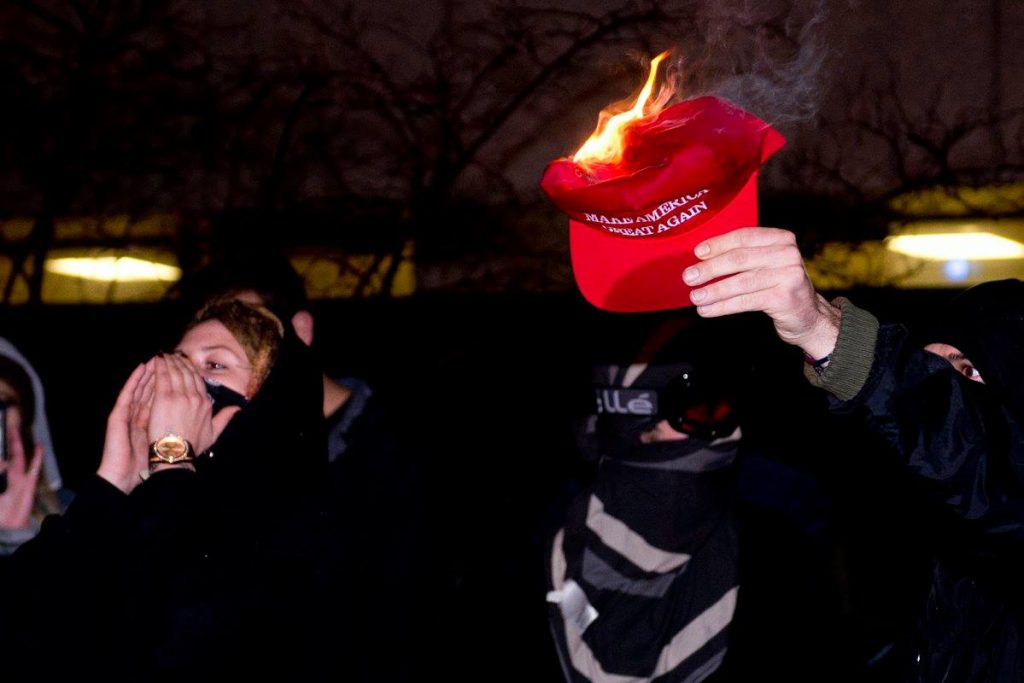
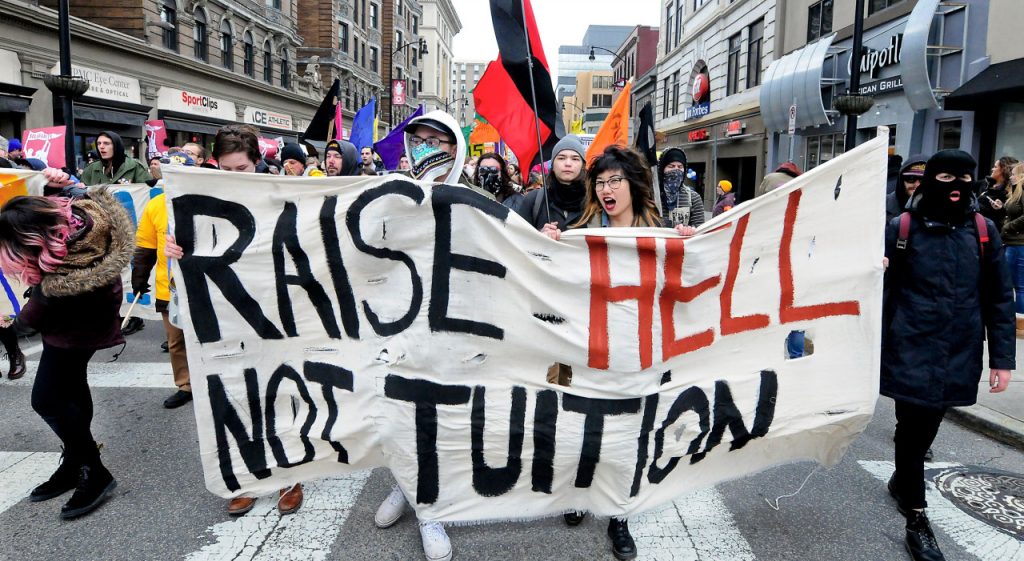 Photo: Our generation’s first autonomous student bloc at Pitt