Statement received on 1/25/18
Stay tuned for updates & replies to right-wing statements.
Trigger warning for racism, xenophobia, anti-semitism, r*pe jokes, csa, and more.
It should come as no surprise that racism, xenophobia, anti-semitism, and other hateful ideologies have been festering at this colonist institution since its inception. However, in the past year, coinciding with the election of Donald Trump, these ideologies have been on greater display in our campus community. We’ve seenfascist postings all over, cops protecting anti-immigrant speakers hosted by racist student groups rather than undocumented students, arrests of nonviolent protesters, swastikas drawn on car windows in the snow, and countless more instances of fascist organizing on this campus. Many of these instances are anonymous or function with the backing of armed agents of the State (paid with our tuition dollars) to do their dirty work. It hasn’t been until now that we can put names and faces to some of the sources of hate at the University of Pittsburgh. In the past few weeks our collective of anti-racist, anti-fascist friends and organizers have been compiling various screen shots and other evidence that ties members of the Pitt College Republicans and alt-right publication Polis Media to disturbing memes, jokes, and genocide apologia as well as r*pe joke including ones targeting some of the most vulnerable members of society – children and incarcerated persons.
Update: An editor at Polis Media has taken down the website and all related accounts in an attempt to keep his name clean. We see you Sam Bleifer, AKA Bleifbart from The Unsafe Place.
Update 1/26 – Second Statement Received from @PittRacists
A lot has happened in the past 48 hours since the @pittracists page went up. Our proudest accomplishment was that Polis Media (formerly The Unsafe Place) has wiped itself entirely from the internet. Their Facebook, Twitter, and website all seem to have disappeared. Apparently the founder & former editor in chief Sam Bleifer, covering his own ass, took it into his own hands to erase his racist right wing publication from existence. Good riddance!
Before they could delete their posts we did get some screen shots of their bullshit statements. They accused us of being “radicals” & “extremists” for making public their own posts. Interestingly, editor in chief Arnaud Armstrong also said that he expects more screenshots to come forward so presumably he knows of more instances of his friends (and those he platformed at Polis) sharing neo-nazi propaganda.
We also got a response from the Pitt College Republicans. They claim that they were made aware of this screenshots “earlier this year.” The e-board of CR saw these screenshots last September and at least one of their officers (Devon Valinsky) was a member of the original groupme where the racist images were shared.
They also referred to the people called out on our account as “former members” when their last post on Facebook showed a picture of a meeting within the past week that featured both Kirk Briner and Devon Valinsky. They claim they were “reprimanded immediately” and have been “formally removed” from membership. However, they’ve know about these screenshots for months and have still been allowed at meetings and events. So the College Republicans must be referring to removing them immediately after they were publicly caught sharing racist propaganda, not after actually doing it.
They go on to whine about “violent leftists” and other antifascists. They reference anarchists threatening “local conservatives” with AK-47s. We agree that was nice to see some honesty out of the College Republicans for once as they are admitting that they consider Identity Evropa, a literal neo-nazi white supremacist organization founded by violent racist Nathan Damigo, a part of their category of “local conservatives” that advance “conservative values” like they do.
[PCR and Polis Statements can be read below]
specifically those who associate with the Pitt College Republicans & alt-right publication Polis Media have been involved in various secret groups where they share genocide apologia & other racist “jokes”
Julia wants to grow up to be a federal judge, presumably to lord power over people of color. Poor Julia, I hope this stuff never gets out! pic.twitter.com/a7ioBF0Y2I
First is from Arnaud Armstrong, former college republican, editor in chief of (the now deleted?) Polis Media, was in the groupme where racist messages were shared: pic.twitter.com/9ar6RKhYNg
the best part of this shit is that they are “expecting more to come forward” like how much Nazi shit have yinz been posting damn?? https://t.co/hme1JxTb0L
You do kind of have to wonder why so many pitt college republicans & their ilk have felt the need to block the @pittracists account… pic.twitter.com/zbnKSvlQQ2
Gotta love how they refer to Ident*ty Evr*pa – a literal neonazi group – as "local conservatives" in reference to this photo pic.twitter.com/rKCzMLmwyP
Here he is responding, “stop anon I can only get so erect” to a picture of the Pennsylvania flag mixed with the Nazi party flag that is captioned, “SOON.” pic.twitter.com/xTDJenHIfh
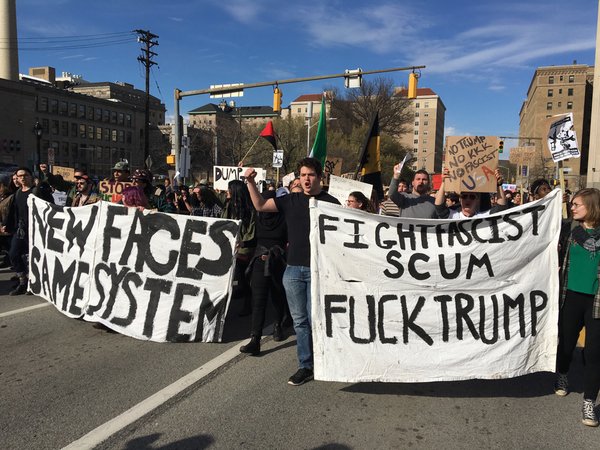
On April 13th Pittsburgh anarchists participated in an attack on a Donald Trump campaign rally. This is a message from some of the organizers of this anarchist contingent as well as thoughts on our current situation.
On April 11th, the Trump campaign announced plans for two events on the same day in different neighborhoods of Pittsburgh. Earlier in the day he would participate in a “town hall” with Sean Hannity in Oakland, a college neighborhood, and in the evening would hold a large campaign rally in the downtown area. Almost immediately, different factions of the Left issued calls for actions and began planning demonstrations. Shortly thereafter came the all-too-common threats from the Right of armed confrontation with demonstrators.
Actions against Trump’s Oakland event were called for by various student activist groups on the University of Pittsburgh campus as well as by WHAT’S UP?!, a local anti-racism group. ANSWER, a front group for the Pittsburgh chapter of Party for Socialism and Liberation, issued a call for a rally and march to Trump’s main campaign event in downtown.
Anarchists and autonomous anti-fascists knew from the very beginning that our goal was full disruption and confrontation with both Trump and his supporters. We felt that established organizations such as WHAT’S UP?! and ANSWER would both work to disrupt this goal in favor of their own visions of what a successful anti-racist action should look like. We chose to organize our own contingent so as to maximize our autonomy and control of our actions and desires.
Actions against Trump’s events began in the early afternoon in different parts of the city, but for the purposes of this piece we will focus on the events surrounding his main campaign rally in the downtown area of Pittsburgh. We choose this focus because it was here that the main energies of anti-authoritarian organizing were placed, and also because we feel that it offers a road map for the fight against the white supremacist Right.
The main gathering of anarchists was a few blocks from Trump’s event and was timed to coincide with the arrival of other marches from different parts of the city. We weren’t aware of other groups’ intentions, numbers, or desired level of disruption, but we thought that our best bet was to time our march to meet the other crowds after they had already arrived at the convention center. This would allow us to bring a surge of our energy and numbers while at the same time pushing forward with our momentum into the crowd of Trump supporters to achieve our primary goal of confrontation.
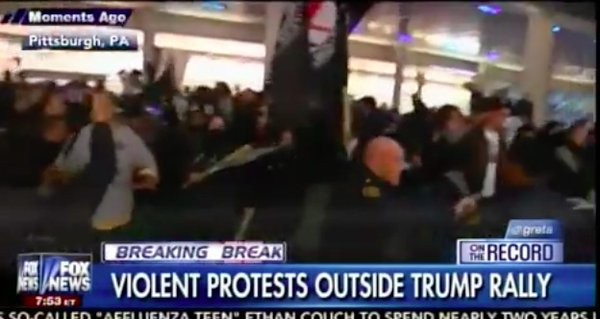
We were successful with this tactic. Our contingent came prepared with a dozen black and Anti-Fascist Action flags on strong poles and a large black banner. As we arrived at the convention center, we marched and pushed straight through a crowd of Trump supporters, knocked aside barricades, and pushed to the main entrance of the building. Many other demonstrators had already made it that far and were blocking the roads; others followed us through the hole in the crowd we created. Once our contingent arrived at the entrance, immediate physical confrontations erupted as we marched directly into the line going into the building. Trump supporters were tackled, punched, and pepper sprayed as we attempted to fight our way inside.
During these fights the police moved in, made some seemingly random arrests of those not involved in the fighting and pepper spraying, and formed a line between us and the group of Trump supporters. People then lit flares and began to throw objects over the police into the line of supporters and repeatedly attempted to push through. At this point it was clear that the rally inside had already begun and the people we were fighting were those stuck outside, unable to get in.
After about an hour of this, Trump’s rally ended and attendees began to leave out of the exits. The crowd rushed the exits, following, screaming at, shoving, and pepper spraying people as they left. The exits were blocked and police inside the convention center redirected the supporters to doors out of our reach. Despite this, stragglers continued to find their way into our crowd and were heckled and attacked. The city and county police eventually donned riot gear and formed a line to clear the streets. Without any more arrests the crowds dispersed and the event ended.
Our Situation:
We see the rise of Donald Trump as a major aspect of the Right’s direct response to the Black Lives Matter movement, Barack Obama’s presidency, and what they see as an existential threat to white supremacy in this country. This reaction from the right wing has taken other forms, as we have seen with the armed Bundy Ranch standoff, the occupation of the Malheur National Wildlife Refuge, and the non-fatal shooting of demonstrators during an anti-police violence demonstration in Minneapolis by white nationalists.
According to The Atlantic, aside from the demographic markers of lower class membership, whiteness, and low education attainment, the main factor tying Trump’s base together is support for authoritarianism and white supremacy. The main policy points of Trump’s campaign have been rooted in the widespread criminalization, detention, and expulsion of Muslims, Arabs, latin@s, blacks, and other non-whites from the United States.
Support of Donald Trump and by extension these aims is enough to justify oneself as a target of anti-racist violence.
It is our belief that recent events have marked a shift in the political struggle of this country. More and more of the populace has fled mainstream political forces for “outsiders” seen as on the fringe, such as Trump and Bernie Sanders. We see a demarcation developing between the Left and the Right – between those who support corporate control of resources, the expulsion of non-Whites, and increased police militarization for urban pacification, and those who support individual autonomy, collective ownership of resources, and racial and socioeconomic justice. The inherent bilateral structure of the American political party system leaves us with bastardized social and political movements – the “Left” must abandon its Marxist tendencies to fit into a Democratic narrative, while the “Right” must attempt to fit its authoritarian Judeo-Christian white supremacist ideology into the Republican establishment.
As we saw inside Trump’s campaign event in Chicago, on the streets of Minneapolis, and in downtown Pittsburgh the other night, militant physical conflict between these two forces – between those who wish to maintain white supremacy, and those who wish to see its abolition, has come into the open and forefront of American political discourse. We see an opportunity here to forcefully attack both the dominant American political structures while at the same time fighting back the far-Right tendencies that we see with Donald Trump’s rise to political fame.
It is our hope that the threat posed by the white supremacist Right, as well as the exploitation of the opportunities that we speak of, can help our movements to more clearly place ourselves in the struggle for liberation. Militant self-defense from authoritarianism can help grant us the individual and collective autonomy necessary for any liberatory revolt to occur. We see this as a time for libertarian anti-capitalists to learn to take seriously the threat posed by the new Right and to take the steps necessary to forcefully fight the structures of white supremacy. This is not a time for the introspection and critical self-reflection of the popular anti-racist praxis, but a time for mutual self-defense and collective force against the American white supremacist system of apartheid.
The time has come to Burn the American Plantation.
– Your comrades from the hills and valleys of Pittsburgh, Pennsylvania.
Report back and perspective from an uncaptured participant of the Anti-Fascist contingent that confronted Trump supporters in Pittsburgh 04/13/16.
Western Pennsylvania has a split. There are those who seek a better existence for all. Dreamers, who see possibilities beyond the Giant Eagles, condo developments, politicians, the gossip of the nightly news on what black person did what. They saw a way out of the cyclical grip of unchallenged rhetoric, the pounding narratives that regularly kill people because of identity, religion, class, gender. Such deaths are often not seen as murder because the structural institution of white supremacy and capitalism have shielded them from contest with an intentionally despicable education system and apathetic, individualistic culture.
A pervasive discourse that makes exceptional the wealthy white man above all has plagued this region. To live in this land is to be ruled by this marker, to see ones self in contrast to this and make every opportunity to find validation and security alone. Class unconsciousness and racism make for an easily manageable population by politicians.
That is the provincial. The way out was to meet together.
As news that the evangelizing force that has been encouraging and emboldening Right-wing politics of white convenience, entitlement and supremacy across the nation was coming to town rang, rebels across this city held a necessity to act. Like Ferguson, St. Louis, New York, Anaheim and countless other cities accomplices were found in resistance to White Supremacy.
An anti-fascist contingent was manifested as a way of locating sanity, self-defense and autonomy. A quick boisterous march to David L. Lawrence Convention Center found a visceral repulsion to organized racism. Immediately upon reaching the line of attendees flag bats and impassioned energy met the domes of Make America Great Again (the slogan worn proudly on Trump hats). Fists hit those who love to see nothing less than walls put between our brothers and sisters. That particular sinister smirk and chuckle that is given by bullies who look down at others as meager and incapable were maced away with pepper spray. On and off for three hours white supremacists were beat as the celebratory roar of the crowed reverberated off the tunnels of the convention center.
Marching bands, colorful signs, chants of “No Trump, No KKK, No Fascist USA” tangoed with the black flags of anarchy to unleash a chaos some internet denizen would later characterize as “Feral, frothing, rabid and violent“. To me it was much more disciplined than that but still wild. Spit landed in the faces of one Trump supporter giving a Nazi Salute as others drowned him out with chants and protest placards.
The Secret Service was made to shut the doors to the event as attendees were turned away. Our movement proved capable of social self-defense. At the end of Trump’s speech the crowd exited, they were met with a gauntlet of trips and berating, more fights broke out, more police, more policing. Heated arguments cleared the air of what people really thought as civil unrest was realized.
The Trump crowd was judged by what its material actions were: attending a white supremacist rally. The only ethical response to this decision was confrontation, eviction, and to grant a denial, perhaps for the first time to those who have have the golden ticket – a wealthy white life.
The slave catchers (police) were also targeted in this attack and will continue to be as long as they continue to serve as an institutionalized oppressive force that seeks to uphold the current ruling order, lock people up, and deny free existence – which is to say as long as they are police. Each officer had a decision to make when they formed a line between the White Supremacists and the crowd of Anti-Fascists. It comes as no surprise that they chose to form and face off with rebels. They had a decision to make when they arrested three comrades. That is why they were maced and hit.
Negative actions like this are the lived act of being present with our capabilities. Pittsburghers like the rest of the planet have it within to bring closure to a traumatic era of racism, policing, class based society, slavery (in the modern form of prisons). An unknown freedom is made within this negation.
In short: Nobody has ever needed some man yellin and telling us what to do!
Past all the patriarchal call to arms of the right, the kitschy politicking of sensibility as a tool of suave leftism exists a structural reality that neither the right nor the left truly want to change; politics seek to manage our movements and life. To act with dignity and autonomy was to do what needed done. In particular some 4,500 jagoffs were dealt with.
This city is unexceptional in its white supremacy but unfuckingbelievable in its resistance.
In solidarity, love and rage,
uncontrollable /// ungovernable
One of many Pittsburgh Anti-Fascist
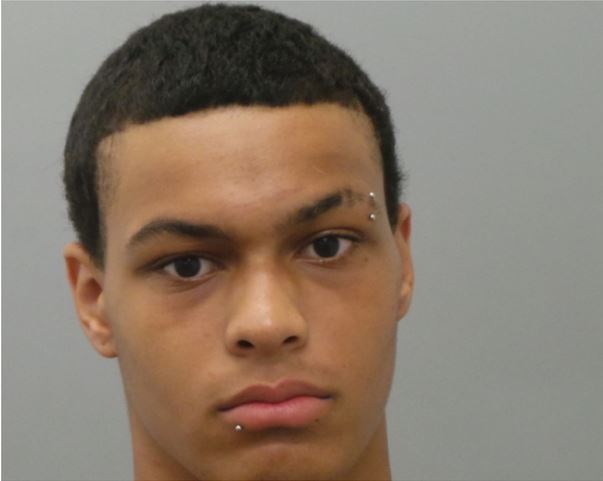
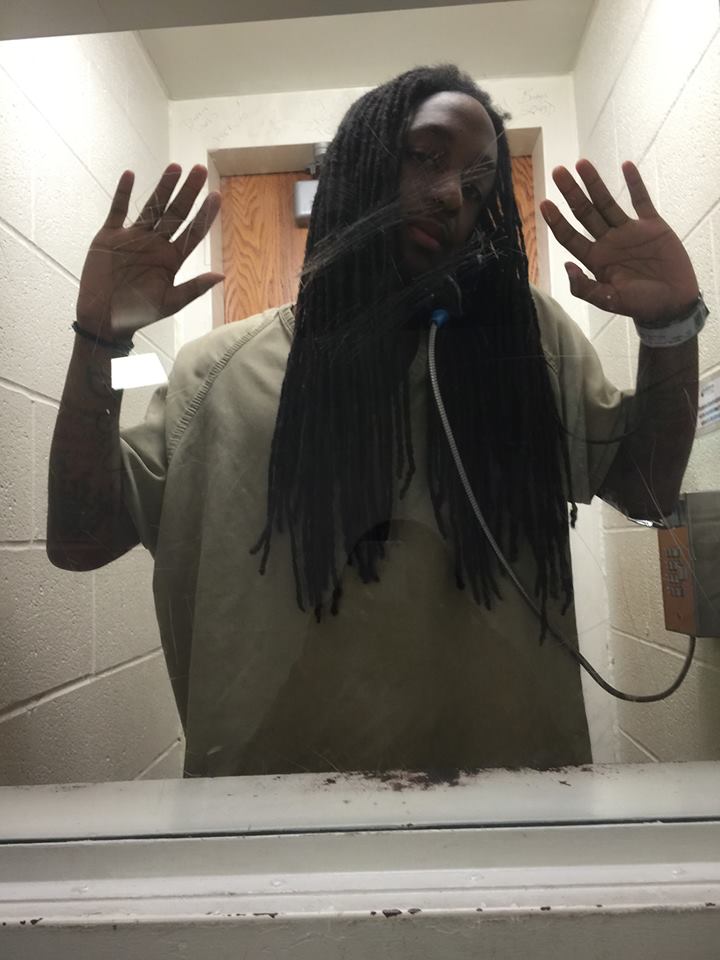
What follows is a list of people who were arrested and imprisoned during the Ferguson rebellions. Their charges, sentences, the particulars of their cases vary widely, as do their interpretations of the events in Ferguson and their participation or alleged participation in those events. We present the information below in hopes of linking up these prisoners with those on the outside who might be interested in writing to them or finding other ways of supporting them during their time in prison.
There is a fund to raise money for these prisoners as well as other Ferguson-related prisoners who did not want their information listed here but still deserve our support. This money will be used to send commissary to these folks during their incarceration.
Although everyone on this list has given permission for their information to be shared in this way, the presence of their information here in no way indicates that they hold any particular political viewpoint.
*Please note that some of these people are still pre-trial. If you wish to write to these folks, please see the note below. Addresses are subject to change for some of the people and there’s a potential that more people will be added to the list. If this happens, we will be sure to update the list.
Alexander Irwin #S16636 // Centralia Correctional Center, P.O. Box 7711, Centralia, IL 62801
*Please note that this person is pre-trial. Please write with care and see below for details.
Birthday: September 5th
Alexander Irwin is facing burglary charges associated with being accused of looting at the Dellwood Market during the riots in August, 2014. He is currently serving a sentence in Illinois on unrelated charges.
Steven Martin #2015017284 // St. Louis County Jail, P.O. Box 16060, Clayton, Missouri 63105
*Please note that this person is pre-trial. Please write with care and see below for details.
Birthday: September 22nd
Steve Martin is facing a second degree burglary charge, falsely accused of looting a Foot Locker on the night of August 10th, 2014.
Robert Stephenson #1140630 // MECC, 18701 Old Highway 66, Pacific, MO 63069
Birthday: October 31
Robert Stephenson was sentenced to 18 months for looting a Toys ‘R’ Us on the night of August 10th, 2014.
Jeffrey Williams #2015005627 // St. Louis County Jail, P.O. Box 16060, Clayton, Missouri 63105
*Please note that this person is pre-trial. Please write with care and see below for details.
Birthday: March 30th
Jeffrey Williams is accused of the shooting of two St. Louis County police officers during a protest outside the Ferguson Police Station on March 12, 2015.
Jermaine Parker #1185800 // MECC, 18701 Old Highway 66. Pacific, MO 63069
Birthday: October 15
Jermaine Parker was sentenced to 14 years for shooting a firearm out of a car in protest during the night of the November 24th in south St. Louis.
Dakota Moss #11400-025 // FCI Mendota. Federal Correctional Institution. P.O. Box 9. Mendota, CA, 93640
Birthday: July 17th
Dakota Moss was sentenced to 14 years for stealing guns for people to use during the non-indictment riots in November 2014.
Josh Williams #1292002 // E.R.D.C.C., 2727 Highway K. Bonne Terre, MO 63628
*Some of these people are pre-trial, which means that the legal outcome of their cases can still be strongly impacted by their actions as well as by ours. Please write to these people only with the utmost care.
Do not discuss any illegal activity or ask, comment on or speculate about the particulars of their cases or about any actions they may or may not have taken to lead to the accusations against them. Please do not send these prisoners any inflammatory political material or do anything else that may draw negative attention to them.
Our letters, engagement, relationship-building, words of encouragement and care are the best way we can express our solidarity for those who are pre-trial.
* * *
We saw ourselves among those who fought where they stood, the looters, the wild ones, the festive ones- opposite the shop-owners, cops, preachers, and activist and professional politicians who told us to calm down, go home, or pray. We recognize what went down in Ferguson was beautifully vast and can’t be codified into a historicized blurb. We’re just a small group trying to get the backs of people we connected with on the streets through a conversation, head nod, smile, or common fit of anger. We can’t forget those they took from us and from the fight; we can’t leave them isolated in the dust of the storms of yesterday.
Thank you for your invitation to those who wish to contribute to your discussion around the reprehensible Milo Yiannopoulos, free speech, and activism/organizing.
First I would like to congratulate you on your communiqué “Reality isn’t Safe”, the strength of which implies (I am far removed from Pittsburgh and Pitt currently) that the movement from which it arises is similarly strong.
However, I found the section “Our Position”, appearing at the end of the communiqué, distressing.
I urge you to consider pressuring the administration to ban rightist and fascist speakers from campus, or/and to stipulate that they must not be funded or offered campus space by the SGB.
Pushing for reform, for minimal or “liberal” demands necessitates pushing for maximal or “radical” demands. Forcing SGB to deny funds or a space to rightist figure-heads and sophists does not set a precedent for SGB to deny funds or space to leftists or anti-oppression groups. These funds and spaces are already closed to us.
The administration and the state already have the power to censor leftists as violent, or dangerous, or unreasonable, or etc. Look at the massive campaigns of censorship deployed against the BDS campaign, or the campaign of fear-mongering rightism against Pitt Students for a Democratic Society (my organization while I was a student at Pitt) in the early 2010s. [1][2] // [1][2][3]
That you say you would march with Pitt Republicans for “human liberty” and “free speech” is distressing. The problem is that Milo, like Trump, is precisely not controversial (you say “Should the liberals succeed in ‘reforming’ the SGB and administration in order to censor controversial speakers, we will march side by side with the Pitt College Republicans to defend free speech”), but is entirely normalized. You spend a fair amount of effort arguing against this idea of controversy, indeed against the very rightist, obscurantist idea of “free speech” and “the marketplace of ideas”, and then turn about-face to defend these ideas once the threat of governmental or administrative intervention in defense of safe spaces appears.
Leftists have nothing in common with libertarians, and decentralization is a trap. Capitalism is decentralized; the State is decentralized. See Bob Black’s “The Libertarian as Conservative” for more on this, and I am sure that the Invisible Committee and Tiqqun would be skeptical of such wholesale rejection of, i.e. turning a blind eye to, apparatuses of power.
Which is all to say: forcing the administration’s hand is not legitimizing its existence or power. The administration is already fully legitimized; it already dictates arbitrarily, which is to say, in a manner (over)determined by power relations, what is and is not “free speech”.
The community you wish to organize, bottom-up, does not exist. At least it exists only as a reflection, a reaction-formation to the “top-down” administration.
Reliance on institutional recourse is not what divides liberals from radicals; rather, a mis-perception of the central antagonism of society on the part of the liberals is what separates liberals from radicals.
The antagonism between the State and the Community is itself constitutive of society, of the community. Liberals privilege the spectral community, conservatives the spectral state, but both are reaction-formations to the central antagonism (hence the obscurantist conservative position that liberals want a form of state socialism). Leftists must not fall into the trap of either side. The result of this is Blanquism.
The Student Government Board at Pitt, if I remember correctly, came out of radical student struggles in the 20th century as a concession, a “pressure valve for would-be dissidents”, as you say. However, this characterization, on its own, minimizes the actual impact the SGB has on everyday life. It is not just a pressure valve; it is a positive formation, a method of distributing bodies, affects, labor. It is unimaginable, in the reign of the “marketplace of ideas”, that this distribution could be specifically anti-fascist. If the liberals succeed in making the SGB anti-fascist, even in this minimal way, they have achieved the impossible, and achieving the impossible is a radical, leftist goal.
I think, finally, that you will not lose your radical accolades if you sit at the table with the liberals, or if you add to your own tactics the so-called liberal tactics of pushing for administrative censorship. You can fight for egalitarian and radical redistributions of power on campus while simultaneously fighting to censor fascists.
As an aside: please never march with the right wing. Their free speech is not our free speech; their freedom is not our freedom; their society is not our society.
Thanks for your response to our statements published in Filler, which were written more for the active campus Left than they were for the general public (and consequently gloss over important details about Milo Yiannopoulos’s presentation at Pitt). Your response has provided an opportunity for an open and accessible dialogue that bridges the gaps between various social groups, and in that spirit we would like to extend an invitation to anyone who wants to participate in this discussion. PSSC will repost your letter, as well as any other letters that folks may contribute in the future.
Our response is broken into two parts:
1) Reality isn’t Safe The first section defines and contextualizes relevant terms and systems of oppression in an attempt to (1) make our discussion more accessible, (2) situate Milo’s claims within a broader political movement, and (3) clarify our positions. Concepts include: safe spaces and trigger warnings, hate speech, violence, rape culture, heteronormative patriarchy, white supremacy, legitimacy and social war.
We will respond to the specific requests and points of contention raised in your letter throughout this section.
2) The Divorce of Thought from Deed The second section aims to explore the concepts of free speech, debate, and censorship. We will also explain our actions within a larger vision for change.
Here’s the video for reference:
PSSC represents a small fraction of the protesters. We do not intend to speak to others’ experiences, nor do we intend to imply a universal understanding of the situation.
We begin from the notion that our identities shape our understanding of the world, and therefore the authors of this response would like to be transparent. We are queer and cisgender folks, poor and wealthy, neuro-atypical and neuro-typical. We are lower-class people of color attending school through our own hard work, as well as privileged white folks with financially and emotionally stable home lives. We are survivors of assault, intersectional feminists, sex workers, socialists, students, and anarchists. PSSC is a forum for communication and collaboration. We use it to coordinate larger efforts and work together because we believe that it will take a diversity of identities, perspectives, and tactics to dismantle the interlocking web of oppression we navigate. And yes, this is all relevant, partly in explaining the abrupt rhetorical shifts, but more pressingly in our treatment of the issues and concepts explored in both sections of this response.
Signed (in alphabetical order),
A. Sid, Amanda, Angel, Annie, Harriet, Marisa, Straw
Reality Isn’t Safe
No word or idea exists in a dictionary-definition vacuum. Everything from the things we say to the places we inhabit make up a broader system of relations, and therefore inherit a complicated social legacy. With this in mind, “Milogate” (awesome term, by the way) has to be examined within a socio-political framework that is grounded in both the contemporary political climate and the historical development of these social relations. Cool? Ok, on with it.
Safe Spaces, Trigger Warnings, Hate Speech and Violence As part of his “Dangerous Faggot Tour,” Milo Yiannopoulos came to Pitt to give a lecture billed as “Free Speech in Crisis.” Milo’s speech challenged what he views as an alarming tendency in the Left to censor offensive or controversial viewpoints, ostensibly under the guise of maintaining safe spaces, or through discouraging open discussion with demands for trigger warnings. Let’s unpack that.
Classroom safe spaces often include trigger warnings to warn students about difficult subjects. Trigger warnings can be likened to epilepsy warnings or food allergy warnings: if something might threaten your health, you would probably like to know beforehand so you can avoid it if you need to. Another example: if you have a friend who is a veteran of the War on Terror, you should probably give them a heads up if your weekend plans include going to a violent movie.*
Since there is a 50% chance that a survivor of sexual assault will develop PTSD, triggering post-traumatic stress cannot be equated to hurting someone’s feelings, as it elicits a physical reaction that threatens a survivor’s health. Contrary to the far-Right’s trolling, “triggering” isn’t synonymous with “offending.” Using the n-word to piss off the “PC police” will merely offend a white anti-racist, but it might trigger someone like the Pittsburgh man who was called racial slurs as he was savagely beaten by five white men, three of whom got off scot-free. Racist violence, including Klan activity (despite Milo’s claim that the Klan is irrelevant, and that Black Lives Matter is the modern equivalent), is pretty common in Pittsburgh.1, 2, 3, 4, 5, 6
Unlike some safe spaces, making classrooms safer does not mean prohibiting discussion of sensitive topics or silencing unpopular positions. All it means is that the harassment of students with marginalized identities will not be tolerated, perpetrators will not be allowed to attend the same classes as the people who survived their violence, and that discussions about difficult issues will prioritize the voices of people whose lives are directly shaped and impacted by these issues. The prioritization of these voices does not mean other voices cannot contribute to the discussion, or that any identity group is monolithic. Rather, it is an acknowledgement that within an educational environment, the honest way to open a discussion or debate is to first ground the conversation in the variety of experiences and opinions held by those most impacted.
For example, a student is free to argue that heteronormative patriarchy does not exist during a class discussion. However, if that student then goes on to make personal attacks and insinuate that other students are lying about their lived experiences of discrimination, assault, or harassment, then they will be asked to leave. Such offensive behavior is the real silencing, as it delegitimizes and intimidates already marginalized people.
Often times, if someone is taking up too much space in a discussion of a topic that does not influence their lived experience, they are asked to “check their privilege,” which in this context is shorthand for “this isn’t your daily life, you cannot speak to my experience.” Many conservative men think that privilege-checking is a way to silence a dissenting opinion, ignoring the fact that men talk about 2.5x more than women in class discussions, and that chances are they’re simply not accustomed to giving sufficient time and space for others to speak. But the point here is that there are ways to contradict an academic concept that don’t involve spewing platitudes in an attempt to trivialize someone’s experience: “well, actually rape culture is a myth because you shouldn’t take those jokes seriously,” or conflating threats of violence with mere offensive language: “Pfft, I’m not offended when Trump implies all Muslims hate America, just look at the statistics.” But more on that later.
Photo: Milo’s autograph on one of the autonomous flyers that was thrown in the air.
Not pictured: comprehension of the point.
At around 45:50, Milo elaborates on his argument against making classrooms safer spaces, offering two ridiculous alternatives with interesting historical legacies:
“Rather than creating so-called safe spaces… it might be better for people who have unfortunate things happen to them to take a year or two or more out of college.”
Instead of making classrooms a place where survivors don’t have to relive trauma in order to participate, Milo would rather have them either attend class anyway, or simply drop out. The first alternative is dangerous, as it means that in order to complete their education, survivors must continually put themselves in psychological and physical danger every time they attend class. Without safer classroom protocol, a survivor of assault can be harassed, called a liar, silenced, or forced to come into contact with a perpetrator. At this point in the lecture, several members of the audience called Milo out on the moral absurdity of his argument and walked out in protest.
Milo’s stance is nothing new. In fact, he is advocating a logic inherited from centuries of misogynist violence. Since the advent of higher education in the 1800s, women (especially women of color) seeking a higher education have faced institutional roadblocks and constant harassment and assault. These barriers did not magically disappear, but continue to this day. Around 1 out of every 4 to 5 women that attend school are assaulted, often coerced into silence through physical and psychological fear, subjected to defamation when they do speak out, and then left alone to choose between letting their grades slide after skipping out on unsafe classes on the one hand, or dropping out to avoid reliving trauma on the other.
Within this same minute or so timeframe of the lecture, Milo goes on to prove that survivors can and will be illegitimized and excluded from ostensibly academic environments. He calls advocates of safe spaces “the most mendacious and dishonest people on campus…” and even singles out actual survivors, like Anna Sulkowicz from Columbia University, as liars. Sulkowicz’s story received national attention when she carried her mattress around campus to protest the administration’s refusal to hold her rapist accountable. For people like Milo, survivors that speak out are probably just attention-seeking “crybabies,” putting themselves in the spotlight because they love alienating their friends and receiving death threats. Since Anna’s perpetrator was never convicted, she must be lying in order to push her agenda of fear and anxiety on women everywhere! Pay no mind to the Department of Justice statistics stating that between 93% and 97% of rapists are never convicted.
When we look at the historical application of discrimination and violence outside of some imaginary academic bubble, we see the real-world consequences that Milo aims to rationalize and perpetuate: many women internalize subservience in the classroom, survivors of all genders are routinely excluded from the university community, and those that speak out are decried as hysterical, entitled brats. But apparently 90% of lawmakers in this country are males because women aren’t interested in getting “practical” degrees, or something. We’ll explore rape culture and patriarchy in greater depth later on.
At 35:15, a man asks,
“Last night, Lady Gaga, who has made her fortune off of pandering to homosexuals and feminists… [stated] that one in five women will be raped on college campus, can you elaborate on how much bullshit that is, please?”
Milo attempts to debunk the sexual assault statistics by claiming that the Left has a “supply and demand problem with bigotry” and they “don’t have enough bigots to go around, so they have to create new ones… and so they widen the definition of sexual assault to include, you know, touching boobs or an unwanted kiss, I mean this is just normal human sexuality.” Milo then backs this claim by saying that anyone who supports these statistics, like President Obama, is deliberately lying.
This is a threat of violence. Milo is telling men in the audience that the definition of sexual assault is a liberal conspiracy, and that assault is just normal, expected human behavior. We’re sure you, Ilya, would claim this isn’t a threat, or misogynist, but merely “an argument.” Two of our friends left at this point in the lecture, collapsed into tears on the pavement outside, and were unable to move until a random passerby helped them to the nearest bench. They recognized the threat, and their stories are not unique. Our Post-Milo Solidarity event statement, which was republished in Filler, was written for them, not you.*
Later in the same harangue, at around 37:30, Milo claims that “there is no basis in science to suppose that gay people are born that way…” despite a plethora of evidence to the contrary. Of course, sexuality is partially situational, but the implication here is that heterosexuality is natural and that deviance is a choice. Absurd statements like these, even when coming from a gay man, attempt to render LGBTQ* identities illegitimate and serve only to rationalize the discrimination that folks continue to experience in employment and many other aspects of daily life. Being gay is not a lifestyle choice, and Milo’s assertion is hate speech.
Around 38:20, Milo is asked why he hates feminists. He explains that “feminists have bred an entire generation of women who have been told lies. They’ve been told they can look like… hideous, monstrous, fat, quivering, horror shows, and that they can still be happy. That’s a lie. No woman will be happy that way.” For Milo, feminism is bad because it might help “ugly” women be happy with themselves. This insinuation is harmful for all genders because it implies feminism only helps women, and only women that don’t adhere to society’s strict guidelines at that. Women looking and dressing how they please, and not how men want them to look, takes power away from men who would otherwise dictate what they should wear, what they should value, and how they should express their sexuality.
The closest thing to an actual argument Milo makes during this sexist diatribe is, “the greatest risk to happiness between the genders is feminism, which is why I rail against it, because it is evil and terrible, and though it had some great accomplishments in the past it is no longer necessary and concerns itself now with man-hating instead of equality.” Instead of citing contemporary feminist authors and public figures to prove that modern feminism is “evil,” he cites phrases that are used primarily for internet trolling, like “masculinity so fragile” and “kill all white men,” as examples of feminist man-hating. Just a few minutes later, and without a hint of irony, Milo praises speech that is offensive to those with power as being one of the major catalysts for change.
Milo’s transphobia is also quite obvious. In an article advocating dropping the “T” from LGBT, he uses multiple transphobic slurs (calling trans men and women “trannies”), claims that transfolk are predisposed to criminal activity, and backs his argument with choice lines like, “If you ask me, when a guy says he needs to cut part of himself off for the world to make sense, we should start with his head.” This is hate speech.
At 54:00, a brave student drops some knowledge about systemic racism and sexism. Milo responds with the same tired, racist platitudes that the right always clings to: “black on black crime,” “although blacks make up only 12% of the population, they make of over half of murderers,” and “Black Lives Matter is basically the KKK.”
Despite Milo’s acknowledgement that slavery was indeed very, very bad, and its legacy continues to this day (deep analysis, bro), these comments are racist as fuck. Milo is implying that the black community is disproportionately impacted by the criminal justice system because black people are predisposed to crime, because black people are more likely to be murderers. Gary Younge writes,
America is very segregated, and its criminality conforms to that fact. So the victims of most crimes are the same race as those who commit them. Eighty-four percent of white people who are killed every year are killed by white people. White people who buy illegal drugs are most likely to buy them from white people. Far from being extraordinary, the fact that black criminals are most likely to commit crimes against black people makes them just like everybody else. A more honest term than “black-on-black crime” would be, simply, ‘crime.’
In response to Bill O’Reilly’s similar attempt to link Black Lives Matter with the KKK, Chauncey Devega writes,
Indeed, the ascendant brand of “colorblind” racism that informs this thinking is predicated on the myth that all people and groups in the United States are equally racist. The end result of such thinking is a type of compromise-based politics built on white-washed myth making and empty claims to “diversity,” a cherrypicked reckoning of American history, past and present, that sanitizes the radicalism of the Civil Rights Movement—reducing it, more or less, to a selectively edited version of the “I Have a Dream” speech… the lie of “black racism” stands in the way of the goal of creating a more just and equitable society for all people.
Racism is a sin that is unique to White America. This is not because of arbitrary distinctions of skin color and melanin count, but rather because of the dynamics of inter-group power. And “Black people do it too” is a rhetorical trick that prevents Americans of good conscience from confronting the very specific ways that white privilege and white racism hurts, kills, and otherwise negatively impacts the life chances of black and brown people in the United States.
Ultimately, such distortions and lies are easily refuted:
The Ku Klux Klan was the largest domestic terrorist organization in American history. It is estimated that the KKK and the mass violence it either directly inspired or took part in killed at least 4,000 black people by lynchings, and perhaps as many as 50,000 by other types of white domestic terrorism. The reign of terror inspired and carried out by the KKK, along with other white paramilitaries, was so great that it compelled the great African-American migrations from the South to other parts of the United States—a move that involved at least 5 million people over several decades.
At the height of its power, the KKK controlled entire towns, states, and territories. It was also was one of the preeminent civil organizations and pathways to white “respectability” in the United States during the 19th and early to mid 20th centuries.
There is no equivalent organization in the history of the United States. And there is most certainly not a black or brown Ku Klux Klan in American history. Why not? The United States was founded as a white racial settler state. Its government from before the founding and through to the 20th century embraced white supremacy as the law of the land. No such arrangement of power would ever tolerate a black “terrorist” organization, much less one to match the scope and influence of the KKK. Moreover, those black and brown organizations that tried to resist white supremacy—even by non-violent means—were destroyed, and their leaders killed and imprisoned by the FBI’s COINTELPRO initiative and the broader United States national security apparatus.
It is possible that Milo did not mean these assertions to serve as generalizations of black people. This is irrelevant. Black people are not some monolithic entity, and to insist that a comment must insinuate a hatred of all black people in order to sufficiently qualify as racist is absurd. Many modern, self-identified racists don’t even say that kind of shit anymore. Racism today is subtle, cloaked in out-of-context MLK quotes and near-religious recitations of crime statistics. Besides, Milo’s made plenty of overtly racist comments in the past.1, 2 Oh yeah, and there was that time he teamed up with a literal white supremacist terrorist for a smear campaign against a black man.
At 12:36, Milo’s blatant hate speech against lesbians also serves an agenda. But first, here are some highlights:
“I don’t want women to be drawn into lesbianism, and that is of course how lesbianism works, women [have] a much more malleable sexuality than men do… your government spent $3 million dollars working out why you [lesbians] are all so fat… there’s of course the lesbian domestic violence epidemic, I wrote about in a column called “Attack of the Killer Dykes”… the only one respect in which there a serious culture of rape on campuses… it’s lesbians.”
Research from the National Sexual Violence Resource Center (NSVRC) confirms Milo’s claim that the LGBTQ* community is more likely to experience sexual assault, sexual harassment, physical assault and stalking than any other group. However, the study notes that this disturbing trend supports the theory that these higher rates represent “a violent attempt to oppress those who are challenging social norms around gender and sexuality.” This implies that the statistics cannot be blamed on “killer dykes,” and should rather be understood in the context of alarmingly frequent anti-LGBTQ* hate crimes. At 14:15, Milo claims straight men wouldn’t assault lesbians “given how they look.” This is the only evidence he offers to substantiate his claim that lesbians “are raping each other at rates similar to those in the Congo, where rape is a weapon of war”: lesbians are too ugly to be raped by straight men.
In reality, hate speech like Milo’s is spreading this violence against LBGTQ* folks: the homophobic notion that sexuality is a choice fuels the all-too-common perception that lesbians “just need to find the right man,” that they need to be “fucked straight,” and directly influences anti-LBGTQ* hate crimes.
We agree with Milo on at least one point: rape is a weapon of war. Heteronormative patriarchy and rape culture represent a constant threat and imposition of violence used to maintain power imbalances in our society. This is the “War on Women,” one of many frontlines in a broader social war; a war that is raging everywhere from Pitt’s campus to the gentrification of East Liberty, from the racist stop-and-frisk policing targeting neighborhoods like Homewood to the rising tuition rates and shitty wages; the same war that is being waged behind every “academic” “debate” at Pitt.
You write in your letter,
As you can see from the quotes, Milo, in his speech at Pitt, did not mock or otherwise disparage victims of sexual violence who are asking for safe spaces. He criticized the claim that safe spaces are the best way to deal with trauma, and he ridiculed the demand that safe spaces in college classrooms must be provided for sexual assault victims, for the reasons that 1) this has unintended and unfortunate political consequences and that 2) based on research, this does not seem to be the best way to handle trauma. The validity of the research he alludes to is irrelevant because very many things scientists claim turn out to be false anyway; what matters is that he bases his advice (advice, not command) on research, not on his disrespect toward sexual assault victims.
If you’re still not with me on this, here’s an (exaggerated) analogy: Mocking homeopathy as a cure for cancer, or opposing the demands of pro-homeopathy cancer patients that their insurance company cover homeopathy the same way it covers mainstream cancer treatment, does not in any way ridicule or disrespect cancer patients themselves or the harsh reality of their lives as cancer patients. And it also does not amount to telling people what cancer treatment to choose, but only to suggesting that, based on research, one way seems to be better than the other and does not have the unfortunate unintended consequences that the other has.
Does calling safe space advocates “the most mendacious and dishonest people on campus,” singling out specific survivors that want these kinds of spaces just to call them liars, and “advising” survivors to drop out somehow not qualify as mocking or disparaging?
If you’re still not with us on this, here’s an exaggerated analogy literally what happened: Milo is travelling from campus to campus, telling his supporters that sexual assault is normal human behavior, telling women their experiences of rape culture are fabrications, “advising” survivors of all genders to drop out rather than fight for a safe learning environment, bolstering the attitudes of the bigots in attendance, claiming women cannot be happy if they don’t meet patriarchal beauty standards, legitimizing the logic of hate (with the aid of university funding) under the guise of defending “free speech,” and building caricatures of the right-wing’s “enemy” in order to turn the social movements of oppressed peoples into scapegoats for the problems these movements aim to address in the first place. This is hate-mongering.
In your letter you state,
Here’s the definition from the American Bar Association: “Hate speech is speech that offends, threatens, or insults groups, based on race, color, religion, national origin, sexual orientation, disability, or other traits.” If you claim that Milo’s speech at Pitt (or parts of it) meets this definition, please provide direct quotes from his speech that do some of the 21 (because math) things that the definition specifies. I can think of only two instances that, to some people, might meet the definition: Milo’s off-color joke implying that lesbians aren’t sexually attractive enough for straight men to rape them, and claiming that there’s no basis in science to believe that gay people are born gay. If that is the extent of his hate speech, please say so (plus it would be quite nice of you to comment on whether that alone justifies your outrage, feeling unsafe, etc.)
When Milo says people within the LGBTQ* community are acting out a “lifestyle choice,” distorts statistics in order to justify calling lesbians “ugly” “killer dykes,” uses slurs and graphically violent rhetoric in reference to transgender men and women, claims that the Black Lives Matter movement is the modern KKK, and relies on grossly inaccurate generalizations about marginalized identity groups in order to discredit their liberation struggles, this is hate speech for all of the reasons we have already discussed in this letter.
You write,
Suppose a few other white people and I find ourselves in a Pitt classroom full of black people engaged in an academic discussion of U.S. race relations, and afterwards we feel physically unsafe, fearful, and anxious. We’re not making it up, we really really feel it. And if we tell the administration or the press about feeling physically unsafe, fearful, and anxious, should our experiences really be taken at face value and given the same weight as objective evidence? Or should we be outed as implicit racists, educated on race and race relations, and be told that we had no reason to feel physically unsafe, fearful, or anxious? You be the judge.
Here’s a more relevant example: Suppose a few other men and I go to a talk given by a female feminist to a mostly female audience at Pitt, and afterwards we genuinely feel physically unsafe, fearful, and anxious. (We’re not making it up! How dare you accuse us of exaggerating?!) If we tell the administration or the press or anyone else about our distressing experiences at the event, should our experiences really be taken at face value and given the same weight as objective evidence? Or should someone tell us that we misunderstand feminism, that the speaker actually never threatened us or condoned violence against us or any other men, that we misinterpreted and twisted the speaker’s words into something threatening—in short, that our fear and anxiety are unreasonable? You be the judge.
Ok, close your eyes and imagine that fear and anxiety in your hypothetical classroom: the worry that no one will believe you, that there is nothing you can do to prove the threat of violence you know is real. But wait! Maybe you can try to explain how the layout of the classroom stifles your ability to participate on equal footing, cite hundreds of studies to substantiate your claims, and then trace the lineage of your situation throughout hundreds of years of systemic oppression. People might change their minds! But then it hits you: even if you bring these points up, you don’t have the same capacity as everyone else to participate in the class discussion. Besides, suppose you did get the chance to debate anyone on equal footing, mere words won’t change the layout of the classroom. You’re probably just better off hoping that someone slips up and says some shit like “shut up, whitey” or “kill all men”…
…and now picture that as every day of your fucking life.
While your letter was presumably well-intentioned, we’d like to briefly walk you through the world of anxiety and violence that exists outside of your privileged, ignorant bubble.
Rape Culture, Heteronormative Patriarchy, White Supremacy, and “Legitimacy” In response to our statement, “The reality of campus rape culture is not an opinion, it is daily violence experienced by 1 in 5 of our female classmates,” you wrote:
“You’re right, it’s not an opinion—it’s an argument. It’s the argument that rape culture, “an environment in which rape is prevalent and in which sexual violence against women is normalized and excused in the media and popular culture,” exists on campuses. Agreeing with an argument doesn’t make it a fact.”
Judging from this paragraph, we’re wondering if you agree with Milo that that the statistics are overblown and inaccurate because of a liberal conspiracy to demonize men and criminalize “normal human sexuality,” and that public discourse does not influence social reality (59:00). Rape culture is an “argument” in the same way it’s an “argument” that women of color were routinely assaulted during the Jim Crow era, were unable to report their assaults out of fear of the police and retaliation, and were often times brutalized and murdered if they tried to hold their attackers accountable.1, 2 We don’t “agree” with an argument, we live through rape culture as a part of our daily lives.
A group of survivors called Order of the White Feather compiled some numbers:
1 in 3 (33%) women are survivors of sexual violence or intimate partner violence. (WHO) This figure is actually low when encompassing all forms of sexual violence, including physical sexual harassment and, what many would consider, innocuous assault, like having your ass slapped, bra-strap snapped, or “copping a feel,” especially during adolescence. Those things do fall on the sexual assault spectrum, and they are traumatizing to varying degrees depending on the situation and individual. Bottom line, they are unwanted, nonconsensual sexual contact. The 1 in 3 I often quote, then, is quite low, as I have yet to meet a woman who hasn’t experienced some kind of groping in her life.1 in 6 women are victims of rape or attempted rape at some point in their lives. For the most current rape statistics, read these: RAINN Statistics & Rape Trauma Services Statistics, also read more on The Rape Spectrum
1 in 6 (17%) men are victims of sexual violence. Similar to above. The figure most often seen when calculating the number of men sexually abused or assaulted in their lifetime. (Source in Canada) (Source in US and Canada)
600 people are raped every day in the USA, one every two minutes. (RAINN)
1 in 3 (30-35%) of men would rape if they knew they’d get away with it. (Source. Plus, second source 11 years later showing the same percentage: Kilpatrick)
1 in 6 or 7 (14-16%) reported cases will ever see the inside of a courtroom. This was a figure given to me by my own sexual assault attorney back in 2012. I took his word for it, especially after all the research I did coupled with my own experience with the police, as well as experiences like this.
1 in 16 (6.5%) men are rapists. 2002 Lisak study, although other studies show as high as nearly 15%, or 1 in 7 men.
Only 27% whose assault met the legal definition of rape consider themselves rape victims, so great is the minimization and normalization of sexual assault in our society. (Source)
Only 40% of rapes are reported to the police. (RAINN)
Between 65% and 85% of rapes are perpetrated by someone the victim knows. (Source)
91% of victims of rape/sexual assault are female and 9% are male. (Source)
97% of rapists will never spend even a single day in jail. (RAINN)
98% of reported rapes are true, only 2% are false, which is lower than false reports in every other type of crime. In fact, the 2% is a little high. The actual statistic is 1.5%, and I’ve seen it stated as low as 0.7%, which in my experience is the most accurate. The FBI quotes 8% false, but read this article to see why I choose the lower percentage. Since cries of “false accusation!” are the greatest of The Great Derailers, please read a more comprehensive explanation on my Derailers: False Accusations
Probably the most comprehensive, sobering, and well-known studies are David Lisak’s findings, which is the basis for the excellent Yes Means Yes post “Meet the Predators,” and the recent United Nations study on the roots of sexual violence spanning six countries and two years. This latter study shows, worldwide, a whopping 25% of men (1 in 4) had raped someone in their lives. 1 in 10 (10%) had raped someone who wasn’t their partner.
Some more: A study by the American Association of University Women found that more than 70 percent of LGBT students encounter sexual harassment at college from fellow students, faculty members and campus employees.
A 2009 investigation by the Center for Public Integrity found that some schools had designed their victim assistance systems in ways that led to nearly every report being designated as “confidential,” keeping official tallies of campus sex offenses low. Past legislation, including the 2013 Campus SaVE Act, has attempted to fix the Clery Act by expanding the range of sexual-violence incidents that must be reported to include domestic violence, dating violence, and stalking. But the legislation did not clarify the requirements that right now allow most sexual-assault reports to fly under the public radar. For now, self-reported (and imperfect) data in campus climate surveys like the one produced by the AAU is the only way for anyone outside university administration to examine the number of sexual-assault reports that schools receive.1
In your letter you state,
“Theft is much more prevalent on campuses than rape, yet we don’t hear claims that there is a campus theft culture, or that challenging such claims amounts to theft apologia or theft denialism, or saying that having precious things stolen is no big deal.”
This is an inherent part of rape culture. The existence of rape culture in this country and on campuses nationwide is due to the normalization of rape, as well as victim blaming and denial of rape by some persons in authoritative positions. Downplaying the criminality of robbery, victim blaming people who have been robbed, and normalizing thievery as just a part of daily life are not common responses to theft crimes, which is why there is no “theft culture.” People do not question the validity of theft claims as they do with rape. In fact, 98% of reported rapes are true, only 2% are false, which is lower than false reports in every other type of crime.The aforementioned are reasons behind the existence of a culture of rape versus just the acknowledgement of rape on campuses, as well as other crimes including theft. In addition, cases of reported rape on the Pitt campus have been doubling since 2012, exceeding robbery rates. Cases of burglary have decreased, while cases of rape, as I mentioned, continue to increase. This does not take into account that sexual assault is one of the most underreported crimes, with 68% nationwide still being left unreported.
At 6:22, Milo says, “you’re not supposed to clap anymore, it might trigger survivors of domestic violence.” Many in the audience applaud, point, and laugh at women that are crying, intentionally trying to trigger survivors. At 28:57, a white man in the audience holds a sign that reads “fuck your safe space”. We already discussed Milo’s insistence that many forms of assault qualify as normal behavior. This is what rape culture looks like. You can read more about the cultural elements here. Although these are more difficult to quantify, our experiences of this culture are legitimate, regardless of any white boy’s whining about the “subjectivity” of harassment.
Here’s a short video that can help contextualize the cultural aspects:
Dictionary.com calls patriarchy “a social system in which power is held by men, through cultural norms and customs that favor men and withhold opportunity from women.” The top definition from Urban Dictionary (and a reflection of our culture) reads, “A term used by feminists, to blame men for all their problems.”
A trailer for a doc about how patriarchy hurts men too:
[youtube https://www.youtube.com/watch?v=hc45-ptHMxo&w=560&h=315]
Black Lives Matter is a liberation struggle. The school-to-prison pipeline, the New Jim Crow of the prison-industrial complex and War on Drugs, the State-sponsored murder of black and brown youth across the country, and the continuation of racialized poverty and segregation constitute a system of racial oppression. These topics and more are worth researching, but you can read a short summary here.
At a certain point, the argument is over. For the survivors and allies that disrupted the event, there is no debate to be had. Rape culture is a lived experience for many women on campus. Patriarchy and white supremacy are as real as the nearly all-white, all-male United States government.
So let us be clear on at least one point: rape culture, heteronormative patriarchy, and white supremacy are not “ideas” that can be peaceably debated in a bubble on campus. They are a pre-existing reality, maintained through violence every day in this country. The sooner we realize this, the sooner we can dismantle the social hierarchies that haunt this country.
Social War
War is the continuation of politics by other means. – Carl von Clausewitz
Nah, fam, fuck that. Politics is war continued by other means. – Michel Foucault
(This section has a TL;DR at the end!)
If we’re to give Milo’s speech an honest “radical” treatment, we need to situate his ideas, and Milogate, within the broader social war. Social war is more than just the varying points of conflict between oppressors and the oppressed. It is social because it is built into the fabric of contemporary society. America today is an amalgamation of the power relations that rebrand and reproduce the same disparities that the old society was built on: slavery becomes Jim Crow becomes the prison-industrial complex–white supremacy survives; manifest destiny becomes imperialism becomes the Cold War becomes the War on Terror and Drugs–economic growth remains inseparable from perpetual war. It is social because there is no political solution to be found.
The way radicals see it, “politics” is the negotiation of power that administers government, and is by no means a process of progressing society towards peace, freedom, or equality. Politics is simply the forum that determines the degree of force that the government will use to reproduce existing power relations. Government is the project of finding new ways to rationalize a hierarchical society divided along lines of race, class, gender, sexuality, and a thousand other social constructs in order to prevent these tensions from reaching a boiling point. It is no coincidence that, despite all our “progress,” we really just outsourced the most visible forms of exploitation to sweatshops overseas, to ghettos beneath the freeway, and to the forced-labor of prisoners and immigrants–all in exchange for the luxury of watching helplessly from behind our iPhones as 1% of the population facilitates the destruction of the earth.
This election season, two candidates are emerging from the political “extremes,” siphoning both sides’ anger over the current power arrangement right back into the political process. The elections will determine which side will be favored in the new government’s policy compromises. Enter, stage right: Donald Trump.
Trump is rallying the far-right elements of the Republican Party against PC culture, immigration, Islamist terrorism, Black Lives Matter, globalism, and the spectre of creeping socialism. Weeks after Trump kicked off his campaign by falsely alleging that Mexican migrants are criminals and rapists, two brothers in Boston beat a 58-year-old houseless Mexican national with a metal pole, pissing on his limp body when they were done. “Donald Trump was right,” they explained to the police, “all these illegals need to be deported.”
Instead of condemning that brutality, Trump excused it by saying “people who are following me are very passionate. They love this country and they want this country to be great again.” But the problem is less about Trump, and more about the ideological mobilization that has put him in the position to legitimize, and thus encourage, such overtly racist, violent, and proto-fascist tendencies.1, 2, 3, 4, 5, 6, 7, 8, 9, 10, 11, 12, 13, 14, 15, 16
Trump is not acting outside of the ideology and practice of the liberal establishment. With every headline scandalizing his latest xenophobic comment, the Obama administration launches another series of deportation raids. After every Republican’s warmongering, Washington expands the scope of the surveillance state. But Trump’s best contribution to the liberal establishment is probably making the Democrats look legit in comparison.
The real threat is the political realignment Trump is helping set into motion. Everyone from celebrities like Ann Coulter and Mike Tyson to the former leader of the KKK and a white supremacist super PAC from New Hampshire have endorsed Trump’s campaign. He represents a nationalist, youth-driven, anti-establishment reactionary force to be reckoned with. Milo Yiannopoulos is a Trump supporter, and so was a large contingent of the crowd in attendance, as demonstrated by the “Trump” chants and the impressive collection of Trump merch at the event.
That tangent in your letter about the word “crowd” as it was used in our original statement was unnecessary. Of course Trump-bros didn’t make up the entire audience. There were around 30 protestors alone, which clearly indicates the diversity of the audience as a whole. That doesn’t change the fact that Milo legitimized the completely immoral behavior of the crowd of Trump-bros that was present. When would it ever be ok to applaud, laugh, and point at survivors of assault in an effort to intentionally trigger them? Milo is most definitely a magnet for this kind of right-winger, as he himself is a part of Trump’s electoral movement.
The hate crimes incited by the speech of those within this new movement are well-documented. For example, to insist that there is some artificial separation between Trump’s transphobia, the transphobia of Trump’s supporters, Milo’s anti-trans article with the line about decapitating trans folx, and last year’s 13% increase in anti-trans violence (which brought anti-trans hate crimes to an all-time high) is completely ignorant of the ways in which hate and violence spread within a culture.
As we all learned as kids, ideas lead to words, which lead to actions. As Trump spits out hatred against marginalized groups, many members of minority communities are beginning to fear or actually experience upticks in identity based violence [1][2][3]. Again, to call this increase in hate crimes a coincidence is to continue to put up blinders to the reality of social war.
Foreign leaders have called America a nation that prefers evolution to revolution. This mindset of expecting slow “progress” makes it hard for many Americans to believe that this country could ever change dramatically, or that a demagogic leader could ever embolden a proto-fascist national movement. If you don’t believe that life in America can become radically worse, very quickly, fine. Perhaps this country hasn’t changed, perhaps Trump has just brought America’s intrinsic colonialism closer to the surface.
In recognizing the historical roots of today’s social war within the ongoing white-settler colonial project, we understand that there is no peace.
The basic idea is straightforward enough. Real peace cannot be imposed; it can only emerge as a consequence of the resolution of conflict. Hence the classic chant: no justice, no peace.
Left to itself, a state of imbalance tends to return to equilibrium. To maintain imbalances, you have to introduce force into the situation. The greater the disparities, the more force it takes to preserve them. This is as true in society as it is in physics.
That means you can’t have rich people and poor people without police to impose that unequal relation to resources. You can’t have whiteness, which inflects and stabilizes that class divide, without a vast infrastructure of racist courts and prisons. You can’t keep two and a half million people—nearly a million of them black men—behind bars without the constant exertion of potentially lethal violence. You can’t enforce the laws that protect the wealth of good liberals like Governor Nixon without officers like Darren Wilson killing black men by the hundred.
The militarization of the police is not an aberration—it is the necessary condition of a society based on hierarchy and domination. It is not just the police that have been militarized, but our entire way of life. Anyone who does not see this is not living on the business end of the guns. These are the forces of peace and justice, the mechanisms that “keep the peace” in a dramatically imbalanced social order.
[…]
Let us not resent those who get out of hand for reminding us of the conflicts that remain unresolved in our society. On the contrary, we should be grateful. They are not disturbing the peace; they are simply bringing to light that there never was any peace, there never was any justice in the first place. At tremendous risk to themselves, they are giving us a gift: a chance to recognize the suffering around us and to rediscover our capacity to identify and sympathize with those who experience it.
For we can only experience tragedies such as the death of Michael Brown for what they are when we see other people responding to them as tragedies. Otherwise, unless the events touch us directly, we remain numb. If you want people to register an injustice, you have to react to it immediately, the way people did in Ferguson. You must not wait for some better moment, not plead with the authorities, not formulate a sound bite for some imagined audience representing public opinion. You must immediately proceed to action, showing that the situation is serious enough to warrant it.
It should be clear by now that the State and its police do not protect us. Nearly 25% of survivors don’t report their assault because they fear the police. This is especially true for those of us coming from the social margins. Often, survivors from marginalized groups only have their knowledge of their experience, and maybe their friends, to back up and validate the violence that was perpetrated against them.
The criminal justice system is not designed to hold perpetrators of assault accountable because it is largely incapable of conceiving of justice outside of the quantitative defense of property. We cannot look to the decisions of American courts to determine if a man sexually assaulted a woman, or if another white cop murdered another young black man, because theircourts and their laws are built on the same capitalist, white-supremacist patriarchy that perpetuates oppression in the first place.
Change will only come through building power on our own terms.
Social War, TL;DR The American political system functions to rebrand and preserve the inequalities that the State and economy are dependent on. In order to balance the opposing social forces that this inequality creates, the State recuperates dissent into the conventional political channels through the advertising campaigns of its two competing corporations. The conservative corporation pushes the State’s social interests, while the neoliberal corporation pushes its economic interests, and the elections result in a compromise that satisfies the moderates and (partially) pacifies the radicals in both factions. In times of unrest, the State will escalate the level of physical and economic force used to impose the social inequalities, sometimes sacrificing legitimacy of the electoral process. The unrest itself polarizes the general public, and populist movements from across the political spectrum will begin to creep into the mainstream discourse of both corporations. Should the State fail to entertain the populists of both camps, it risks creating space for radical autonomous action.
In this election season, the populists are Bernie Sanders and Donald Trump. Trump’s movement represents the potential for a right-wing political realignment that may develop its capacity to escalate autonomous action, should the State fail to adequately preserve white privilege and heteropatriarchy. Much of their speech represents a physical threat to us. We’re not exactly fans of them either. So instead of relying on administrative power to “represent” the interests of a static identity group’s self-appointed leaders (which is a practice of assimilating the “respectable” members of a group at the expense of the margins), we aim to build fluid communities through acts of resistance that are guided by the logic(s) of collective liberation.
The Divorce of Thought from Deed: On Free Speech, Debate, and Censorship
Today Western Imperialism is the imperialism of the relative, of the “It all depends on your point of view”; it’s the eye rolling or the wounded indignation at anyone who is stupid, primitive, or presumptuous enough to believe in something, to affirm anything at all. – The Coming Insurrection
Freedom of speech means no institution has the right to censor or restrict your right to express your beliefs. For the university, free speech operates within the discourse of a “marketplace of ideas,” the notion that all platforms and perspectives can compete freely and equally in a purely academic environment. Students can buy into the ideas they like, and either debate or ignore the ideas they disagree with.
Students at UNC Chapel Hill are skeptical of this marketplace, and they are worth quoting at length. If the following sounds familiar, it’s because one of the communiqués tossed in the air by autonomous protesters (unaffiliated with any organization) was adapted from a North Carolina “Piece” Corps publication, The Divorce of Thought from Deed, alongside a shout out to the UNControllables.
In “War by Other Means: A trip through the marketplace of ideas on UNC campus,” a student writes:
In a rare moment of accidental wisdom, the U.S. Supreme Court declared in 1967, “The college classroom, with it surrounding environs, is peculiarly the marketplace of ideas.” Perhaps no better phrase can be found to characterize the social malaise, passive nihilism, and active relativism with which ideas are “debated” on campus at UNC. Here, ideas are not so much exchanged as general commodities, per se, but more specifically bought and sold like gas station candy bars, with all the import, value, and meaning those entail. “You like Baby Ruths more than Snickers? Ok, ok, that’s fine, but why get so worked up about it? It’s only a candy bar!”
Every aspect of this marketplace allusion, or should I say, illusion, is implied in the economic analogy: an isolation from the real physical world of violently conflicting social forces, a consequent lack of moral or ethical urgency, a pretense of equality in the mass media distribution of and financial investment in the ideas themselves, and an ahistorical understanding of the social position which the ideas in question have been assigned to…
An exchange of ideas which occurs with no underlying threat that those ideas might become reality, with no possibility of action, is a meaningless exchange…
Specifically, YWC [Youth for Western Civilization] opponents understand that debates around what is and is not white supremacist do not occur in a bubble, but in a society whose entire economic and political machinery was built upon and is maintained by racial hierarchies. Any debate around race takes place somewhere in that hierarchy, which is a structure that is permanently maintained by violence.
This violence isn’t just rhetoric. If students were to talk to Northside neighbors about police harassment, or have some honest conversations with the day laborers Jones Ferry Rd. about the conditions that brought them to the US, this would all be readily apparent. The realities that force people to move here from the Global South, that cause people to take undervalued service work jobs on campus, are all conditioned by coercion and violence. To speak of the “free and equal exchange” of perspectives about immigration in a country where migrant workers die of pesticide exposure and families face deportation, where border walls partition the once-whole territories of indigenous people and private corporations run immigrant detention centers, is laughable. A debate where one side has the power to arrest, imprison, deport, or murder the other side is no debate at all. The “marketplace of ideas” model pretends to freeze these conflicts in order to conduct debate outside of real space and time, somehow removed from a physical world where the fate of migrants is not guided by ideas per se but actually by police, judges, racist vigilantes, bankers, authorities, wealth, power, interests.
Critics of the marketplace of ideas understand that in a country where nearly every textbook, every classroom, and every TV-screened political debate affirm the basic logic of capitalism and the State, the “free and equal exchange of ideas” is a hollow gesture. Given this larger context, most dialogue around “issues” is just a superficial repetition of foregone conclusions, based on the unexamined larger frameworks for understanding that we’ve already been given. This is what passes for “debate” in this society. It should be no surprise that its function is to keep things as they are.
What’s more, what is the point of debate if there is no sanctioned action to achieve the results of that debate? If every xenophobe was suddenly convinced of the barbarity of the Border, would the wall suddenly crumble? We would still find ourselves in a place where our only choices lie between the endless deliberations of useless politicians, on the one hand, and the direct action of our own social forces, on the other.
So this all raises the question: What happens when the debate is over? Do we act then? But what if our acting stifles further debate? Is that bad? When do we act?
The point of the “marketplace of ideas” is to ensure that the debate never ends, so that we never act. Debate only has meaning when we are prepared to act on our beliefs, to take risks beyond those of the classroom. This is why, despite the whining of Thorp and the Daily Tar Heel about the silencing of free speech, debate around issues of speech, immigration, and white supremacy was actually stronger after the events of past April. Debate has substance when it occurs in an honest context that reflects the daily, physical conflicts occurring inside and outside of the University. Discussion and critique must be imbued with the urgency of real life.
It would be interesting to ask what would have happened had anti-racists instead obeyed the expected rules for civil discourse. Tancredo’s speech could have proceeded uninterrupted, while he insulted immigrants and Hispanic culture generally, until eventually students would have gotten their chance to ask him some “hard questions.” He would have answered them politely, the students would feel a small nagging frustration, and everyone would go home peacefully to a world where immigrants are being incarcerated and deported, families separated, workers fired, and migrants killed. Surely little attention would have been paid to the event at all… Capitalizing on its new political legitimacy, the group might eventually have grown large enough to push policy changes at UNC, keeping undocumented students out of the classroom, making sure cops weren’t accountable for any racial profiling, among other things. All the while, the vast majority of UNC students could rest assured that there was nothing important enough to get worked up about…
Thankfully, this isn’t what happened. A tiny spark of excitement and tension was instead injected into campus life, along with the possibility of challenging not just a tiny racist student group but the larger framework of how we do politics.
From the autonomous communiqué:
Just last month in Pittsburgh, Janese Talton Jackson was shot to death for telling a man “no.” Is a woman really as free to express herself as a man, when even a simple “no” can get her killed?
Ideas alone have no intrinsic force. Our capacity to act on our beliefs, not just to express them, determines how much power we have. In this sense, the “free speech in crisis” slogan is strikingly apt: in America, you need capital (and often times some good ol’ white cis-male privilege) to participate, and the more capital you have, the greater your ability to enact the ideas you buy into.
Our Position Some of those opposed to Milo’s presence are organizing for institutional recourse. Their demands center around punitive action against the individuals responsible for inviting Milo, as well as the installment of new university guidelines that would prevent such a speaker from being invited to our campus again. Though we understand such desires and respect the value of a multiplicity of tactics, PSSC refuses to pursue these goals. Our rationale:
To deny our opponents the right to invite whatever speakers they please is to set a harmful precedent to be deployed against our own speech. As radicals, we realize the capacity of groups and individuals to say what they please cannot be contingent upon anyone else’s demands; whether that outside force be public opinion or institutional repression, using it as a bludgeon to silence debate is a violation of one of the most fundamental tenets of human liberty. We affirm the right of Pitt College Republicans to say what they want, and are merely exercising our individual and organizational strength in response. Our actions, perceived by the privileged as “censorship,” are in reality the true face of free speech freed from ideological constraint.
Reliance on institutional recourse is what divides liberals from radicals. Liberals believe that it is possible to reform institutions — whether schools or markets or governments — to serve the public interest. This well-intentioned faith falls apart upon examining the role of institutions throughout history in neutralizing grassroots movements. From the struggle for Black liberation to the LGBTQ* movement, government action has served for decades to defuse the tension brought about by mass movements while eliciting the bare minimum amount of change needed to suppress dissent. “Democracy,” as it functions in America, is little more than a pressure valve for would-be dissidents: blow off some steam by voting for edgy candidates like Trump or Bernie, and siphon alternative political organizing efforts into establishment electoral campaigns. As discussed in the UNC zine, the university is no different. Our role as radicals is to mobilize the community, for there is no institution on Earth capable of withstanding the weight of popular resistance. A top-down approach will not change the minds of our fellow students who think intentionally triggering survivors is acceptable under any circumstances. These pernicious attitudes can only be challenged through a community-oriented and community-organized approach.
We don’t recognize the State’s monopoly on granting and protecting basic rights, but we do acknowledge its history of taking them away. Should the liberals succeed in “reforming” the SGB and administration in order to censor controversial speakers, we will march side by side with the Pitt College Republicans to defend free speech. Besides, while radicals may have more in common with liberal views around social issues and policies regarding the public sector, we have far more in common with libertarians when it comes to our belief in decentralization, our commitment to our 1st and 2nd amendment rights, our resistance to the militarization of the police and government surveillance, our opposition to liberal trade agreements that outsource jobs and hurt local businesses, 420 blaze it, and especially our hatred of respectability politics and authority. It’s really a shame that so many libertarians are racist, misogynist jagoffs.
Like Milo, we believe that in order to be heard over all the noise and static of outrage culture, you have to be outrageous. That’s why we disrupted him. Our hatred for oppression, our intolerance of intolerance, compels us to act. We knew that this would be the largest far-right gathering on campus in recent memory. We chose to confront those that would treat oppression like something to joke about, to “debate,” to perpetuate. Talk is cheap. Direct action gets the goods.
Solidarity means mutual aid. We must support one another emotionally and materially. The safe space is a tactic in advancing the practice of mutual aid, as it is important for facilitating honest discussion, healing, reclaiming collective memory, and avoiding the bullshit that would derail productive organizing work. But mutual aid means we must also build on our capacity to defend ourselves against fascists and the State.
Solidarity means action. We must educate, agitate, and organize our peers and communities. But we must also diversify our movements, conspire with people from vastly different backgrounds than our own, and inspire action that’s worth telling our children about.
Solidarity means attack. The systems of oppression will not wither away by “raising awareness” about the issues or through gradual reform. Change will only come through disrupting the illusions of “civil debate” and “peace” that disguise the violence of everyday life, through blockading the flow of normalcy that reproduces the logic of the system, through occupying and repurposing capitalist infrastructure in order to win physical ground and organize a material force, and through dismantling the institutions of oppression with a diversity of tactics. We’re not so arrogant as to call ourselves revolutionaries, but we do believe in revolution.
We hope you pick a side and act it out. Pittsburgh Student Solidarity Coalition
*Endnotes:
[1] Angus Johnston, a history professor at the City University of New York, said that trigger warnings can be a part of “sound pedagogy,” noting that students encountering potentially triggering material are “coming to it as whole people with a wide range of experiences, and that the journey we’re going on together may at times be painful. It’s not coddling them to acknowledge that.” In February of 2014, students at the University of California, Santa Barbara, passed a resolution that urged professors among others to institute mandatory trigger warnings on class syllabi. Professors who present “content that may trigger the onset of symptoms of Post-Traumatic Stress Disorder” would be required to issue advance alerts and allow students to skip those classes. Mathias Weymar of the University of Greifswald in Germany, conducted a study to identify what happens in the brain when we unintentionally remember emotional moments to better help people who are depressed, suffer from PTSD, or otherwise have traumatic memories that create problems during everyday life. The study found that emotionally evocative cues trigger familiarity-based episodic retrieval even when the brain is not instructed to retrieve the memory. Episodic memory is the memory of events associated with specific times, places, and emotions.
[2] The Post-Milo Solidarity event was hosted to brainstorm ways to build community, not to “prove” the necessity of these efforts. This event helped advance our ongoing projects to compile a list safe-houses, to build a support network that folks can contact if they need help getting away from unsafe situations at parties, and to organize share fairs to distribute free food, clothing, tampons and other essentials to those who need them.
Some brave women took the lead in standing up to MRA Milo Yiannopoulos at Pitt.
TW: This jagoff literally got Trump bro’s to applaud in order to intentionally trigger survivors of assault, said campus rape culture doesn’t exist, spewed a ton of racist bullshit, and everything else you can imagine.
Several students left the assembly room in tears.
“2468 STOP THE VIOLENCE STOP THE RAPE”
“WE’RE HERE, WE’RE QUEER, WE’RE FEMINISTS AND WE’LL FUCK YOU UP”
We do not believe that Milo should be censored, or that the administration has any right to prevent a student group from hosting controversial speakers. That being said, the reality of campus rape culture is not an opinion, it is daily violence experienced by 1 in 5 of our female classmates. When Milo told a crowd of Trump-bros that rape culture isn’t real, they cheered. When he told them that applause would trigger survivors of assault, they clapped, pointed and laughed at women that were crying in the audience. We are not trying to change their minds, we know they will never admit to their roles in oppression. There is no “debate” to be had over and over again in some imaginary vacuum, racism and sexism must be confronted. If we do not confront bigots, we have no hope of stopping their violence. You cannot ignore hate-mongers because the violence they inspire will only spread. You cannot ignore large gatherings of racists and sexists because they will only continue to normalize their discourse and build their capacity to act. Trump’s new right-wing is part of a national movement that is growing in popularity regardless of the attention we give them. The varying types of disruptions taken on by autonomous students, Pitt Against Debt members, USASers and PSSC were not intended to silence an “opinion” but rather to let the bros in the audience know that the culture of violence they perpetuate will no longer be tolerated.
Milo doesn’t just piss us off or upset us, he is threatening people. We went there to show the racists, transphobes, rapists and sexists in attendance that they are not welcome on this campus. We will fight back, because some of our lives depend on it.
PSSC post-Milo solidarity event statement:
This past week the Pitt College Republicans Hosted speaker Milo Yiannopoulos at the University of Pittsburgh. As many of us know, Milo’s presentation was blatant hate speech that incited acts of violence against marginalized students and created general fear and anxiety amongst many members of the Pitt Student body.
Following this event, many Pitt students are wondering what to do next. How do we as students move forward after an evening of such hate and trauma?
Some students want to reform the school or the SGB to bar speakers like Milo from our University. This idea is a great way to stop inciting hate speech from reaching our campus. However, censorship is a slippery slope, and this plan of action fails to address the broader reasons for Milo’s presence at Pitt. We cannot myopically view Milo’s appearance as a result of SGB or administration oversight. Rather, we must understand Milo’s hate speech within its national, political context.
Milo’s speech is part of a nationwide movement of hatred, of threatening and murdering our brothers and sisters from marginalized and oppressed communities. It is no coincedence that students were chanting “TRUMP TRUMP TRUMP” as feminist protesters disrupted Milo’s event. Monday night highlighted a movement of hatred on our campus and in our nation that is bigger than one speaker or one student club. This is a national movement that condones misogyny, homophobia, racism, transmisogyny and xenophobia. This is a national movement that has called for it’s followers to carry out acts of violence against people from marginalized or otherwise oppositional communities. Thus, we must address Milo’s presence and form strategies of resistance based on the national context in which this event and its aftermath is occurring.
As we move forward as a student body, we need to take into account the contingency of students on our campus who are currently willing to terrorize students from marginalized and oppressed identities. What do we do as students when we see men harassing our sisters at a South O party this weekend? What do we do tomorrow when we see the police threatening our friends of color?
The administration and our SGB has given us wishy-washy answers promising that they are making changes but enusring us that change is slow to come. Unfortuantley, promises of change from our systems of governance are often more about PR and attracting prospective students than fundamentally addressing the issues that we as students have. Has anyone noticed a decrease in sexual assault since the It’s on Us campaign began? Has any trans student felt safer now that we have gender neuteral housing? The changes that the administration and SGB can offer us are important but they do not address the root reason for the hatred that is unleashed against marginalized students on this campus. The promises of “change will happen” does more to pacify us and to stop us from fighting for our needs than it does to fully address the problems we have.
With reform only going so far to address our concerns, we need to think of new ways to ensure that students on our campus are safe and able to express their identies. We must fundamentally change the way that we as students support one another. Our struggles are united in an effort to oppose the movement of hatred that Milo represents. In that regard, it is important that we stand with one another to support eachother, to provide for one another. We need to change the culture of our campus from one of apathetic disregard towards issues from marginalized students to active participation in ensuring that students from marginalized groups are respected and safe.
With this in mind, join us tomorrow night to discuss our needs and to discuss how we as students can provide for one another and empower eachother to stand in solidarity against hatred. Join us as we choose to stand in solidarity for love and care.
One of the flyers that was thrown in the air:
Communiqué distributed during the first autonomous disruption:
Ok, we get it. You disagree. Why didn’t you just ask some tough questions? Isn’t that a better use of your right to free speech?
The discourse of free speech in democracy presumes that no significant imbalances of power exist, and that the primary mechanism of change is rational discussion.
There can be no truly free speech except among equals—among parties who are not just equal before the law, but who have comparable access to resources and equal say in the world they share.
Just last month in Pittsburgh, Janese Talton Jackson was shot to death for telling a man “no.” Is a woman really as free to express herself as a man, when even a simple “no” can get her killed?
Ideas alone have no intrinsic force. Our capacity to act on our beliefs, not just to express them, determines how much power we have. In this sense, the “free speech in crisis” slogan is strikingly apt: in America, you need capital (and often times some good ol’ white cis-male privilege) to participate, and the more capital you have, the greater your ability to enact the ideas you buy into.
In a country where nearly every textbook, every classroom, and every TV-screened political debate affirm the logic of hetero-normative patriarchy, capitalism and the State, the “free and equal exchange of ideas” is a hollow gesture. Given this larger context, most dialogue around “the issues” is just a superficial repetition of foregone conclusions, based on the unexamined larger frameworks for understanding that we’ve already been given. This is what passes for “debate” in this society. It should be no surprise that its function is to keep things as they are.
What’s more, what is the point of debate if there is no sanctioned action to achieve the results of that debate? If every misogynist was suddenly convinced of the reality of sexism, would the Patriarchy suddenly crumble? We would still find ourselves in a place where our only choices lie between the endless deliberations of useless politicians, on the one hand, and the direct action of our own social forces, on the other.
So this all raises the question: What happens when the debate is over? Do we act then? But what if our acting stifles further debate? Is that bad? When do we act?
This action is in solidarity with the brave queer folx and women at Rutgers. You are an inspiration, and we send our love, rage and solidarity.
Shout out to the UNControllables at the University of North Carolina, we totally ripped off The Divorce of Thought from Deed for this communiqué.
Some Street Justice:
The Student Government Board held a forum for students to voice their concerns about the event, a blatant attempt to recuperate student anger within the conventional channels. Some reformist groups took the bait and are now attempting to force the administration and SGB to remove their neutrality clause and restrict the ability for student groups to book controversial speakers. Should they succeed, the admin will clearly use their new power to censor anarchist and other revolutionary speakers, not just hate-mongers. And it’s hard enough to secure any funding for the events that radicals book in the first place. However, the forum did at least embarrass the school and catalyze a wave of solidarity efforts.
At the forum, several Pitt Republicans mocked and photographed survivors of sexual assault as they courageously relived their trauma in front of a large crowd. In retaliation, an unknown number of hackers created fake facebook accounts for these assholes, editing their real photos as negatives and flipping them upside down, and posted their personal information online, including their home addresses and their parents’ phone numbers. The next day, flyers with the fascist assholes’ names, faces, and parents’ phone numbers were spotted around campus.
While we think this autonomous action is pretty badass, we’re not going to get that personal and repost the information.
Written by J. Northam
[Black Autonomy Federation // twitter @BlackAutonomist]
This article, originally published on counterpunch, was reprinted with permission from the Black Autonomy Federation and comrade Northam in the third issue of Filler, “Resisting Co-Optation: Perspectives on respectability, power disparities within movements, and the whitewashing of struggle.”
The Black Lives Matter movement exhibited a schism since the first few days following the first Ferguson rebellion. I remember watching live streams of the rebellion early on as Ferguson’s youth waged small scale urban combat armed with little more than rubble and glass bottles. The heroic resistance to state power, against all odds of victory in forcing a retreat of the occupying militarized police, and in the face of material consequences in the form of a brutal crackdown, was a demonstration of courage that we all should aspire to.
The repression by the armed apparatus of the state in Ferguson (and Baltimore months later) provoked another popular response. But this response took on a different character. It seemed to want to place distance between itself and those who were engaged in combat with the police. Cloaked in a veneer of inclusiveness, it drowned out the original spirit of resistance that the rebelling youths exhibited nights before. The message was “we don’t want to be associated with them and we will ‘resist’ within the confines of rules and regulations given to us by established power”.
The latter trend did what it set out to do. It attracted a vast segment of the liberal left, respectable quasi-radicals, nonprofit organizations and sympathetic politicians. There were denunciations of riots, looting, and property destruction as these tactics were considered “infantile” and “alienating” to potential supporters and allies. Think piece after think piece was written about themerits and demerits of various tactics of resisting police occupation. The ones who fought back against the police in Ferguson and Baltimore were touted as “misguided” and “lacking in overall strategy” and they were ultimately left with virtually no material support to continue their organic, grass roots, militant struggle.
This schism between militant resistance and respectability has since become more acute. The mass movement has become amorphous, and what should have been channeled into organic revolutionary energy has dissipated under the weight of having an incoherent structure and lack of a declarative revolutionary political program that includes building international, intercommunal alliances with other Black left movements and anti-imperialist organizations worldwide. This flaw was seized upon by petit bourgeois elements, who have seen fit to reduce the Black Lives Matter movement to a “New Civil Rights Movement”, hell bent on simply effecting policy changes rather than assigning it the character of a revolutionary liberation struggle that requires a coherent strategy and a diversity of tactics for its success.
This notwithstanding, there have been enormous organizational strides made by local chapters of Black Lives Matter that have challenged the status quo at an operational level. It shouldn’t be overlooked that the overall indictment of institutional racism that the movement has reintroduced into mainstream discourse has indeed had an effect on the consciousness of various strata of the population. The question at hand is whether or not this indictment can be carried through to its ultimate conclusion: that those invested in maintaining our systemic oppression are not fit to rule and should be removed from power. The longer Black Lives Matter waits to answer this question, the more vulnerable it is to co-optation, derailment and ultimately, dissolution.
Naturally, within a power structure that is programmed to halt all revolutionary advances and counter all threats to its existence, the reformist trend within the Black Lives Matter schism obviously picked up the most steam; grant offers from foundations, visits to see liberal capitalist politicians and airtime on CNN and MSNBC ensured that. Now we have the ultimate bastardization of militant resistance manifested in the form of Campaign Zero, a series of policy proposals that seek to end police violence in America, as if it’s possible that an institution founded in order to capture and torture runaway slaves and to protect slave masters’ property can be reformed.
Campaign Zero was proposed by so called leaders of the movement and twitter celebrities alike, with virtually no consultation with the mass base of people who put themselves on the line in the streets against the armed apparatus of the state. It is an arbitrary and piecemeal attempt to synthesize militant resistance with the “progressivism” of the Democratic Party, which ultimately leaves white supremacist institutions intact. This overt display of conciliatory politics is nothing short of a betrayal by Black petit-bourgeois liberals who legitimately hate the system, but couldn’t garner the fortitude to imagine what they would do without it. It is opportunist defeatism in writing.
Anyone who has a halfway decent grasp of history knows that the wanton destruction of social movements spurred on by establishment liberals is not a new phenomenon. At this point it’s formulaic. The Democratic party exists to adapt to the ebbs and flows of social changes in this country in a manner that provides concessions while maintaining the current political economy of white supremacist, capitalist society. This is the Democratic party’s only real demarcation from the outward and openly bigoted reactionary Republican party. Both preserve the system. It is not far off to suggest that the rapid resurgence of white nationalist fascism that is currently being nurtured by the political right wing is a safeguard should the liberal wing of the political establishment fail to disrupt the movement and quell Black radicalism entirely.
With Campaign Zero and the corresponding frantic search for support within the current bourgeois political milieu, the reformists within Black Lives Matter are holding their breath for the 2016 elections, where the US ruling class will ultimately decide whether the reactionary or “humanitarian” wings of ruling power will respond to the political unrest in a way that guarantees their continued existence. While this anticipation may signal a decline in movement activity, it should be primer to those activists (who don’t have to be reminded that the white supremacist capitalist power structure will remain in place no matter who wins the presidency) to begin to nurture the elements within the movement that are not seeking to coexist with the system.
“Black Lives Matter” should not be declared as an appeal to ruling power or racist white America to accept us as human. They don’t and they won’t. Our value in this country has always been directly proportional to the amount of profit we produce. With the advent of financial mechanisms that no longer rely on Black labor to produce wealth, we have now become disposable. The increase of extrajudicial murders by the state and relative impunity that racist vigilante murderers of our people seem to have are indicators of this. We say “Black Lives Matter” as a reminder to us as Black people that our lives matter regardless if we’re accepted as human by white society or not, and is said as a declaration of resistance to our condition as beasts of burden for capital.
But a declaration is not enough. Neither are policy reforms, symbolic political actions and awareness campaigns. What is needed right now is an entire shift in orientation. A complete overhaul of all of the resources we have and can acquire at our disposal dedicated to the purpose of relinquishing our dependency on the economic system that exploits us; the building, maintenance, and defense of our own institutions and organs of power, channeled for the general uplift of our people, for our people, and by our people. The institutions that the state uses to oppress us must have their diametrical counterpart built by us for liberation purposes and must function to fill the void that has been left by the excesses and crises of transnational capitalism. Responsibility for the defense of our institutions rests with us, and this defense will also serve the purpose of resisting any and all attempts to put us back on the capitalist plantation.
We must strive for nothing less than the goal of complete self-determination and autonomy of African descended people in the US and abroad, working hand in hand in communal fellowship with other oppressed peoples who have their own contradictions with the power structure. Only by aligning ourselves with the international anticolonial, anti-imperial movement can success be achieved, as we represent only a little less than 13% of the national population.
Our organs of power will create a situation in which dual power will give rise to all manner of reactionary fascism and their corresponding weapons, as we are under siege on two sides: one side by the state that wants to continue our exploitation or annihilate us, and on the other side by the nation’s white nationalist and white supremacist silent majority which simply just wants to annihilate us. Organization, preparation, and development of the means to combat these threats is paramount and should be considered an immediate priority.
This is our reality. We do not live in a reality whereby those who are materially invested in our subjugation will suddenly come to their senses, take pity on us, pay us reparations while we ride off into the sunset and live happily ever after like the reformists tacitly imply by their attempts at negotiating with US elites. The rest of the colonized and neo-colonized world is ready to shake off their yoke of oppression the moment it becomes clear that we’ve made our move. Evidence is seen in the way that African Jews in Israel were inspired by videos of Baltimore’s youth overrunning riot squads. The comrades shutting down traffic arteries and battling police in Tel Aviv were hardly inspired by paid activists with forty thousand dollar a year salaries and 401Ks, but by those who heroically abandoned all respectability and asserted their identity as a threat to the establishment.
US fascism would not have established itself so securely, with every safeguard in place and every mechanism utilized at its disposal to stifle the growth of revolutionary consciousness of Black people in the US were we not innately and at our deepest core threatening to the white power structure. Acknowledgement of this orientation puts US fascism on the defensive. A movement of angry Black people should be threatening. It should heighten contradictions, it should make those invested in the status quo uneasy, and it should provoke raging emotions in ourselves as well as our class enemies.
The movement for Black Autonomy, although nascent, is the inevitable outgrowth of a decaying strategy of reformist appeals to power. We know Black lives matter. The question is whether or not we have the capacity to check any attempts at devaluation by counterrevolutionary elements from the outside and from within. The autonomous movement is building this capacity, synthesizing elements of anarchism and revolutionary socialism. Modern examples of this type of political self-determination include the Kurdish PYD/PKK in Syria and Turkey and the Zapatistas and Autodefensas in Mexico.
The autonomous movement explicitly rejects of the kind of separatist reactionary nationalismwhich is unfortunately endemic to many formations within the Black Liberation movement. It rejects the hetero-patriarchal ethos that women should be relegated to servant status. It rejects the demonization of Black queer and trans people and instead uplifts them as leaders. We hold that one immediately relinquishes the role of “vanguard” if one subscribes to Eurocentric authoritarian hetero-patriarchal standards of gender and their corresponding roles as the norm.
The movement for Black autonomy does not include coexistence with white supremacist authority in its platform. We understand that the development of a scientific, intersectional revolutionary political theory that is applicable to our specific material conditions in the US, and our development of a praxis that tangibly counters the power of white supremacist institutions that control our lives, is the difference between being victims of genocide or soldiers at war. We understand that the striving for autonomy means provoking violent reactionary resistance to our advances. We accept this. We understand that Black liberation means human liberation, so we act in solidarity with the oppressed. Long live the Black resistance. We have nothing to lose but our chains!
After the recent confrontation with anti-choicers on Pitt’s campus, an ideological split as old as the University is surfacing yet again. This is the first in a series of compilations we will be printing that will include perspectives on disruptive tactics, the discourse of free speech, social immediacy, and what it means to put your beliefs into practice.
The original zine can be downloaded in a print-ready format HERE. Check out NC Piece Corps for more like it.
The following zine was written in the fall of 2009, partly in response to the administrative and liberal backlashes against the successes of YWC opponents, and partly as a broader critique of the “marketplace of ideas” concept. YWC, or Youth for Western Civilization, is a white supremacist student group. After a sustained and militant anti-racist campaign, the group was essentially driven off campus – despite the University’s best efforts to protect it for the sake of “free speech”.
On a most basic level, this piece asserts that the equality of actors intrinsic to the “marketplace of ideas” is a myth only made possible by the illusion of the University’s separation from the rest of society.
War by Other Means: A trip through the marketplace of ideas on UNC campus
Today Western Imperialism is the imperialism of the relative, of the “It all depends on your point of view”; it’s the eye rolling or the wounded indignation at anyone who is stupid, primitive, or presumptuous enough to believe in something, to affirm anything at all. – The Coming Insurrection
In a rare moment of accidental wisdom, the U.S. Supreme Court declared in 1967, “The college classroom, with it surrounding environs, is peculiarly the marketplace of ideas.” Perhaps no better phrase can be found to characterize the social malaise, passive nihilism, and active relativism with which ideas are “debated” on campus at UNC. Here, ideas are not so much exchanged as general commodities, per se, but more specifically bought and sold like gas station candy bars, with all the import, value, and meaning those entail. “You like Baby Ruths more than Snickers? Ok, ok, that’s fine, but why get so worked up about it? It’s only a candy bar!”
Every aspect of this marketplace allusion, or should I say, illusion, is implied in the economic analogy: an isolation from the real physical world of violently conflicting social forces, a consequent lack of moral or ethical urgency, a pretense of equality in the mass media distribution of and financial investment in the ideas themselves , and an ahistorical understanding of the social position which the ideas in question have been assigned to.
Somewhere in this silly “environ,” the concept of free speech emerges, pathetically attempting to assert itself with some meaning in a world where no student really cares, and no student group is particularly willing to risk anything: to extend itself beyond the safety and comfort of the teach-in or the permitted demo in order to turn their idea into a reality. And this is where the marketplace of ideas becomes just like any other marketplace: a house of cards built on faith and rhetoric, waiting to be either dismantled or transformed into its more overtly fascist counterpart as soon as a truly active opposition emerges.
An exchange of ideas which occurs with no underlying threat that those ideas might become reality, with no possibility of action, is a meaningless exchange. This is why every year student groups face almost complete turnover, why service clubs are more popular than “activism,” why the apolitical always seems to triumph over the potential for transforming the University into a place that could actually challenge our social conditions.
“No critique is too radical among postmodernist thinkers, as long as it maintains a total absence of certitude. A century ago, scandal was identified with any particularly unruly and raucous negation, while today it’s found in any affirmation that fails to tremble. “ – The Coming Insurrection
In the past 8 or 9 months, UNC’s administration, in partnership with the Daily Tar Heel and the leadership of several student groups, has gone on the offensive to promote this concept of the marketplace of ideas. In response to repeated challenges from forces, both in and outside of the University, that stand in active opposition to the ultra-right-wing Youth for Western Civilization, this coalition of mediators, moderates, and bureaucrats have taken a normally unspoken framework implied by the inertia and timidity of campus “politics” and turned it into a vocal institution in and of itself.
Soon after the wildly successful disruption of a speaking event hosted by YWC on April 14th, in which an anti-immigrant ex-congressman was forced into an undignified trot upon being chased off by anti-racists, Chancellor Thorp sent an email to all students, condemning the largely participatory action and calling for a return to civil discourse. To a certain extent, his public shaming worked: just days later, leaders of both CHISPA, a Latino student group, as well as members of the Black Student Movement and student body president Jasmin Jones gathered in a circle with several members of the white supremacist YWC to hold hands and sing the school anthem. Cameras flashed, journalists rejoiced, and everything seemed to return to normal.
On another level, however, his shaming was a failure. A second YWC event was also disrupted, as well as protested from outside. Propaganda around campus continued to go up, urging fellow students to not be fooled by YWC’s attempts at political legitimacy or by calls for polite dialogue with a hate group. This work had its affect. Despite the DTH and Thorp’s pleas for civility and appeals to the marketplace of ideas, YWC’s advisor Chris Clemens quit his post, citing the group as too “inflammatory” and a magnet for “extreme left-wing” protests. In other words, the protests worked.
Actions have continued against YWC: on the first day of fall classes, 3,000 copies of the Daily Tar Heel were wrapped with a “special anti-racist edition,” which detailed YWC’s racist origins as well as the false opposition presented by liberal discourse around white supremacy and protest. A pamphlet exposing YWC’s new advisor as a racist collaborator prompted him into overreaction, thus causing the second resignation of a faculty sponsor. In order to combat this continued campaign, Thorp gave $3,000 out of a private fund to YWC, and personally sought three new advisors for the group, one of whom (Jon Curtis) is himself the head director of student organizations and activities. A conflict of interest, perhaps?!
Nearly every faculty member, bureaucrat, or student associated with YWC has publicly gone on record as opposing YWC’s national mission statement. And yet, amazingly, these professed “liberals” are the only thing keeping the group alive, pathetic martyrs to the existence of an idea that has no visible proponents on our campus. It’s one big joke: the idea that an idea’s opponents are obliged to support it merely so those opponents have something with which to peacefully debate. It is nonsense that can only be explained by the weakness of the administration’s position: With only one or two actual members, no public meetings, and a president that publicly criticizes his own group, YWC is in affect dead in the water. The anti-racists have basically won. So YWC becomes a corpse on life support, maintained by a concept of ideological exchange that is as meaningless as it is irrelevant to the way in which ideas actually travel in the real world.
Containing all affirmations and deactivating all certainties as they irresistibly come to light – such is the long labor of the Western intellect. The police and philosophy are two convergent, if formally distinct, means to this end. – The Coming Insurrection
The reason the administration and some faculty are so desperate to assure YWC’s “rightful place” is that the group’s abolition would be a tremendous defeat for the Liberal conception of the University, a rupture with how and why students are taught to enter into debate. The administration understands what most students do not, that in breaking with the marketplace of ideas, anti-racists presented an active critique of the primary tenets of Liberal discourse. More and more students around the country are challenging this discourse: from occupations and tree-sitting at UC-Santa Cruz to the shutting down of a speech by once-Homeland Security Secretary Tom Ridge in New York, the rickety framework of Liberalism is in shambles. Students wonder, could there be another way of doing politics?
Specifically, YWC opponents understand that debates around what is and is not white supremacist do not occur in a bubble, but in a society whose entire economic and political machinery was built upon and is maintained by racial hierarchies. Any debate around race takes place somewhere in that hierarchy, which is a structure that is permanently maintained by violence.
This violence isn’t just rhetoric. If students were to talk to Northside neighbors about police harassment, or have some honest conversations with the day laborers Jones Ferry Rd. about the conditions that brought them to the US, this would all be readily apparent. The realities that force people to move here from the Global South, that cause people to take shitty service work jobs on campus, are all conditioned by coercion and violence. To speak of the “free and equal exchange” of perspectives about immigration in a country where migrant workers die of pesticide exposure and families face deportation, where border walls partition the once-whole territories of indigenous people and private corporations run immigrant detention centers, is laughable. A debate where one side has the power to arrest, imprison, deport, or murder the other side is no debate at all. The “marketplace of ideas” model pretends to freeze these conflicts in order to conduct debate outside of real space and time, somehow removed from a physical world where the fate of migrants is not guided by ideas per se but actually by police, judges, racist vigilantes, bankers, authorities, wealth, power, interests.
Critics of the marketplace of ideas understand that in a country where nearly every textbook, every classroom, and every TV-screened political debate affirm the basic logic of capitalism and the State, the “free and equal exchange of ideas” is a hollow gesture. Given this larger context, most dialogue around “issues” is just a superficial repetition of foregone conclusions, based on the unexamined larger frameworks for understanding that we’ve already been given. This is what passes for “debate” in this society. It should be no surprise that its function is to keep things as they are.
What’s more, what is the point of debate if there is no sanctioned action to achieve the results of that debate? If every xenophobe was suddenly convinced of the barbarity of the Border, would the wall suddenly crumble? We would still find ourselves in a place where our only choices lie between the endless deliberations of useless politicians, on the one hand, and the direct action of our own social forces, on the other.
“War is nothing more than the continuation of politics by other means.” Karl Von Clausewitz
So this all raises the question: What happens when the debate is over? Do we act then? But what if our acting stifles further debate? Is that bad? When do we act?
The point of the “marketplace of ideas” is to ensure that the debate never ends, so that we never act. Debate only has meaning when we are prepared to act on our beliefs, to take risks beyond those of the classroom. This is why, despite the whining of Thorp and the Daily Tar Heel about the silencing of free speech, debate around issues of speech, immigration, and white supremacy was actually stronger after the events of past April. Debate has substance when it occurs in an honest context that reflects the daily, physical conflicts occurring inside and outside of the University. Discussion and critique must be imbued with the urgency of real life.
It would be interesting to ask what would have happened had anti-racists instead obeyed the expected rules for civil discourse. Tancredo’s speech could have proceeded uninterrupted, while he insulted immigrants and Hispanic culture generally, until eventually students would have gotten their chance to ask him some “hard questions.” He would have answered them politely, the students would feel a small nagging frustration, and everyone would go home peacefully to a world where immigrants are being incarcerated and deported, families separated, workers fired, and migrants killed. Surely little attention would have been paid to the event at all. NPR wouldn’t have done a story about the immigration debate, Mexican journalists wouldn’t have written sympathetic articles about pro-immigrant UNC students. YWC would probably have continued to grow, and had no trouble finding a new president this fall. Capitalizing on its new political legitimacy, the group might eventually have grown large enough to push policy changes at UNC, keeping undocumented students out of the classroom, making sure cops weren’t accountable for any racial profiling, among other things. All the while, the vast majority of UNC students could rest assured that there was nothing important enough to get worked up about. The cowardice and apprehension of campus “activism” would have gone untested.
Thankfully, this isn’t what happened. A tiny spark of excitement and tension was instead injected into campus life, along with the possibility of challenging not just a tiny racist student group but the larger framework of how we do politics. In reaction to this possibility, the administration is now actively aiding a group whose goal is the growth of a “right-wing youth movement on campus.” Thorp is doing this under the rubric of the marketplace of ideas, assuring the existence of a defunct group so that he can save face and make a bizarre gesture towards a skewed version of “free speech.”
Nevertheless, the unstable marketplace has been challenged, and for some, the house of cards has fallen. The administration has now shown its true colors, that it will actively aid a racist tendency if it means protecting the notion of Liberalism, thus preventing any kind of break with the current University framework. Students must decide whether or not they have the courage to act against the Administration on this issue, or will instead sit idly by while anti-immigrant ideas gain a foothold on our campus under the protection of the marketplace of ideas.
Free Speech FAQ:
myths around fascism and free speech
Stopping fascists from speaking makes you just as bad as them.
You could just as easily say that not stopping fascists from speaking—giving them the opportunity to organize to impose their agenda on the rest of us—makes you as bad as them. If you care about freedom, don’t stand idly by while people mobilize to take it away.
Shouldn’t we just ignore them? They want attention, and if we give it to them we’re letting them win.
Actually, fascists usually don’t want to draw attention to their organizing; they do most of it in secret for fear that an outraged public will shut them down. They only organize public events to show potential recruits that they have power, and to try to legitimize their views as part of the political spectrum. By publicly opposing fascists, we make it clear to them—and more importantly, to anyone else interested in joining them—that they will not be able to consolidate power over us without a fight. Ignoring fascists only allows them to organize unhindered, and history shows that this can be very dangerous. Better we shut them down once and for all.
The best way to defeat fascism is to let them express their views so that everyone can see how ignorant they are. We can refute them more effectively with ideas than force.
People don’t become fascists because they find their ideas persuasive; they become fascists for the same reason others become police officers or politicians: to wield power over other people. It’s up to us to show that fascist organizing will not enable them to obtain this power, but will only result in public humiliation. That is the only way to cut off their source of potential recruits.
History has shown over and over that fascism is not defeated by ideas alone, but by popular self-defense. We’re told that if all ideas are debated openly, the best one will win out, but this fails to account for the reality of unequal power. Fascists can be very useful to those with power and privilege, who often supply them with copious resources; if they can secure more airtime and visibility for their ideas than we can, we would be fools to limit ourselves to that playing field. We can debate their ideas all day long, but if we don’t prevent them from building the capacity to make them reality, it won’t matter.
Neo-Nazis are irrelevant; institutionalized racism poses the real threat today, not the extremists at the fringe.
The bulk of racism takes place in subtle, everyday forms. But fascist visibility enables other right-wing groups to frame themselves as moderates, helping to legitimize the racist and xenophobic assumptions underlying their positions and the systems of power and privilege they defend. Taking a stand against fascists is an essential step toward discredit- ing the structures and values at the root of institutionalized racism.
Here and worldwide, fascists still terrorize and murder people because of racial, religious, and sexual difference. It’s both naïve and disrespectful to their victims to gloss over the past and present realities of fascist violence. Because fascists believe in acting directly to carry out their agenda rather than limiting themselves to the apparatus of representative democracy, they can be more dangerous proportionate to their numbers than other bigots. This makes it an especially high priority to deal with them swiftly.
Free speech means protecting everyone’s right to speak, including people you don’t agree with. How would you like it if you had an unpopular opinion and other people were trying to silence you?
We oppose fascists because of what they do, not what they say. We’re not opposed to free speech; we’re opposed to the fact that they advance an agenda of hate and terror. We have no power to censor them; thanks to the “neutrality” of the capitalist market, they continue to publish hate literature in print and the internet. But we will not let them come into our communities to build the power they need to enact their hatred.
The government and the police have never protected everyone’s free speech equally, and never will. It is in their self-interest to repress views and actions that challenge existing power inequalities. They will spend hundreds of thousands of taxpayers’ dollars on riot police, helicopters, and sharpshooters to defend a KKK rally, but if there’s an anarchist rally the same police will be there to stop it, not to protect it.
Anarchists don’t like being silenced by the state—but we don’t want the state to define and manage our freedom, either. Unlike the ACLU, whose supposed defense of “freedom” leads them to support the KKK and others like them, we support self-defense and self-determination above all. What’s the purpose of free speech, if not to foster a world free from oppression? Fascists oppose this vision; thus we oppose fascism by any means necessary.
If fascists don’t have a platform to express their views peacefully, it will drive them to increasingly violent means of expression.
Fascists are only attempting to express their views “peacefully” in order to lay the groundwork for violent activity. Because fascists require a veneer of social legitimacy to be able to carry out their program, giving them a platform to speak opens the door to their being able to do physical harm to people. Public speech promoting ideologies of hate, whether or not you consider it violent on its own, always complements and correlates with violent actions. By affiliating themselves with movements and ideologies based on oppression and genocide, fascists show their intention to carry on these legacies of violence—but only if they can develop a base of support.
Trying to suppress their voices will backfire by generating interest in them.
Resistance to fascism doesn’t increase interest in fascist views. If anything, liberals mobilizing to defend fascists on free speech grounds increases interest in their views by conferring legitimacy on them. This plays directly into their organizing goals, allowing them to drive a wedge between their opponents using free speech as a smokescreen. By tolerating racism, homophobia, anti-Semitism, and xenophobia, so-called free speech advocates are complicit in the acts of terror fascist organizing makes possible.
They have rights like everybody else.
No one has the right to threaten our community with violence. Likewise, we reject the “right” of the government and police—who have more in common with fascists than they do with us—to decide for us when fascists have crossed the line from merely express- ing themselves into posing an immediate threat. We will not abdicate our freedom to judge when and how to defend ourselves.