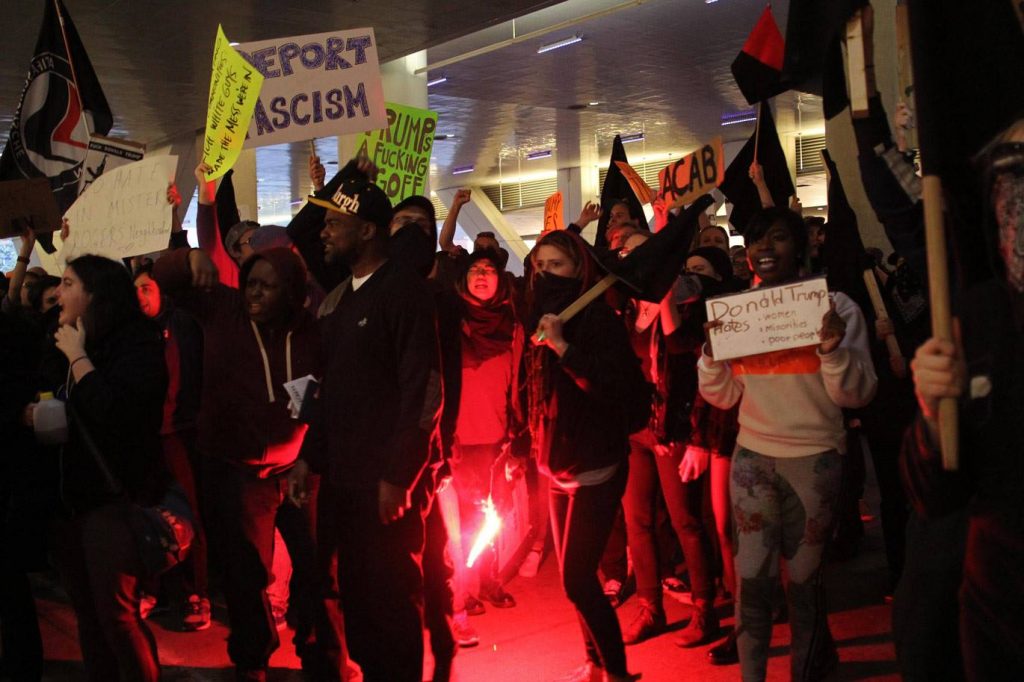
For this year’s day of solidarity with Eric King, anarchists in Pittsburgh PA threw his name up around the city with streaks and stickers. A banner was nailed up over a gross navy seal recruitment billboard in support of EK as well, because fuck the water pigs. The shit Eric went down for was an action in support of the Ferguson Uprising; in the wake of the murder of Antwon Rose Jr. by a killer cop here in Pittsburgh, his action resonates deeply right now especially.
Fuckin stay strong homie, Pitts loves you Eric!!!!
Love, Rage + Chaos Magik,
Some Anarchists in So-Called PA
WE dont have to
A Poem by Eric King
We dont have to accept this world
We dont have to be ok with the cammo bros
Destroying lives and invading worlds
We dont have to be ok with orange rapist
Becoming leaders
They dont have to be our leaders
We dont have to accept Veterans Day
We dont have to tip toe around these clowns
We dont have to Salute flags and Blue ribbons
We dont have to tolerate predators
We dont have to build fucking walls
and lock fucking cages
We dont have to stand by while this happens
We dont have to stay silent or submissive
We dont have to forget our friends
or pretend they are doing just fine
We dont have to ignore our mental issues
and act like we aren’t on the brink
We dont have to be ok with capitalism
We dont have to fucking buy everything
they push down our throats til were
gagging on god damn receipts
We dont have to laugh at rape jokes
We dont have to quietly endure ‘casual racism’
We dont have to be accept ‘locker room talk’
We don’t have to bow down
We dont have to close our eyes to whats happening
We dont have to belong and fit in
We dont have to devour our world
We dont have to hate and we dont have to stay angry
We dont have to do anything that doesn’t feel right
We dont have to give our support to things that make
Originally published by Torchlight — Anarchist News from Pittsburgh
Friday saw more protests over the police murder of Antwon Rose in East Pittsburgh. The evening’s action started conventionally enough, meeting at the Wood Street subway station downtown at 5:30, and stepping off around 6. At least 200 people took the streets, marching slowly through downtown and stopping frequently to block intersections while holding speakouts. A trailing caravan of cops accompanied the march, but they weren’t doing anything yet. More cops on motorcycles circled, blocking off intersections as marchers approached, and causing even further disruption to rush hour traffic.
From downtown protesters made their way over the Sixth Street bridge toward PNC Park, where a Pirates game was getting under way. After stopping on the bridge, and again in front of the left field entrance, to give the fans an earful, marchers took General Robinson over to the Seventh Street bridge and back downtown for what was meant to be the finale. Surrounded by police vehicles in Market Square, almost exactly two hours after first taking to the street, organizers with bullhorns led the group in chants of “We’ll be back! We’ll be back!”, clearly intending to send everyone home.
It didn’t quite work out that way. While some people drifted off, a smaller but highly determined group closed ranks and headed back out. Brandi Fisher and another woman with a megaphone held them up at the edge of Liberty Avenue to make a long passive-aggressive speech about how people could do what they wanted, BUT the cops had tear gas, and they should think of the children, and they were all likely to get arrested. The crowd listened respectfully until the speeches were over, and then rolled out onto Liberty.
They headed back toward the ballpark, at the same slow pace, and with the same police accompaniment, but the target was a little different. Instead of taking a different bridge back to town the march kept going on General Robinson toward the I-279 on ramp. Our correspondent takes up the tale:
“I ended up staying with a smaller group who didn’t want to take the highway, so we hung back to blockade the intersection at General Robinson and River Street. A couple of motorcycle cops stayed with us, and a legal observer came running back from the main group a few minutes later. We had just enough people to hold the blockade, so we did that for a while and then headed north past the Giant Eagle and kept going on Cedar. When we got to East Ohio we found a pleasant surprise – the main group, who had gotten off the highway at the East Ohio exit and come back to us. I swear it was bigger than when it left. I don’t know if people just jumped in off the sidewalk, or some of the folks who had left earlier came back or what, but either way our numbers were back close to what we started with.
We stayed at East Ohio and Cedar for a while blocking the intersection. A couple of big vans full of riot cops pulled up, and the cops got out and lined up in two columns looking menacing. That was it though. When we started moving again they had to stuff themselves back in the vans before they could follow us. We had about ten minutes with no cops except a couple of motorcycles and a few really obvious undercovers who had been tagging along all night.”
The march arrived back at the ballpark in the top of the 11th inning of a 0-0 game between Pittsburgh and the Arizona Diamondbacks, and promptly blockaded the intersection at General Robinson and Federal. The riot cops did the same thing they had at East Ohio, and had an even longer delay following the march when it moved down to the home plate entrance. They still hadn’t caught up by the time the march continued to the parking garage on General Robinson. Our correspondent again:
“It was really confused. People were yelling about splitting up to blockade both entrances to the garage. A few people went around the corner and pulled some loose crowd control barrier fence sections into the street. Some asshole in a black Mercedes pushed through the crowd and turned the corner with a bunch of people screaming and hitting the car. Other people at the barriers picked them up to swing at the car, which actually made it easier for the asshole to break through and escape. A couple of cops came running up on foot but all they did was put the barriers back on the sidewalk. It was really lucky nobody got hurt.”
The game was finally over by the time the police arrived in force, but many of the fans stayed in the park for Fireworks Night. The riot cops piled out of their vans yet again, and arranged themselves in a diagonal line across the intersection of General Robinson and Dorsett, blockading it more thoroughly than the march had. Marchers held their ground, lining up across both streets facing the cops. A rear line of foot cops, sans helmets, stood facing away from the protesters toward a couple of drunk white guys yelling on the sidewalk, as the fireworks began to go off in the background. A tense standoff persisted throughout the fireworks display and continued as the crowd leaving PNC Park began to thin out. By that time Pittsburgh police chief Scott Schubert was on the scene, as was a contingent of Pennsylvania state police. A line of cop cars stretched all the way back to the ballpark, and news crews were posted up wherever they could get a good view.
And finally, the marchers did again what they had proven adept at all night – moving on just as it looked like the cops were maybe going to do something. This time though, it was really over. Marchers filtered out past the cops on the sidewalk and took the street again near home plate entrance, but the chanting was quieter, and there were no more blockades. By midnight everyone arrived back at Market Square and dispersed.
Related counter-information:
*the image below should read East Pittsburgh police officer…
Originally published by Torchlight PGH — Anarchist News from Pittsburgh
A Torchlight operative managed to get a picture of an undercover cop filming the rally for Antwon Rose yesterday afternoon at the Allegheny County courthouse.
Originally published by Torchlight PGH — Anarchist News from Pittsburgh
Torchlight received the following reportback from an anarchist who attended the first rally for Antwon Rose on Wednesday evening. There was also a larger rally and march Thursday night that blocked Parkway East for over five hours. The reportback has been lightly edited for spelling and grammar, but is otherwise unchanged.
I got there late, about a half hour after the 6 PM start time. There were about 300 people there, most of them young and Black, rallying at an intersection. I recognized some people I knew, but not as many as I would have hoped ordinarily. East Pittsburgh is a pretty long way from where most of the anarchists live, and the protest was called with only a few hours notice.
The rally split up into a couple of groups, one in the intersection and another further up Electric Avenue (yup, Electric Avenue). The second group seemed louder so I gravitated in their direction. A bunch of people were screaming at the cops, especially this one pig in a white shirt. There were cops there from a bunch of different towns, including a few I hadn’t even heard of. None from Pittsburgh though, and I didn’t see any state cops either. The cops who were being screamed at backed off slowly and made a line across the road, but eventually pulled back to the sidewalks.
The other group was bigger but less confrontational. At one point a white unmarked cop SUV tried to drive through the big group and people started screaming and lined up to block it in. All the cops from Electric Avenue came over and surrounded the thing while it did a slow three point turn and finally left. That was as intense as anything got while I was there. After the SUV left some people started yelling at a few kids in black bloc about violence, which seemed kind of ridiculous when you think about what we were protesting.
Pretty soon after that people mad a giant circle in the intersection of Electric and Braddock and seemed prepared to stay for a while. Then the clouds started gathering, the news helicopter dippe out, and it began to rain hard. People clustered under a railroad bridge that runs over Electric and a few people sat down in the middle of the road. It seemed ilke the rain was thinning out the crowd though, and I eventually headed out because my ride was leaving.
Nobody seemed very well prepared, including the cops, but I guess that’s not surprising. I saw a couple of green legal observer hats, but no marked medics. A few people were there in black bloc, but in my opinion that wasn’t a great place for a bloc. They stood out more than if they had just worn regular clothes. The cops were mostly hands off. The Allegheny County pigs showed up, but they didn’t bring their horses. Nobody was in riot gear. The only crowd control weapons I saw were these assault-looking rifles that I think fire rubber bullets. Some cops from Monroeville had those, but they put them away pretty early. Except for the SUV incident they didn’t seem to be doing anything to provoke people.
The rain definitely took a lot of the fight out of the crowd but even before that people seemed more about grieving and venting their anger at the cops than throwing down. There’s going to be another protest downtown tomorrow at noon at the county courthouse, so we’ll see what happens there.
***
Related counter-information:
*the image below should read East Pittsburgh police officer…
Over the next few days, we’ll be publishing pieces to highlight the work of some of the groups participating in the Cutting Class counterinfo network. We hope this will provide some clarity on where our crews are coming from and how that affects the way we have organized this project.
We also hope that these interview questions can provide a template for other autonomous groups to distill a collective understanding of their context and projects. If your crew finds these questions useful, write up a summary of your conversations and send them our way as a form of introduction! Cutting Class can be your platform, and we’d love to publish an interview with your crew and start collaborating—not just around CC but also with any other projects that these introductions might incite!
Today’s featured crew is the Filler collective from Pittsburgh, Pennsylvania.
Introduce your crew: what are some projects you working on, how long have you been around, where are you based, etc etc.
FillerPGH is a zine distro and counterinfo crew currently based in Pittsburgh.We’re basically just an informal collective of punks and writers who run a distro and claim the name Filler whenever it’s convenient.
Filler started in 2012 as a punk/hardcore fanzine, but has since grown into a platform for local anarchist scenes to share news, analysis, and other counterinfo. We write, design, and distro our own zines, and we usually table with cool zines from other projects too. You can visit our pdf archive and read or print our zines here. Our three most widely-distributed zines are The Relevance of Max Stirner to Anarcho-Communists, Destroy Gender, and For a University Against Itself.
Most of us currently go to / have graduated from the University of Pittsburgh, and so a lot of the content we get is affiliated with the autonomous student network and other youth crews. That being said, we’ve been actively trying to make the project relevant/useful for anarchists outside of the campus bubble.
The Big Idea is an anarchist collective that provides space for exploring radical ideas and putting them into action. The collective aims to foster a culture of resistance and mutual aid that celebrates individual and collective autonomy. Plus we have coffee and free wifi.
SCAM is a relatively new project that grew out of conversations between individuals from the Big Idea collective and the (now-defunct) Pittsburgh Student Solidarity Coalition. SCAM is not an organization, it’s just the name for a specific (1) autonomous forum, (2) social media platform, and (3) anarchist network – meaning that anyone who participates can use the SCAM “brand” to suit their own project’s purposes. The forum uses a spokescouncil model that’s meant to be a space of encounter to encourage mutual aid and coordination, and is in no way a decision-making body.
Nightshade is a two–year–old anarcha-feminist collective dedicated to providing physical, digital, and written safer spaces for women and queer people, as well as engaging in direct action against the heteropatriarchy. Nightshade collective members hold monthly meetings and at least one community event per month. This month, Nightshade is hosting a benefit partyto raise money for Survived and Punished—a collective that supports people wrongfully incarcerated for protecting themselves against domestic abuse. Not all community events are parties. Last month, Nightshade hosted two events—a reading of “The Secret Joy of Accountability” by Shannon Perez-Darby from the zine-turned-book, “The Revolution Starts at Home” and a facilitated discussion called ’Let’s Talk About Sex…Work’ to initiate conversations about sex work from a feminist perspective.
What are some challenges you’ve faced (internal or external)?
Pittsburgh anarchyland is currently recovering from some serious repression and burnout. Over a year of consistent militant actions resulted in ~30 felony arrests. Two comrades served several months in prison (hit us up if you want to throw some $$$olidarity their way) and a few more are still tied up in legal battles. By the summer of 2017, state repression dovetailed with existing internal tensions, and the subsequent burnout was real.
In the coming weeks, Filler will be publishing a longer piece(s) about this through several projects, including Cutting Class. Here’s an *ahem* exclusive sneak peak:
“2018 marks five years since the resurgence of an autonomous radical youth movement at Pitt, three years since the Pittsburgh Student Solidarity Coalition officially began flying black flags, two years since the organizations and crews affiliated with the autonomous student scene posed a real collective challenge to the populist-left’s monopoly on dissent, and over one year since the first coordinated Disorientation Week.
That first Disorientation Week sparked the brief and brilliant dumpster fire we refer to as “the” autonomous youth scene: a transient (yet genuine) expression of a collective “we.” At times, it felt like it was our first real glimpse of community, militancy, trust, repression, betrayal, and (attempted) accountability. It’s a declaration of “we” that weighs a bit heavy on the tongue these days.
Ten black blocs, 30-something arrests, and over a hundred felony charges later, it’s difficult to remove ourselves from the collective identity that “we” have developed over the past years’ struggles. The “we” used here is shorthand for the web of chance encounters that deepened as the autonomous youth scene grew. Filler most definitely cannot speak to the experiences of everyone in Pittsburgh’s autonomous youth scene. Consider this our contribution to a growing mythology of closure, a burial ritual for our own lingering nostalgia, a call for multiplicity.”
This resurgence in the local anarchist scene has broken down both social bubbles and social scenes.We’ve learned that we need more than the usual cycle of escalation and repression if we wanna rep the yinzurrection. We’d like to think that projects like SCAM and Nightshade (especially the second issue of their zine) reflect a broader learning curve in the Pittsburgh youth scene. To quote “PSSC is a SCAM,”
“[PSSC] originally began collaborating because we were sick of wasting our time seeking legitimacy through the dead-end channels provided by the Pitt administration and their police. But as much as we liked to position ourselves as inhabiting a space somewhere outside of Campus Life and its toxic social institutions and useless reformist activism, we now realize that we were merely carving out niche spaces within it […] Despite our best intentions, PSSC became an umbrella organization that assimilated (and sapped energy away from) the independent formations that comprised it. And so rather than continue to work together as a student coalition, we decided to re-prioritize our individual projects, crews, and organizations. ”
Photo: autonomous youth bloc turning up on election night on Pitt’s campus.
Read the report-back HERE.
What are some short and long-term objectives your crew has been working towards?
Counterinformation is communication, and communication is an end in itself. We’re not going to save the world (not that there’s anything about this civilization worth “saving”), but we might be able teach each other how to survive through the love and rage that grows in resisting it.
What do you think some of the major limits / major untapped possibilities for radical campus organizing are today?
Over the years, Filler has provided a platform for a variety of student voices. The only way to honestly discuss that question is to include them in the convo. We’ve compiled a selection of quotes from some of our personal favorite pieces below, which are divided into three broader themes:
Seizing and Repurposing University Space
The “Marketplace of Ideas” and Social War
Solidarity is a Weapon
TL;DR = There’s no unified “lesson” to take away, but one recurring thread is that students who work through the University framework end up compromising their politics. We have seen one too many radical organizations get recuperated after becoming / affiliating with University-sanctioned organizations. While organizing through the University can provide material benefits (beyond just funding and space), we think student crews should dedicate most of their organizing efforts to autonomous projects that operate outside the established University channels.
Not surprised at the administration’s routine disregard for student voices, we decided to continue our occupation of University space. Excited, scared and pissed, we brought flags, posters, zines, coloring supplies, books and snacks to a student study area on the second floor of the Cathedral of Learning. We sat down with confidence and declared that we were occupying the space. With comrades new and old, we plastered the walls with fliers, flags and art. We used the space for everything our teachers scolded us for doing in school: we shared food, played games, held political discussions and worked through interpersonal conflicts. After writing space agreements for our self-governance, we felt more at peace than we ever have walking the halls of our University.
An occupation is the realization of the threats we make through disruption. To occupy is to strike, to remove a material place from capitalist time and space, to derail alienated activity and ride its inertia off the tracks, to rip open latent contradictions in the fabric of consensus reality. When we occupy, we create a base from which to launch new negations, but more importantly a subjectivity that is actively experimenting with new forms of life.
Disruption, negation, experimentation, occupation — the suspension of routine and rhythm, the conversion of a thousand plagiarized, angst-ridden zines into something terrifying and new: the insurrectional desire to experience unmediated forms of life here and now, to live communism and spread anarchy. […] Elaborating insurrectionary potential requires more than blockading the flow of relations conducive to capital; it is a process of reorienting relationships and shared spaces towards the creation of new and transient collective realities. In other words, we must constantly recreate a “we” that isn’t a lie. […] Seriously, though. I sure as hell wasn’t radicalized after hitting up some student group’s meeting. I’m here because I’m still chasing the high from that first punk show in a squat house basement, that first queer potluck, that first renegade warehouse party, that first unpermitted protest, that first smashed Starbucks window.
Incite, Conspire, Diversify
Photo: Our generation’s first autonomous student bloc at Pitt Click HERE for the first report-back.
In the past two weeks at Pitt, we’ve shared ghost stories around campfires that we sparked with stolen electoral campaign signs from all political parties. We’ve cried in front of strangers and cheered each other on as we took turns shouting down the Pitt College Republicans outside of the library. We’ve kicked racists, sexists, and queer-phobes out of Halloween parties with both intelligent arguments and the occasional fist. We’ve graffiti-bombed racist propaganda and flipped over the tables of pro-Trump canvassers. We’ve seen glimpses of the future that’s offered to us, and then stumbled into an alleyway to piss all over it.
“We” don’t necessarily remember all of these stories, share a political disposition, or even know each others’ names. “We” is just a name for this sudden, transient inclination towards defiance, or some shit like that. Filler has heard a lot of inspiring anecdotes over the past few weeks, but we’ve also noticed that the far-right students at Pitt have monopolized the narrative over what is happening. On Halloween, we heard about yet another entirely spontaneous action and decided we’d try our hand at unpacking the situation. “We” don’t speak on behalf of anyone except those that resonate with our interpretation of their actions. To our friends we don’t yet know: keep turning shit up!
It hasn’t been until now that we can put names and faces to some of the sources of hate at the University of Pittsburgh. In the past few weeks our collective of anti-racist, anti-fascist friends and organizers have been compiling various screen shots and other evidence that ties members of the Pitt College Republicans and alt-right publication Polis Media to disturbing memes, jokes, and genocide apologia as well as r*pe joke including ones targeting some of the most vulnerable members of society – children and incarcerated persons.
We are queer and trans. Our existence clashes against the gender binary, and its crushing grip which polices our bodies and threatens our safety. The ways that we live—relate to one another, dress, gesture, and dream—are all in inherent subversion to that binary, which seeks to classify, erase, separate, and homogenize us. In turn, we fight for spaces free from gendered expectations, places where we can function and thrive in peace. […]
We will not be fooled – Pitt is a blatant and knowing enemy in our fight for trans-liberation. […]
Nightshade beckons the University to respond: Why are you, University officials, holding this basic need of your trans*queer students hostage?
What a shit show it would become if you were denied safe access to bathrooms…
Nightshade supports the autonomous actors taking matters of trans-liberation into their own hands. We should not need to assimilate to normative gender presentations in order to use the bathroom, and we stand against anyone who forces that upon us.
In the neoliberal university, the valorization of free speech norms and student choice allows students to feel political as long as they don’t step out of bounds. Note the ever multiplying number of politically oriented student groups, each centered on a specific set of goals that are not meant to overlap and instead provide a safe outlet for the desire to be political. These organizations can be housed in student government organizations, and you can be as radical as you as want as long as you don’t act in such a way that would significantly disturb the status quo, which is a strange shift when put in contrast with previous student agitation centered on questions of radical political change in the university structure.
[As soon as the disruption of the transphobe Reverend Scott Stiegemeyer began], self-appointed “peace police” within the body of “protesters” sprang into action, demanding that we sit down and continue to take Stiegemeyer’s bullshit while our trans siblings die every day through murder and suicide.
Those who stood up to oppose us played directly into the hands of the Reverend’s ilk. By presenting themselves as the “respectable” LGBT community, they took the side of the Reverend and the cops against those who were not willing to be silent in the face of the war against our trans bodies. They forget the war cry of ACT UP’s fight against AIDS during the 80’s and 90’s: Silence Equals Death. Only those “allies” who are not directly threatened by hate speech against trans people and the violence against us it engenders have the option to remain silent without potential deadly consequences. […]
Instead of joining our mutual enemies in attempting to snuff out our rage, we’d prefer you to accept our methods as equally valid to other forms of struggle so we can all take on our adversary in our own ways. We see you as potential accomplices in our liberatory project, and would much rather fight beside you than against you.
And I’d do it again. […] I would be astonished if either [cop] believed “disrupting a meeting” was an actual crime. The intention with which they bandied the phrase about was likely an attempt to make us fearful enough for our individual futures that we would comply with the questions they asked us about each other. Upon arriving at the station, my friend and I were led into an interrogation room. In an hour-plus conversation, the officers offered up such gems as “the Constitution is dead” and a lecture about my disrespect for the men and women who died defending my right to speech, the latter of which rang as hollow as the former did true while I sat handcuffed to a wooden bench for talking at the wrong time.
Photo: Trump visits Pittsburgh Click HERE or HERE to check out two report-backs from this action.
The line goes through the door as the rush peaks. I walk over to the cooler, put my back to it, and slide down. The AM sees me and immediately gets red in the face screaming at me.
“What is this? A fucking strike?!”
“I guess so!”
Five minutes of back and forth screaming and the area manager agrees to rehire the mother she fired an two hours ago. Unfortunately, none of my coworkers joined in. Some thought I was absolutely out there to risk my job, some later thanked me and started talks of something bigger…
We are deeply saddened and angered by the murder of comrade Scout Schultz by Georgia Tech campus police. As a small crew of radical queer youth and accomplices, we recognize that Scout could have been any one of us. We too struggle daily with and against our mental health; we take these actions as part of that struggle. We will continue to answer the calls to fight in Scout’s memory, one of which reads:
To anyone who is enraged, grieving, or who stands against the police and the murderous system they protect, we call for actions in solidarity with our fight here in Atlanta. To anyone who is fighting for liberation: in the coming days, fight with Scout’s name on your lips, on your banners, and in your hearts.
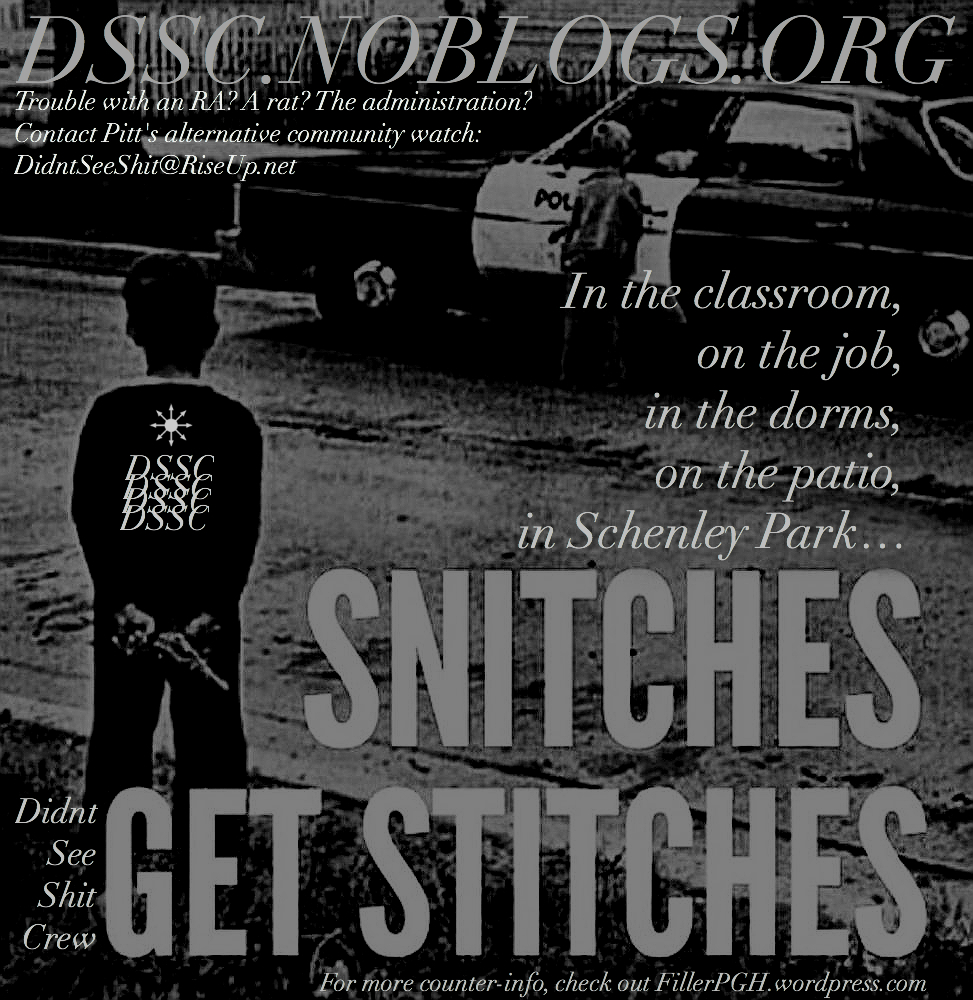
The University of Pittsburgh is full of snitches, from the tough-guy RA who takes his job too seriously, to the bigots who knowingly out queer folks and put them at risk. We’re sick of seeing good kids get expelled, arrested, or otherwise screwed over because some holier-than-thou bootlicker decided to fuck up someone’s life; because some snitch reported a graffiti artist, or tipped off a Pitt employee about a darknet mail order, or called the cops on students for flyering and promoting events without a permit, or chose to be an asshole of an RA and actually conduct a random dorm search, or ratted out a student who stole the textbooks they couldn’t afford…
Want help dealing with a rat? Send the Didn’t See Shit Crew an email detailing the nature of the incident (no incriminating details, please!), the informant’s motive, and your desired course of action. We will work with you to figure out how to best discourage this sort of toxic behavior, support any folks who are facing legal or school repercussions, and, if necessary or requested, facilitate retaliatory dialogue.
How can folks support your work?
Submit content, distro our zines, critique our zines, talk shit on/with us, email us your juicy intel, give us money – fillercollective [at] riseup [dot] net
Submit to the spectacle and follow us on social media:
Any closing thoughts / reflections from your crew’s conversation?
When we first came to Pitt, we had to reinvent the wheel when it came to spreading anarchy, and we made a fuckton of mistakes along the way. We’re stoked to be connecting with other youth projects, and honestly should have tried to sooner. We’re also stoked to hash out some ideas around intergenerational infrastructure and communication, because there’s always the possibility that Oryx and Crake accurately depicts the whole “no global future” collapse: the University is both a gatekeeper to the means of survival and an enemy as formidable as the state, and will be for the rest of the forseeable futures / protracted collapse.
And never forget that cringing is an affective bond, because maybe the real insurrection was the friends we made along the way 😉
Today, March 8, 2018, marks International Women’s Day, and across the globe millions of women and gender non-conforming people are showing up in solidarity with one another—many folks taking part in an international strike, rejecting capitalism as a means of liberation from the patriarchy. Actions ranging from strikes and protests to rallies and meetings have been reported in Spain, Kenya, Afghanistan, the Philippines, South Korea, and countless other locations around the United States and world. Nightshade is keeping an active eye on these various movements, and stands in solidarity and excitement with them as those involved continue to fight for their demands, big and small.
Particularly, it is important to remember the roots of International Women’s Day, which originated in 1909 as International Working Women’s Day, and its direct relationship with labor movements. While massive attention was drawn to the Women’s Day march last year in DC, marked by a sea of stunningly-gendered pink pussy hats, along with it came critiques of white-feminism and other organizing strategies which neglected to honor the voices of women of color and trans-women, and neglected to address the position of incarcerated women, poor women, and other women marginalized on multiple axes, in relation to capitalism and white supremacy. This year, however, Women’s Day falls right amidst the Teacher’s Strike in West Virginia, where, like in many states, 75% of teachers are women. According to Tithi Bhattacharya, an organizer involved with the International Women’s Strike,
“the core strength of [the teacher’s strike] lies in the fact that it is vast majority women, and because women play a very significant role bridging the gap between the workplace, the home and the community, when the teachers went on strike, a vast portion of the community was immediately galvanized in support of the teachers. So churches came out, community members came out, because women are not just teachers, they’re mothers, they’re church members, they’re breadwinners in their family. So they sort of form this astonishing bridge between the workplace and the home, making visible both kinds of labor.”
Compensation for unpaid or underpaid labor, whether in community organizing, emotional/care work, teaching, or elsewhere, is demanded on this day by women worldwide. The failure of current structures, whether on an institutional scale or in the household, to provide due credit, compensation, and support to women and gnc folks is a direct result of the interplay between capitalism and the heteronormative patriarchy. As demonstrated bya recent crackdown on sex-work and strip clubs in New Orleans, neoliberal privatization and gentrification, also known as “(re)development,” goes hand-in-hand with violence against women and trans- people, particularly those already in close proximity to gendered and sexual violence.
It is true, and has been shown by all of the recent strikes and acts of feminist resistance, that capitalism cannot function without the exploitation of women and gnc folks. And until that exploitation ends, we will not be free. Beyond this, Nightshade also stands in solidarity with those demanding an end to all violence against women and gnc people–the physical and sexual assault, the policing and gendering of our bodies, the repression of our minds and spirits. Every year when this day comes around, we are as sick and tired of being oppressed as any other day. We recognize that our fight against capitalism is a feminist fight, it is an intersectional fight, it is a queer fight. And we also understand that the worlds we build together, here and now, are crucial to the then and there of our imaginations, to our liberated futures which connect us to so many feminists past, present, and to come. We realize that the end to violence does not come without ceaseless practice of healing, defense, accountability, and learning new ways to be with one another. This requires ongoing work, where we hold each other with care and bravery, and move towards a world beyond patriarchy and all other forms of dominance.
As March 8th comes to a close, we encourage you to show love to the women and gnc folks in your life, not just today but every day. We mourn those who have been stolen from us so far this year by acts of gendered violence, and will continue to fight like hell for the living. Remember that this fight does not end when the spotlight disappears: this month Nightshade is holding a queer dance fundraiserwhere all proceeds will go to Survived and Punished, a collective which supports survivors of domestic violence criminalized for defending themselves, and we hope to see you there!
While the rivalry on the football field between WVU and Pitt is well known, on the streets we declare our comradely support. On Tuesday, November 14th a coalition of autonomous students occupied Pitt’s Cathedral of Learning. At the time that we release this document the occupation has been ongoing for 18 hours. Faced with federal, state, city, and university police intimidation, the occupiers face an uphill battle to have a list of 15 demands met.
We call on the university to immediately fulfill the 15 demands as written. We also call on WVU autonomous students and other Morgantown radicals to show solidarity with the occupation and equal commitment to similar goals in our city and campus. Occupations and the fulfillment of the demands are only the first steps in the development of an anti-capitalist struggle. Even after the demands are met, we and our comrades will continue to demand the impossible.
MF1, Daniel Montano, pictured on the right, has passed away at 30.
Possibly Pittsburgh’s most well known graffiti writer and a life long anarchist, MF1 had an absolutely unique and thoughtful style that even many who dislike graffiti had trouble not being inspired by. While he could certainly look intimidating, you’d be hard pressed to find anybody who knew Daniel who doesn’t describe him as warm, caring and joyful.
In 2008 Daniel went to prison for committing over $713,000 in 79 instances of property damage stemming largely from a graffiti campaign targeting the rapidly gentrifying East Liberty neighborhood where he lived. He and his friend HERT were made examples by the city and were both sentenced to multiple years in prison, during which Pittsburgh ABC helped them release the zineNow Serving Feloniesin which Daniel tells us:
“When I was 12 years old I decided to become an anarchist… Graffiti, for me, was one of the ways to reshape the world. It was my voice to stand up as an individual for my own individual freedom, to express my own personal idea of freedom, and to stand in direct and deliberate opposition to the existing social norms/the state. What I did was about human and world development. To me, it placed importance on the spirit that exists in all of us over the material world and possessions. It was like putting what was inside of me on the outside and saying “People matter! Fuck property!!!” It is a shame that my friend Ian (HERT) was put in prison for cosmetic property damage when there is real suffering going on in the world! Walls do not have feelings, walls do not suffer, walls do not starve, and paint does not kill people. I would like to see a society free of money, capitalism, material property. A society that is free to govern itself, built on the principles of non-violence and equality. The crimes for which I am currently serving my sentence were in no way violent. To me these actions are a symbol of what true freedom means to me and they represent even the slightest possibility of something different than what currently exists. Simply, they represent change. In the state system there are hundreds of thousands who are imprisoned solely for their beliefs and their own personal ideas of morality. I am proud to say that I was imprisoned for being one who stood up against the state, and for making it clear that I will not abide by a rule I do not believe in. I remain a voice that identifies itself with liberation, equality, pacifism, truth, justice, and above all else love.
Free the creative hands and minds suppressed by prisons. Freedom for all people.
-Daniel Joseph Montano”
Daniel would unfortunately get caught up in the all too common cycle of parole violations and spend the next 9 years in and out of jail and prison. In his most recent trip back, he was also charged with 40 more counts of graffiti because he was an unfuckwithable bad-ass. In a city that literally always succeeds at scaring writers into taking deals with menacing 30-65 count indictments, Daniel decided to fight all the charges. They were dropped and he walked free earlier this month. Our city has lost somebody truly special.
Torchlight, a new anarchist counter-info site based here in Pittsburgh, released this response to an anonymous submission we published several weeks ago. (Pretty cool to see a dialogue starting, although it looks like they think we wrote “Solidarity in the Streets,” which we didn’t. We just used to be the only counterinfo game in town, but now we’re not!)
Pittsburgh activism has long and sordid history of cooptation by the police. Liberal organizers invariably honor a tacit agreement in which they guarantee that their “actions” generate minimal material disruption of the prevailing order, in exchange for the cops’ allowing them to proceed unimpeded. The police, notoriously lazy in Pittsburgh, benefit from protest organizers doing most of their work for them, plus they don’t have to tarnish their image by pepper spraying and arresting protesters. Organizers in turn get to boost turnout by offering a risk-free, conscience salving experience, while claiming success based on nothing more than seamless logistics, regardless of the lack of movement toward their claimed goals.
On the ground the result will be familiar to anyone who has attended a protest in Pittsburgh in this century. Dozens of marshals, police liaisons, and PR flacks, few to no legal observers or medics; inspiring speeches by carefully chosen “leaders”, zero opportunity for spontaneous action; occasionally unpermitted, but always pacified.
Sometimes though, an action breaks this mold and the police end up having to do some work, which brings us to arecent articleby the Filler Collective. The piece is a criticism of a pair of noise demos at Allegheny County Jail at which some windows were broken, themost recent of whichtook place on March 20. Eleven people were arrested and arecurrently being chargedwith multiple felony counts. The other noise demo happened on New Years Eve 2011 and resulted in dozens of protesters being detained, but no arrests. The author focuses their criticism on the 2011 demo, claiming that they weren’t at the more recent one and do not wish to risk jeopardizing the cases of the arrestees. However the timing of the piece, and in fact the very inclusion of the recent demo, make a joke of this posture. If Filler really doesn’t want to criticize the March action why mention it at all?
Instead, the author uses the 2011 noise demo as a proxy, in an attack that is misguided as well as displaced. Their thesis is that since the organizers didn’t intend or prepare for windows to be broken, the window breakers are responsible for the detentions that followed. More generally, they believe that all protests should have a pre-planned and communicated level of risk so that participants can make informed decisions about whether and how to involve themselves.
That’d be nice wouldn’t it? If you could know ahead of time exactly how risky an action was going to be, if everyone who showed up could be counted on to follow the same script, if there was never any uncertainty about how the cops would respond to a particular tactic? The only problem is it’s impossible. There is no way to reliably predict what will happen at a protest without going full liberal and extinguishing any possibility of militancy before it can begin – the usual approach in this town.
That doesn’t mean organizers haven’t tried, and Filler cites a couple of very selective examples from recent history. One is the mobilization against the 2009 G20 summit meetings in Pittsburgh, which featured thePittsburgh Principles, a framework designed to let activist groups with different politics work together effectively throughout the demo. (Ignore for now the vast difference between a multi-day mass mobilization and a half hour jail noise demo.) While the Pittsburgh Principles were reasonably successful in their purpose, they didn’t prevent the cops frombrutally attackinga completely non-confrontational protest against police brutality on the Pitt campus in the final hours of the event, not because any windows got broken, but just because they wanted to. The author of the Filler piece conveniently fails to mention this.
Filler’s other example is theJ20 mobilizationin DC against Trump’s inauguration, where a wide variety of tactics were used by a broad coalition of groups, all of which were clearly announced ahead of time, supposedly allowing participants to gauge the risk involved. While the various blockades, rallies and permitted marches were left comparatively unmolested (by G20 standards at least), J20 was hardly a testament to the predictability of police repression at mass mobilizations. The 200-plus felony arrests at the black bloc march were anunprecedented departurefrom past police practice in DC, even to the point of violating court orders.
A broader look at the history of big demos (not to mention small ones) reveals similar patterns. The practice of designating red, yellow, and green zones during the global justice movement never worked. In fact arrests were probably more frequent in green zones because protesters there weren’t expecting them. TheMiami Modelof protest policing involves cracking down on protesters of all stripes, peaceful or otherwise, actually protesting or not. Witness theraids against the puppet warehouseat the 2000 RNC in Philadelphia, and theconvergence centerandlegal support officeat the 2008 RNC in St. Paul, where no one was even protesting anything, let alone breaking windows.
In short, the idea that we can predict what the cops will do in the face of any meaningful protest is ridiculous. It might look like we can in Pittsburgh, where protest theater too often takes the place of militant action in the streets. But that’s just policing ourselves to save the cops the trouble. So instead of blaming arrests, detentions, beatings and other repression on our own comrades, let’s pin the blame where it belongs – on the cops. Instead of relying on our enemies to restrain themselves if we don’t provoke them, let’s rely on ourselves. It’s time to build the support structures necessary to resist police action as it happens, to propagate a culture of tactical awareness, instead of expecting followers to show up and blindly follow the orders of few self appointed organizers.
Determining what this might look like in practice is left as an exercise for the reader, but in the Trump era it is one well worth undertaking. Just don’t forget to tell Torchlight about it…



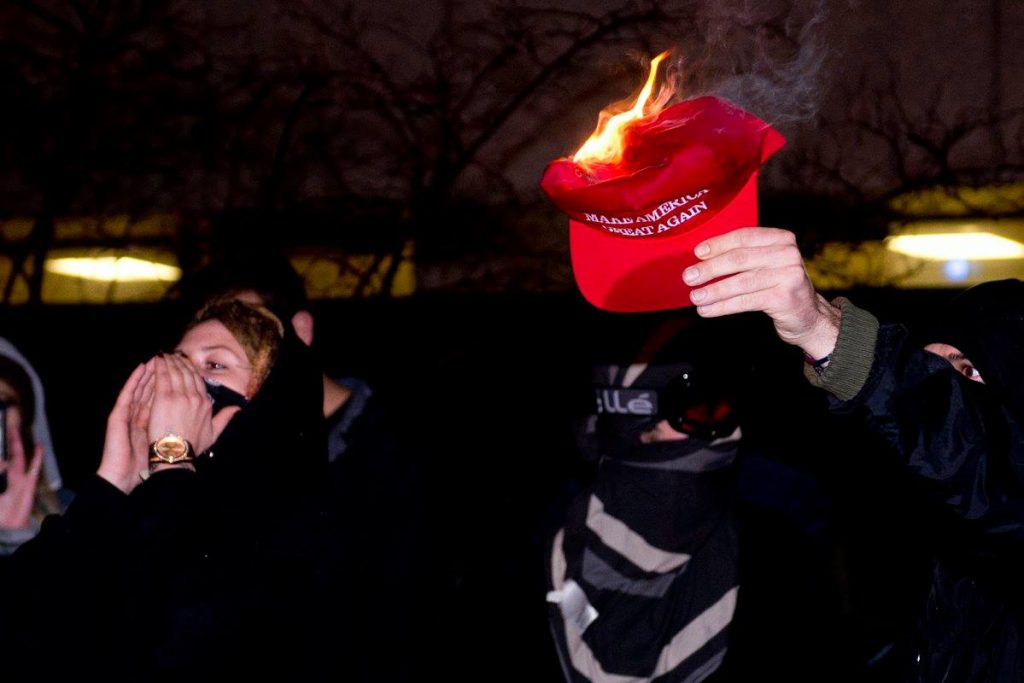
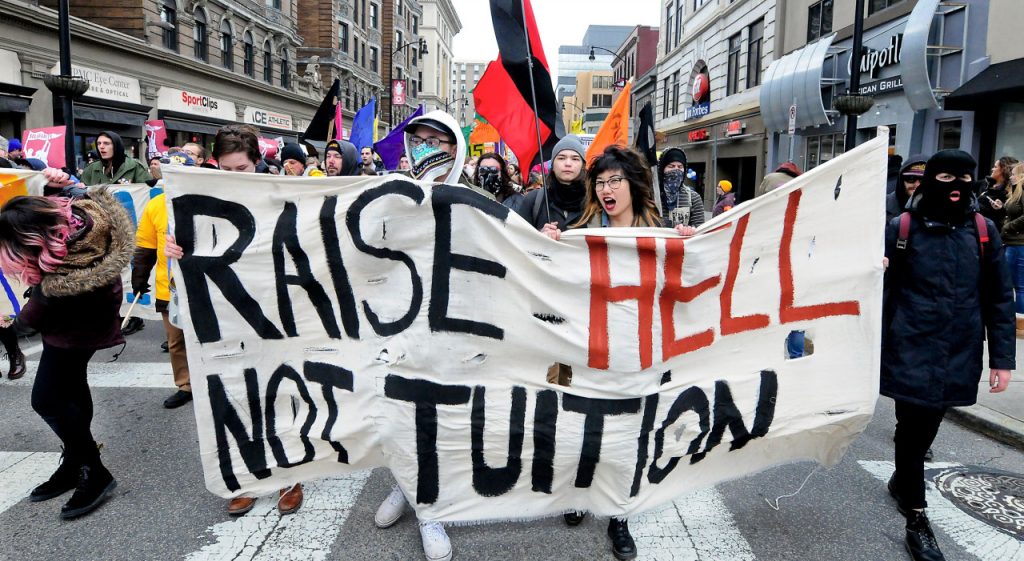 Photo: Our generation’s first autonomous student bloc at Pitt